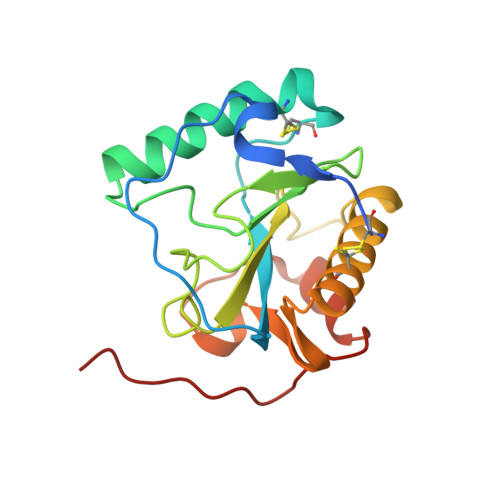
1SXR | pdb_00001sxr

Drosophila Peptidoglycan Recognition Protein (PGRP)-SA


Experimental Data Snapshot

  • Method: X-RAY DIFFRACTION
  • Resolution: 1.56 Å
  • R-Value Free: 
    0.211 (Depositor) 
  • R-Value Work: 
    0.177 (Depositor), 0.183 (DCC) 
  • R-Value Observed: 
    0.181 (Depositor) 

Starting Model: experimental
View more details

wwPDB Validation 3D Report Full Report

Validation slider image for 1SXR

This is version 1.4 of the entry. See complete history

Literature

Crystal structure of the Drosophila peptidoglycan recognition protein (PGRP)-SA at 1.56 A resolution

Reiser, J.B.Teyton, L.Wilson, I.A.

(2004) J Mol Biology 340: 909-917

  • DOI: https://doi.org/10.1016/j.jmb.2004.04.077
  • Primary Citation Related Structures: 
    1SXR

  • PubMed Abstract: 

    Peptidoglycan recognition proteins (PGRPs) form a recently discovered protein family, which is conserved from insect to mammals and is implicated in the innate immune system by interacting with/or degrading microbial peptidoglycans (PGNs). Drosophila PGRP-SA is a member of this family of pattern recognition receptors and is involved in insect Toll activation. We report here the crystal structure of PGRP-SA at 1.56 A resolution, which represents the first example of a "recognition" PGRP. Comparison with the catalytic Drosophila PGRP-LB reveals an overall structure conservation with an L-shaped hydrophilic groove that is likely the PGN carbohydrate core binding site, but further suggests some possible functional homology between recognition and catalytic PGRPs. Consistent with sequence analysis, PGRP-SA does not contain the canonical zinc-binding residues found in catalytic PGRPs. However, substitution of the zinc-binding cysteine residue by serine, along with an altered coordinating histidine residue, assembles a constellation of residues that resembles a modified catalytic triad. The serine/histidine juxtaposition to a threonine residue and a carbonyl oxygen atom, along with conservation of the catalytic water molecule found in PGRP-LB, tantalizingly suggests some hydrolytic function for this member of receptor PGRPs.


  • Organizational Affiliation
    • Department of Molecular Biology, The Scripps Research Institute, 10550 North Torrey Pines Road, La Jolla CA 92037, USA.

Macromolecule Content 

  • Total Structure Weight: 41.03 kDa 
  • Atom Count: 3,160 
  • Modeled Residue Count: 346 
  • Deposited Residue Count: 366 
  • Unique protein chains: 1

Macromolecules

Find similar proteins by:|  3D Structure
Entity ID: 1
MoleculeChains  Sequence LengthOrganismDetailsImage
Peptidoglycan recognition protein SA CG11709-PA
A, B
183Drosophila melanogasterMutation(s): 0 
EC: 3.4.17.13
UniProt
Find proteins for Q9VYX7 (Drosophila melanogaster)
Explore Q9VYX7 
Go to UniProtKB:  Q9VYX7
Entity Groups
Sequence Clusters30% Identity50% Identity70% Identity90% Identity95% Identity100% Identity
UniProt GroupQ9VYX7
Sequence Annotations
Expand
Reference Sequence

Experimental Data & Validation

Experimental Data

  • Method: X-RAY DIFFRACTION
  • Resolution: 1.56 Å
  • R-Value Free:  0.211 (Depositor) 
  • R-Value Work:  0.177 (Depositor), 0.183 (DCC) 
  • R-Value Observed: 0.181 (Depositor) 
Space Group: C 1 2 1
Unit Cell:
Length ( Å )Angle ( ˚ )
a = 136.29α = 90
b = 64.42β = 100.33
c = 45.87γ = 90
Software Package:
Software NamePurpose
REFMACrefinement
HKL-2000data reduction
SCALEPACKdata scaling
AMoREphasing

Structure Validation

View Full Validation Report


Entry History 

Deposition Data

Revision History  (Full details and data files)

  • Version 1.0: 2004-06-29
    Type: Initial release
  • Version 1.1: 2008-04-30
    Changes: Version format compliance
  • Version 1.2: 2011-07-13
    Changes: Derived calculations, Version format compliance
  • Version 1.3: 2023-08-23
    Changes: Data collection, Database references, Derived calculations, Refinement description
  • Version 1.4: 2024-10-16
    Changes: Structure summary