1E8M | pdb_00001e8m

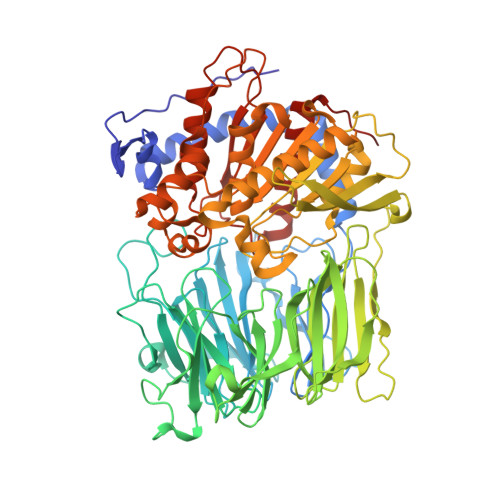
PROLYL OLIGOPEPTIDASE FROM PORCINE BRAIN, MUTANT, COMPLEXED WITH INHIBITOR


Experimental Data Snapshot

  • Method: X-RAY DIFFRACTION
  • Resolution: 1.50 Å
  • R-Value Free: 
    0.217 (Depositor) 
  • R-Value Work: 
    0.193 (Depositor) 
  • R-Value Observed: 
    0.193 (Depositor) 

Starting Model: experimental
View more details

wwPDB Validation 3D Report Full Report

Validation slider image for 1E8M

This is version 1.4 of the entry. See complete history

Literature

Structures of Prolyl Oligopeptidase Substrate/ Inhibitor Complexes. Use of Inhibitor Binding for Titration of the Catalytic Histidine Residue

Fulop, V.Szeltner, Z.Renner, V.Polgar, L.

(2001) J Biological Chem 276: 1262

  • DOI: https://doi.org/10.1074/jbc.M007003200
  • Primary Citation Related Structures: 
    1E8M, 1E8N

  • PubMed Abstract: 

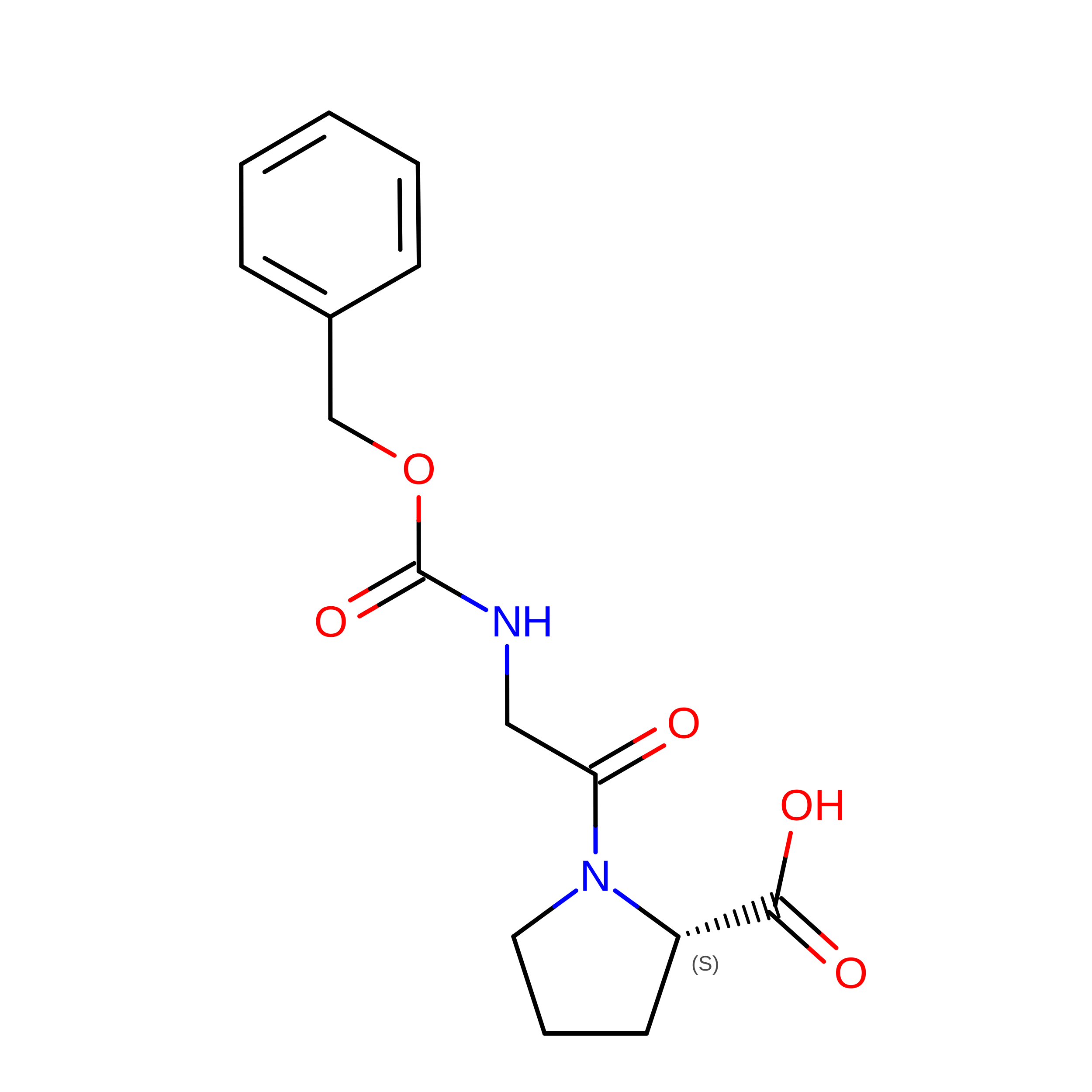
    Structure determination of the inactive S554A variant of prolyl oligopeptidase complexed with an octapeptide has shown that substrate binding is restricted to the P4-P2' region. In addition, it has revealed a hydrogen bond network of potential catalytic importance not detected in other serine peptidases. This involves a unique intramolecular hydrogen bond between the P1' amide and P2 carbonyl groups and another between the P2' amide and Nepsilon2 of the catalytic histidine 680 residue. It is argued that both hydrogen bonds promote proton transfer from the imidazolium ion to the leaving group. Another complex formed with the product-like inhibitor benzyloxycarbonyl-glycyl-proline, indicating that the carboxyl group of the inhibitor forms a hydrogen bond with the Nepsilon2 of His(680). Because a protonated histidine makes a stronger interaction with the carboxyl group, it offers a possibility of the determination of the real pK(a) of the catalytic histidine residue. This was found to be 6.25, lower than that of the well studied serine proteases. The new titration method gave a single pK(a) for prolyl oligopeptidase, whose reaction exhibited a complex pH dependence for k(cat)/K(m), and indicated that the observed pK(a) values are apparent. The procedure presented may be applicable for other serine peptidases.


  • Organizational Affiliation
    • Department of Biological Sciences, University of Warwick, Gibbet Hill Road, Coventry CV4 7AL, United Kingdom.

Macromolecule Content 

  • Total Structure Weight: 81.25 kDa 
  • Atom Count: 6,931 
  • Modeled Residue Count: 710 
  • Deposited Residue Count: 710 
  • Unique protein chains: 1

Macromolecules

Find similar proteins by:|  3D Structure
Entity ID: 1
MoleculeChains  Sequence LengthOrganismDetailsImage
PROLYL ENDOPEPTIDASE710Sus scrofaMutation(s): 1 
EC: 3.4.21.26
UniProt
Find proteins for P23687 (Sus scrofa)
Explore P23687 
Go to UniProtKB:  P23687
Entity Groups
Sequence Clusters30% Identity50% Identity70% Identity90% Identity95% Identity100% Identity
UniProt GroupP23687
Sequence Annotations
Expand
Reference Sequence

Small Molecules

Ligands 2 Unique
IDChains Name / Formula / InChI Key2D Diagram3D Interactions
P0H

Query on P0H


Download:Ideal Coordinates CCD File
C [auth A]N-[(benzyloxy)carbonyl]glycyl-L-proline
C15 H18 N2 O5
ZTUKZKYDJMGJDC-LBPRGKRZSA-N
GOL

Query on GOL


Download:Ideal Coordinates CCD File
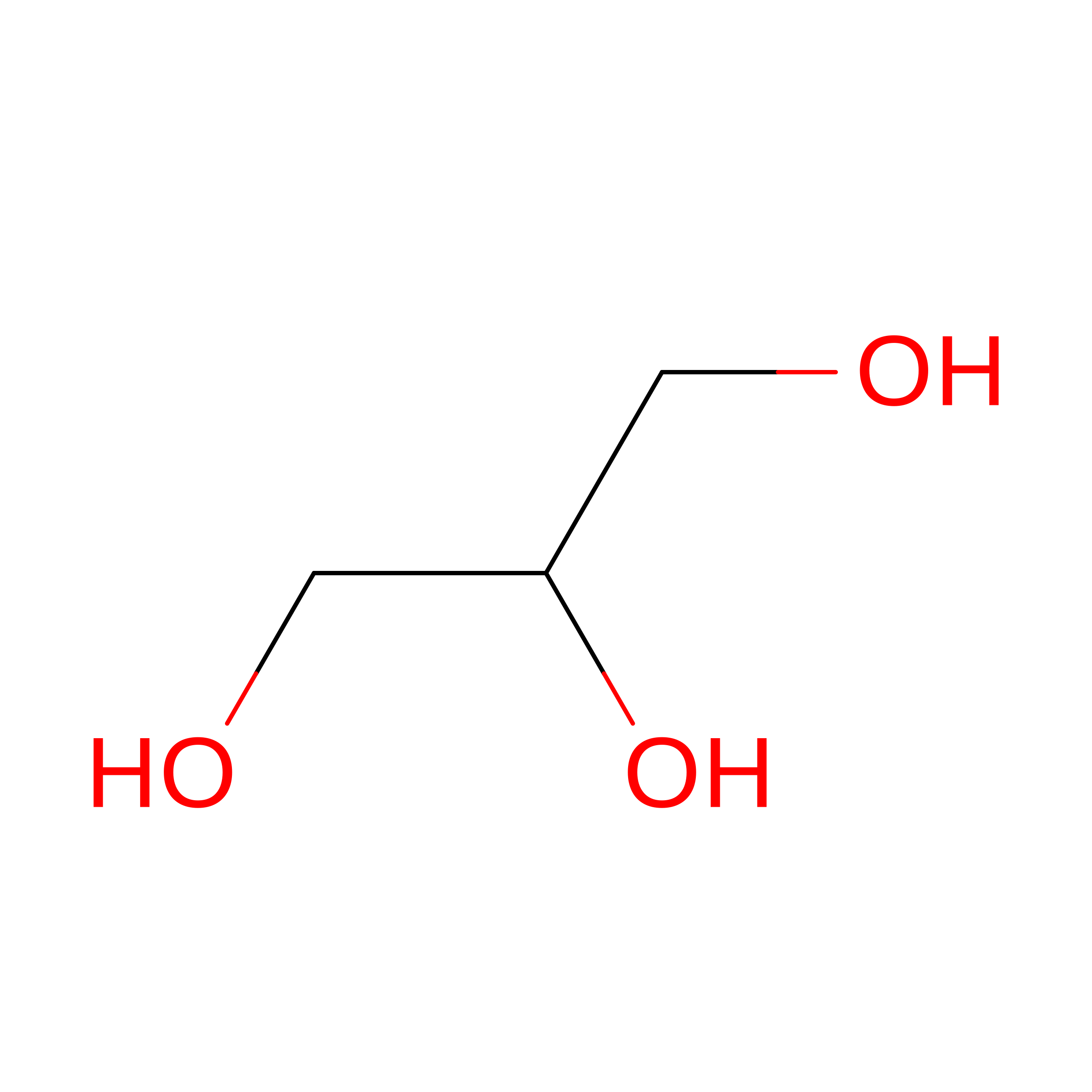
B [auth A]GLYCEROL
C3 H8 O3
PEDCQBHIVMGVHV-UHFFFAOYSA-N

Biologically Interesting Molecules (External Reference) 

1 Unique

Experimental Data & Validation

Experimental Data

  • Method: X-RAY DIFFRACTION
  • Resolution: 1.50 Å
  • R-Value Free:  0.217 (Depositor) 
  • R-Value Work:  0.193 (Depositor) 
  • R-Value Observed: 0.193 (Depositor) 
Space Group: P 21 21 21
Unit Cell:
Length ( Å )Angle ( ˚ )
a = 71.1α = 90
b = 100.1β = 90
c = 111.3γ = 90
Software Package:
Software NamePurpose
X-PLORrefinement
DENZOdata reduction
SCALEPACKdata scaling
X-PLORphasing

Structure Validation

View Full Validation Report


Entry History 

Deposition Data

  • Released Date: 2001-01-16 
  • Deposition Author(s): Fulop, V.

Revision History  (Full details and data files)

  • Version 1.0: 2001-01-16
    Type: Initial release
  • Version 1.1: 2011-07-13
    Changes: Atomic model, Database references, Derived calculations, Non-polymer description, Structure summary, Version format compliance
  • Version 1.2: 2012-11-30
    Changes: Other
  • Version 1.3: 2019-07-24
    Changes: Data collection
  • Version 1.4: 2023-12-13
    Changes: Data collection, Database references, Derived calculations, Refinement description