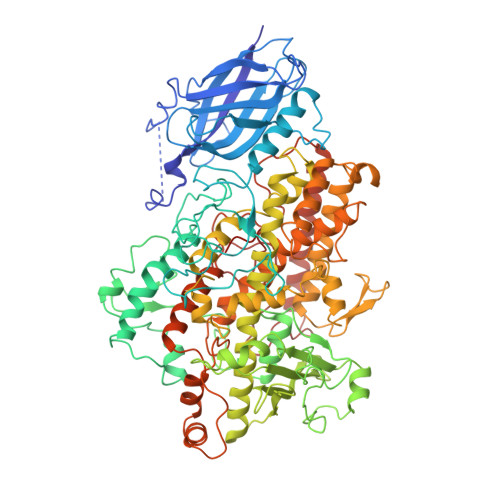
1LNH | pdb_00001lnh

LIPOXYGENASE-3(SOYBEAN) NON-HEME FE(II) METALLOPROTEIN


Experimental Data Snapshot

  • Method: X-RAY DIFFRACTION
  • Resolution: 2.60 Å
  • R-Value Free: 
    0.265 (Depositor), 0.256 (DCC) 
  • R-Value Work: 
    0.174 (Depositor), 0.168 (DCC) 
  • R-Value Observed: 
    0.174 (Depositor) 

Starting Model: experimental
View more details

wwPDB Validation 3D Report Full Report

Validation slider image for 1LNH

This is version 1.4 of the entry. See complete history

Literature

Structure of soybean lipoxygenase L3 and a comparison with its L1 isoenzyme.

Skrzypczak-Jankun, E.Amzel, L.M.Kroa, B.A.Funk Jr., M.O.

(1997) Proteins 29: 15-31

  • Primary Citation Related Structures: 
    1LNH

  • PubMed Abstract: 

    Soybean lipoxygenase isoenzyme L3 represents a second example (after L1) of the X-ray structure (R = 17% at 2.6 A resolution) for a member of the large family of lipoxygenases. L1 and L3 have different characteristics in catalysis, although they share 72% sequence identity (the changes impact 255 amino acids) and similar folding (average C alpha rms deviation of 1 A). The critical nonheme iron site has the same features as for L1:3O and 3N in pseudo C3v orientation, with two oxygen atoms (from Asn713 and water) at a nonbinding distance. Asn713 and His518 are strategically located at the junction of three cavities connecting the iron site with the molecule surface. The most visible differences between L1 and L3 isoenzymes occur in and near these cavities, affecting their accessibility and volume. Among the L1/L3 substitutions Glu256/ Thr274, Tyr409/His429, and Ser747/Asp766 affect the salt bridges (L1: Glu256...His248 and Asp490...Arg707) that in L1 restrict the access to the iron site from two opposite directions. The L3 molecule has a passage going through the whole length of the helical domain, starting at the interface with the Nt-domain (near 25-27 and 254-278) and going to the opposite end of the Ct-domain (near 367, 749). The substrate binding and the role of His513, His266, His776 (and other residues nearby) are illustrated and discussed by using models of linoleic acid binding. These hypotheses provide a possible explanation for a stringent stereo-specificity of catalytic products in L1 (that produces predominantly 13-hydroperoxide) versus the lack of such specificity in L3 (that turns out a mixture of 9- and 13-hydroperoxides and their diastereoisomers).


  • Organizational Affiliation
    • Department of Chemistry, University of Toledo, Ohio 43606, USA. ejankun@uoft02.utoledo.edu

Macromolecule Content 

  • Total Structure Weight: 96.97 kDa 
  • Atom Count: 6,867 
  • Modeled Residue Count: 836 
  • Deposited Residue Count: 857 
  • Unique protein chains: 1

Macromolecules

Find similar proteins by:|  3D Structure
Entity ID: 1
MoleculeChains  Sequence LengthOrganismDetailsImage
LIPOXYGENASE-3857Glycine maxMutation(s): 0 
EC: 1.13.11.58
UniProt
Find proteins for P09186 (Glycine max)
Explore P09186 
Go to UniProtKB:  P09186
Entity Groups
Sequence Clusters30% Identity50% Identity70% Identity90% Identity95% Identity100% Identity
UniProt GroupP09186
Sequence Annotations
Expand
Reference Sequence

Small Molecules

Ligands 1 Unique
IDChains Name / Formula / InChI Key2D Diagram3D Interactions
FE2

Query on FE2


Download:Ideal Coordinates CCD File
B [auth A]FE (II) ION
Fe
CWYNVVGOOAEACU-UHFFFAOYSA-N

Experimental Data & Validation

Experimental Data

  • Method: X-RAY DIFFRACTION
  • Resolution: 2.60 Å
  • R-Value Free:  0.265 (Depositor), 0.256 (DCC) 
  • R-Value Work:  0.174 (Depositor), 0.168 (DCC) 
  • R-Value Observed: 0.174 (Depositor) 
Space Group: C 1 2 1
Unit Cell:
Length ( Å )Angle ( ˚ )
a = 112.8α = 90
b = 137.4β = 95.5
c = 61.85γ = 90
Software Package:
Software NamePurpose
X-PLORmodel building
X-PLORrefinement
MSCdata reduction
X-PLORphasing

Structure Validation

View Full Validation Report


Entry History 

Deposition Data

Revision History  (Full details and data files)

  • Version 1.0: 1997-02-02
    Type: Initial release
  • Version 1.1: 2008-03-24
    Changes: Version format compliance
  • Version 1.2: 2011-07-13
    Changes: Version format compliance
  • Version 1.3: 2023-08-09
    Changes: Database references, Derived calculations, Other, Refinement description
  • Version 1.4: 2024-05-22
    Changes: Data collection