1PEQ | pdb_00001peq

Ribonucleotide Reductase Protein R1E from Salmonella typhimurium


Experimental Data Snapshot

  • Method: X-RAY DIFFRACTION
  • Resolution: 2.80 Å
  • R-Value Free: 
    0.246 (Depositor), 0.244 (DCC) 
  • R-Value Work: 
    0.215 (Depositor), 0.216 (DCC) 
  • R-Value Observed: 
    0.217 (Depositor) 

Starting Model: experimental
View more details

wwPDB Validation 3D Report Full Report

Validation slider image for 1PEQ

Ligand Structure Quality Assessment 


This is version 1.4 of the entry. See complete history

Literature

Structure of the large subunit of class Ib ribonucleotide reductase from Salmonella typhimurium and its complexes with allosteric effectors.

Uppsten, M.Farnegardh, M.Jordan, A.Eliasson, R.Eklund, H.Uhlin, U.

(2003) J Mol Biology 330: 87-97

  • DOI: https://doi.org/10.1016/s0022-2836(03)00538-2
  • Primary Citation Related Structures: 
    1PEM, 1PEO, 1PEQ, 1PEU

  • PubMed Abstract: 

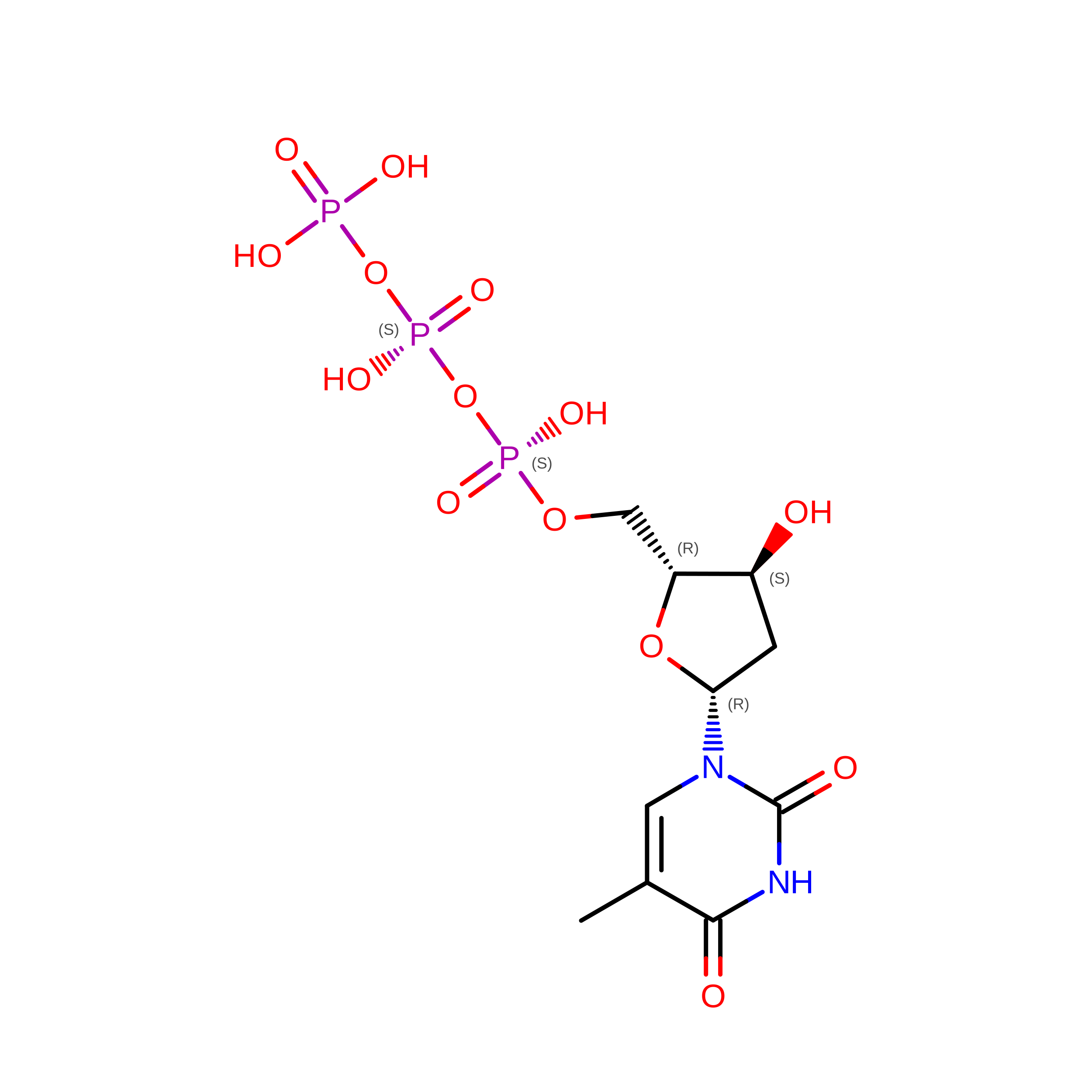
    The three-dimensional structure of the large subunit of the first member of a class Ib ribonucleotide reductase, R1E of Salmonella typhimurium, has been determined in its native form and together with three allosteric effectors. The enzyme contains the characteristic ten-stranded alpha/beta-barrel with catalytic residues at a finger loop in its center and with redox-active cysteine residues at two adjacent barrel strands. Structures where the redox-active cysteine residues are in reduced thiol form and in oxidized disulfide form have been determined revealing local structural changes. The R1E enzyme differs from the class Ia enzyme, Escherichia coli R1, by not having an overall allosteric regulation. This is explained from the structure by differences in the N-terminal domain, which is about 50 residues shorter and lacks the overall allosteric binding site. R1E has an allosteric substrate specificity regulation site and the binding site for the nucleotide effectors is located at the dimer interface similarly as for the class Ia enzymes. We have determined the structures of R1E in the absence of effectors and with dTTP, dATP and dCTP bound. The low affinity for ATP at the specificity site is explained by a tyrosine, which hinders nucleotides containing a 2'-OH group to bind.


  • Organizational Affiliation
    • Department of Molecular Biosciences section of Structure Biology, Uppsala Biomedical Center, Swedish University of Agricultural Sciences, Box 590, Sweden.

Macromolecule Content 

  • Total Structure Weight: 81.19 kDa 
  • Atom Count: 5,464 
  • Modeled Residue Count: 679 
  • Deposited Residue Count: 714 
  • Unique protein chains: 1

Macromolecules

Find similar proteins by:|  3D Structure
Entity ID: 1
MoleculeChains  Sequence LengthOrganismDetailsImage
Ribonucleoside-diphosphate reductase 2 alpha chain714Salmonella enterica subsp. enterica serovar TyphimuriumMutation(s): 0 
Gene Names: NRDE OR STM2807
EC: 1.17.4.1
UniProt
Find proteins for Q08698 (Salmonella typhimurium (strain LT2 / SGSC1412 / ATCC 700720))
Explore Q08698 
Go to UniProtKB:  Q08698
Entity Groups
Sequence Clusters30% Identity50% Identity70% Identity90% Identity95% Identity100% Identity
UniProt GroupQ08698
Sequence Annotations
Expand
Reference Sequence

Small Molecules

Experimental Data & Validation

Experimental Data

  • Method: X-RAY DIFFRACTION
  • Resolution: 2.80 Å
  • R-Value Free:  0.246 (Depositor), 0.244 (DCC) 
  • R-Value Work:  0.215 (Depositor), 0.216 (DCC) 
  • R-Value Observed: 0.217 (Depositor) 
Space Group: P 43 21 2
Unit Cell:
Length ( Å )Angle ( ˚ )
a = 99.144α = 90
b = 99.144β = 90
c = 289.544γ = 90
Software Package:
Software NamePurpose
REFMACrefinement
DENZOdata reduction
SCALEPACKdata scaling
AMoREphasing

Structure Validation

View Full Validation Report


Ligand Structure Quality Assessment 


Entry History 

Deposition Data

Revision History  (Full details and data files)

  • Version 1.0: 2004-05-25
    Type: Initial release
  • Version 1.1: 2008-04-29
    Changes: Version format compliance
  • Version 1.2: 2011-07-13
    Changes: Version format compliance
  • Version 1.3: 2024-04-03
    Changes: Data collection, Database references, Derived calculations, Refinement description
  • Version 1.4: 2024-10-09
    Changes: Structure summary