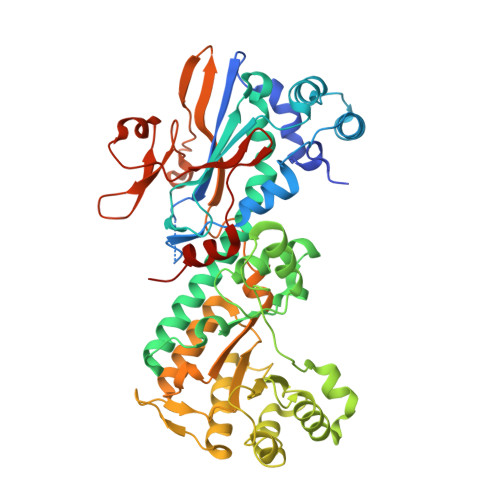
2E5C | pdb_00002e5c

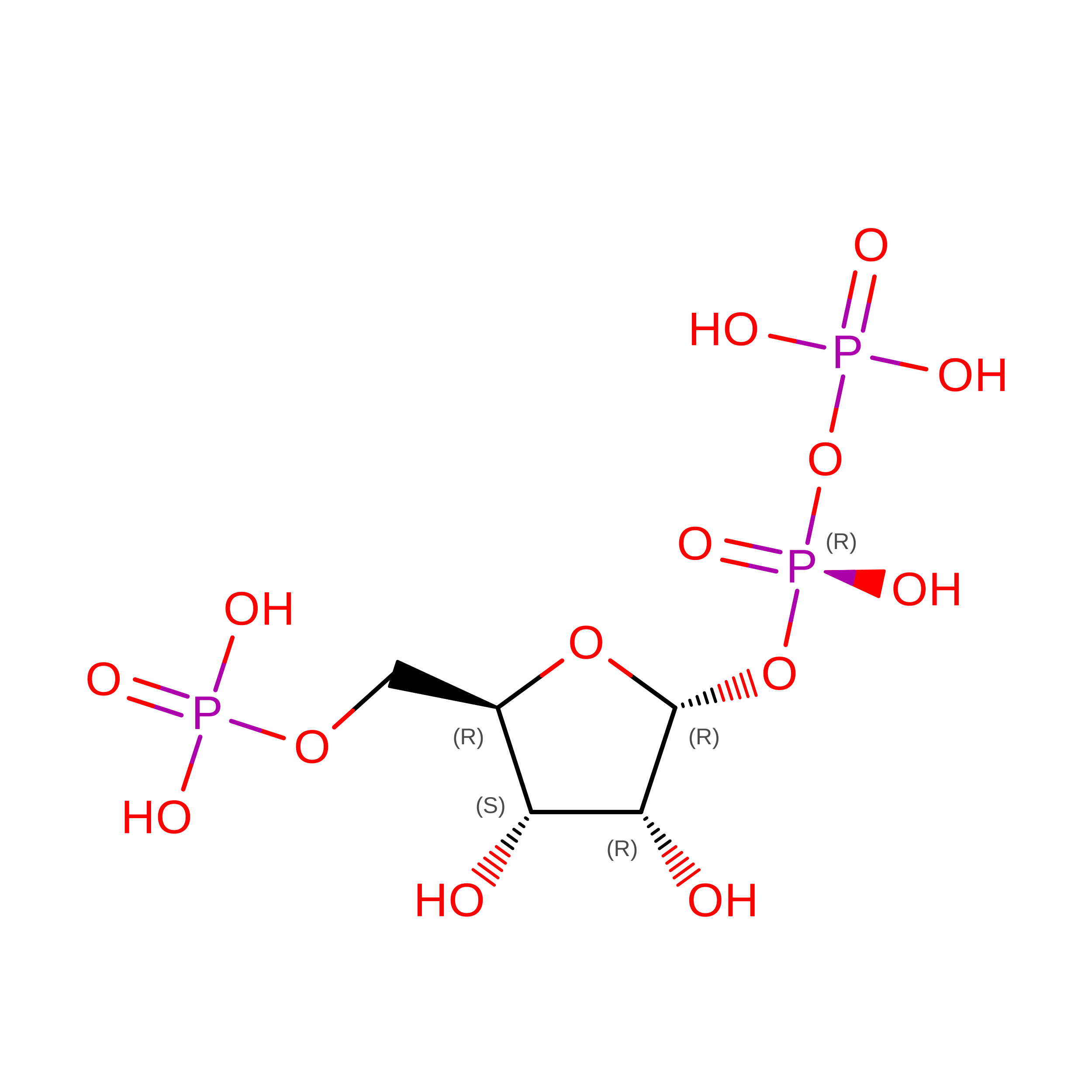
Crystal structure of Human NMPRTase complexed with 5'-phosphoribosyl-1'-pyrophosphate


Experimental Data Snapshot

  • Method: X-RAY DIFFRACTION
  • Resolution: 2.20 Å
  • R-Value Free: 
    0.221 (Depositor), 0.222 (DCC) 
  • R-Value Work: 
    0.174 (Depositor), 0.175 (DCC) 
  • R-Value Observed: 
    0.177 (Depositor) 

Starting Model: experimental
View more details

wwPDB Validation 3D Report Full Report

Validation slider image for 2E5C

Ligand Structure Quality Assessment 


This is version 1.3 of the entry. See complete history

Literature

Structure and reaction mechanism of human nicotinamide phosphoribosyltransferase

Takahashi, R.Nakamura, S.Nakazawa, T.Minoura, K.Yoshida, T.Nishi, Y.Kobayashi, Y.Ohkubo, T.

(2010) J Biochem 147: 95-107

  • DOI: https://doi.org/10.1093/jb/mvp152
  • Primary Citation Related Structures: 
    2E5B, 2E5C, 2E5D

  • PubMed Abstract: 

    Nicotinamide (NM) phosphoribosyltransferase (NMPRTase) catalyzes the reaction of NM and 5'-phosphoribosyl-1'-pyrophosphate (PRPP) to form NM mononucleotide (NMN) and pyrophosphate (PPi) in the pathway of NAD-biosynthesis. Monitoring the (1)H and (31)P NMR spectra of the reaction mixture, we found that this reaction is reversible as dictated by the equilibrium constant K = [NMN][PPi]/([NM][PRPP]) = 0.14, which agreed well with the ratio of second-order rate constants for forward and backward reactions, K = 0.16. The crystal structures of this enzyme in the free form and bound to NM and PRPP at the resolution of 2.0-2.2 A were essentially identical to that of the complex with NMN, except for some variations that could facilitate the substitution reaction by fixing the nucleophile and the leaving group for the requisite inversion of configuration at the C1' carbon of the ribose ring. In the active site near the C1' atom of the bound PRPP or NMN, there was neither negatively charged group nor waterproof environment necessary to support the feasibility of a ribo-oxocarbocation intermediate inherent in the S(N)1 mechanism. The structures and catalytic mechanism thus revealed are also discussed in connection with the multiple biological functions of NMPRTase.


  • Organizational Affiliation
    • Graduate School of Pharmaceutical Sciences, Osaka University, Suita, Osaka, Japan.

Macromolecule Content 

  • Total Structure Weight: 113.54 kDa 
  • Atom Count: 8,286 
  • Modeled Residue Count: 932 
  • Deposited Residue Count: 998 
  • Unique protein chains: 1

Macromolecules

Find similar proteins by:|  3D Structure
Entity ID: 1
MoleculeChains  Sequence LengthOrganismDetailsImage
Nicotinamide phosphoribosyltransferase
A, B
499Homo sapiensMutation(s): 0 
EC: 2.4.2.12
UniProt & NIH Common Fund Data Resources
Find proteins for P43490 (Homo sapiens)
Explore P43490 
Go to UniProtKB:  P43490
PHAROS:  P43490
GTEx:  ENSG00000105835 
Entity Groups
Sequence Clusters30% Identity50% Identity70% Identity90% Identity95% Identity100% Identity
UniProt GroupP43490
Sequence Annotations
Expand
Reference Sequence

Small Molecules

Experimental Data & Validation

Experimental Data

  • Method: X-RAY DIFFRACTION
  • Resolution: 2.20 Å
  • R-Value Free:  0.221 (Depositor), 0.222 (DCC) 
  • R-Value Work:  0.174 (Depositor), 0.175 (DCC) 
  • R-Value Observed: 0.177 (Depositor) 
Space Group: P 1 21 1
Unit Cell:
Length ( Å )Angle ( ˚ )
a = 60.23α = 90
b = 106.746β = 96.24
c = 82.613γ = 90
Software Package:
Software NamePurpose
REFMACrefinement
HKL-2000data collection
HKL-2000data reduction
HKL-2000data scaling
MOLREPphasing

Structure Validation

View Full Validation Report


Ligand Structure Quality Assessment 


Entry History 

Deposition Data

Revision History  (Full details and data files)

  • Version 1.0: 2007-12-25
    Type: Initial release
  • Version 1.1: 2011-07-13
    Changes: Derived calculations, Version format compliance
  • Version 1.2: 2020-07-29
    Type: Remediation
    Reason: Carbohydrate remediation
    Changes: Data collection, Database references, Derived calculations, Structure summary
  • Version 1.3: 2023-10-25
    Changes: Data collection, Database references, Refinement description, Structure summary