2YXN | pdb_00002yxn

Structual basis of azido-tyrosine recognition by engineered bacterial Tyrosyl-tRNA synthetase


Experimental Data Snapshot

  • Method: X-RAY DIFFRACTION
  • Resolution: 1.80 Å
  • R-Value Free: 
    0.247 (Depositor), 0.248 (DCC) 
  • R-Value Work: 
    0.199 (Depositor), 0.199 (DCC) 
  • R-Value Observed: 
    0.199 (Depositor) 

Starting Model: experimental
View more details

wwPDB Validation 3D Report Full Report

Validation slider image for 2YXN

Ligand Structure Quality Assessment 


This is version 1.5 of the entry. See complete history

Literature

Functional replacement of the endogenous tyrosyl-tRNA synthetase-tRNATyr pair by the archaeal tyrosine pair in Escherichia coli for genetic code expansion

Iraha, F.Oki, K.Kobayashi, T.Ohno, S.Yokogawa, T.Nishikawa, K.Yokoyama, S.Sakamoto, K.

(2010) Nucleic Acids Res 38: 3682-3691

  • DOI: https://doi.org/10.1093/nar/gkq080
  • Primary Citation Related Structures: 
    2YXN

  • PubMed Abstract: 

    Non-natural amino acids have been genetically encoded in living cells, using aminoacyl-tRNA synthetase-tRNA pairs orthogonal to the host translation system. In the present study, we engineered Escherichia coli cells with a translation system orthogonal to the E. coli tyrosyl-tRNA synthetase (TyrRS)-tRNA(Tyr) pair, to use E. coli TyrRS variants for non-natural amino acids in the cells without interfering with tyrosine incorporation. We showed that the E. coli TyrRS-tRNA(Tyr) pair can be functionally replaced by the Methanocaldococcus jannaschii and Saccharomyces cerevisiae tyrosine pairs, which do not cross-react with E. coli TyrRS or tRNA(Tyr). The endogenous TyrRS and tRNA(Tyr) genes were then removed from the chromosome of the E. coli cells expressing the archaeal TyrRS-tRNA(Tyr) pair. In this engineered strain, 3-iodo-L-tyrosine and 3-azido-L-tyrosine were each successfully encoded with the amber codon, using the E. coli amber suppressor tRNATyr and a TyrRS variant, which was previously developed for 3-iodo-L-tyrosine and was also found to recognize 3-azido-L-tyrosine. The structural basis for the 3-azido-L-tyrosine recognition was revealed by X-ray crystallography. The present engineering allows E. coli TyrRS variants for non-natural amino acids to be developed in E. coli, for use in both eukaryotic and bacterial cells for genetic code expansion.


  • Organizational Affiliation
    • RIKEN Systems and Structural Biology Center, 1-7-22 Suehiro-cho, Tsurumi, Yokohama 230-0045, Japan.

Macromolecule Content 

  • Total Structure Weight: 36.21 kDa 
  • Atom Count: 2,847 
  • Modeled Residue Count: 322 
  • Deposited Residue Count: 322 
  • Unique protein chains: 1

Macromolecules

Find similar proteins by:|  3D Structure
Entity ID: 1
MoleculeChains  Sequence LengthOrganismDetailsImage
Tyrosyl-tRNA synthetase322Escherichia coli str. K-12 substr. W3110Mutation(s): 2 
Gene Names: tyrS
EC: 6.1.1.1
UniProt
Find proteins for P0AGJ9 (Escherichia coli (strain K12))
Explore P0AGJ9 
Go to UniProtKB:  P0AGJ9
Entity Groups
Sequence Clusters30% Identity50% Identity70% Identity90% Identity95% Identity100% Identity
UniProt GroupP0AGJ9
Sequence Annotations
Expand
Reference Sequence

Small Molecules

Ligands 1 Unique
IDChains Name / Formula / InChI Key2D Diagram3D Interactions
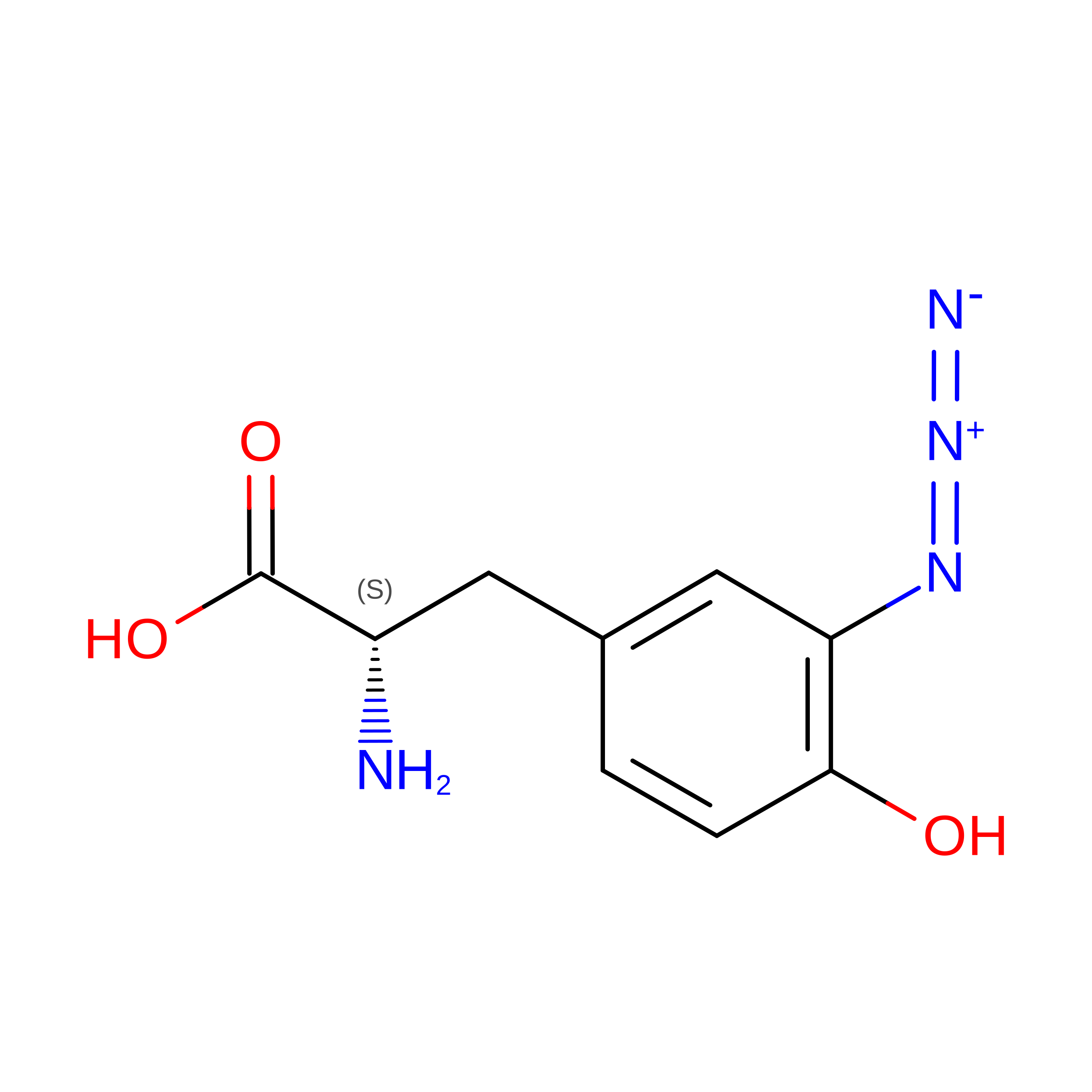
AZY

Query on AZY


Download:Ideal Coordinates CCD File
B [auth A]3-AZIDO-L-TYROSINE
C9 H10 N4 O3
VGCRDUSYLLNJSS-LURJTMIESA-N

Experimental Data & Validation

Experimental Data

  • Method: X-RAY DIFFRACTION
  • Resolution: 1.80 Å
  • R-Value Free:  0.247 (Depositor), 0.248 (DCC) 
  • R-Value Work:  0.199 (Depositor), 0.199 (DCC) 
  • R-Value Observed: 0.199 (Depositor) 
Space Group: P 31 2 1
Unit Cell:
Length ( Å )Angle ( ˚ )
a = 83.155α = 90
b = 83.155β = 90
c = 93.668γ = 120
Software Package:
Software NamePurpose
CNSrefinement
HKL-2000data collection
HKL-2000data reduction
HKL-2000data scaling
MOLREPphasing

Structure Validation

View Full Validation Report


Ligand Structure Quality Assessment 


Entry History 

Deposition Data

Revision History  (Full details and data files)

  • Version 1.0: 2008-04-29
    Type: Initial release
  • Version 1.1: 2011-07-13
    Changes: Source and taxonomy, Version format compliance
  • Version 1.2: 2012-05-30
    Changes: Database references
  • Version 1.3: 2019-10-16
    Changes: Data collection
  • Version 1.4: 2021-11-10
    Changes: Database references, Derived calculations
  • Version 1.5: 2023-10-25
    Changes: Data collection, Refinement description