Download Mendeley
C-RAF Sequence-Encoded Cooperativity Hotspots for 14-3-3/C-RAF Molecular Glues.
Pennings, M.A.M., Lauffer, G.A.M., Konstantinidou, M., de Vries, R.M.J.M., Ottmann, C., Arkin, M.R., Brunsveld, L.(2026) J Med Chem 69: 22869-22881
- PubMed: 42917907 Search on PubMed
- DOI: https://doi.org/10.1021/acs.jmedchem.6c02049
- Primary Citation Related Structures:
31UG, 31UH, 31UI, 31UK, 31UL, 31UM, 31UN, 31UO, 31UP, 31UQ, 31UR, 31US, 31UT, 31UU, 31UV, 31UW, 31UX, 31UY, 31UZ, 31VA, 31VB, 31VC, 31VD, 31VE, 31VF, 31VG - PubMed Abstract:
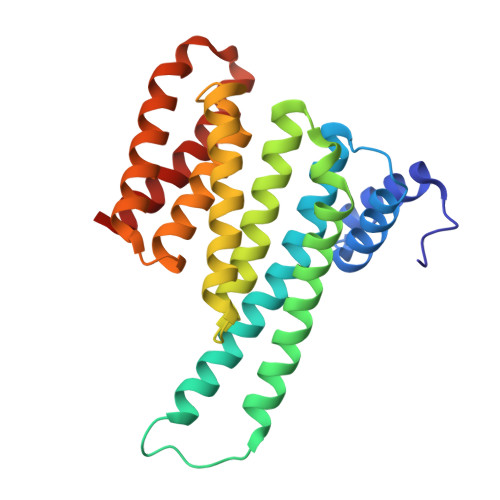
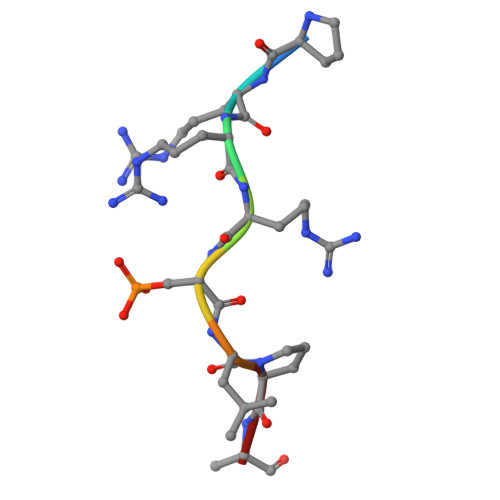
14-3-3 Proteins are hub proteins with an extensive interactome of phosphorylated client proteins, making them attractive targets for molecular glues (MGs) that stabilize specific 14-3-3/client protein complexes. However, selectively stabilizing individual 14-3-3 protein-protein interactions (PPIs) remains a key challenge for effectively drugging the 14-3-3 interactome. Here, we systematically investigated the sequence-encoded determinants underlying selective stabilization of the 14-3-3/C-RAF complex by covalent MGs. Using stepwise C-terminal peptide sequence extension, alanine scanning, and MG activity analysis on a large 14-3-3 peptide interactome panel, we demonstrate that residues beyond the canonical +1 and +2 positions contribute to cooperative ternary complex formation. The C-RAF +4Val and +6Met residues promote stabilization by an MG through sequence-dependent conformational arrangements that position the peptide backbone and enable the +6Met side chain to wrap around the MG, thereby reducing ternary complex dissociation. These findings provide general principles for the rational design of selective cooperative MGs targeting hub protein PPIs.
- Laboratory of Chemical Biology, Department of Biomedical Engineering and Institute for Complex Molecular Systems (ICMS), Eindhoven University of Technology, Eindhoven5600MB, The Netherlands.
Organizational Affiliation: