3ZDU | pdb_00003zdu

Crystal structure of the human CDKL3 kinase domain


Experimental Data Snapshot

  • Method: X-RAY DIFFRACTION
  • Resolution: 2.20 Å
  • R-Value Free: 
    0.262 (Depositor), 0.269 (DCC) 
  • R-Value Work: 
    0.214 (Depositor), 0.223 (DCC) 
  • R-Value Observed: 
    0.217 (Depositor) 

Starting Models: experimental
View more details

wwPDB Validation 3D Report Full Report

Validation slider image for 3ZDU

Ligand Structure Quality Assessment 


This is version 1.3 of the entry. See complete history

Literature

CDKL Family Kinases Have Evolved Distinct Structural Features and Ciliary Function.

Canning, P.Park, K.Goncalves, J.Li, C.Howard, C.J.Sharpe, T.D.Holt, L.J.Pelletier, L.Bullock, A.N.Leroux, M.R.

(2018) Cell Rep 22: 885-894

  • DOI: https://doi.org/10.1016/j.celrep.2017.12.083
  • Primary Citation Related Structures: 
    3ZDU, 4AAA, 4AGU, 4BBM, 4BGQ

  • PubMed Abstract: 

    Various kinases, including a cyclin-dependent kinase (CDK) family member, regulate the growth and functions of primary cilia, which perform essential roles in signaling and development. Neurological disorders linked to CDK-Like (CDKL) proteins suggest that these underexplored kinases may have similar functions. Here, we present the crystal structures of human CDKL1, CDKL2, CDKL3, and CDKL5, revealing their evolutionary divergence from CDK and mitogen-activated protein kinases (MAPKs), including an unusual ?J helix important for CDKL2 and CDKL3 activity. C. elegans CDKL-1, most closely related to CDKL1-4 and localized to neuronal cilia transition zones, modulates cilium length; this depends on its kinase activity and ?J helix-containing C terminus. Human CDKL5, linked to Rett syndrome, also localizes to cilia, and it impairs ciliogenesis when overexpressed. CDKL5 patient mutations modeled in CDKL-1 cause localization and/or cilium length defects. Together, our studies establish a disease model system suggesting cilium length defects as a pathomechanism for neurological disorders, including epilepsy.


  • Organizational Affiliation
    • Structural Genomics Consortium, University of Oxford, Old Road Campus, Roosevelt Drive, Oxford OX3 7DQ, UK.

Macromolecule Content 

  • Total Structure Weight: 37.99 kDa 
  • Atom Count: 2,516 
  • Modeled Residue Count: 297 
  • Deposited Residue Count: 325 
  • Unique protein chains: 1

Macromolecules

Find similar proteins by:|  3D Structure
Entity ID: 1
MoleculeChains  Sequence LengthOrganismDetailsImage
CYCLIN-DEPENDENT KINASE-LIKE 3325Homo sapiensMutation(s): 2 
EC: 2.7.11.22
UniProt & NIH Common Fund Data Resources
Find proteins for Q8IVW4 (Homo sapiens)
Explore Q8IVW4 
Go to UniProtKB:  Q8IVW4
PHAROS:  Q8IVW4
GTEx:  ENSG00000006837 
Entity Groups
Sequence Clusters30% Identity50% Identity70% Identity90% Identity95% Identity100% Identity
UniProt GroupQ8IVW4
Sequence Annotations
Expand
Reference Sequence

Small Molecules

Ligands 4 Unique
IDChains Name / Formula / InChI Key2D Diagram3D Interactions
38R

Query on 38R


Download:Ideal Coordinates CCD File
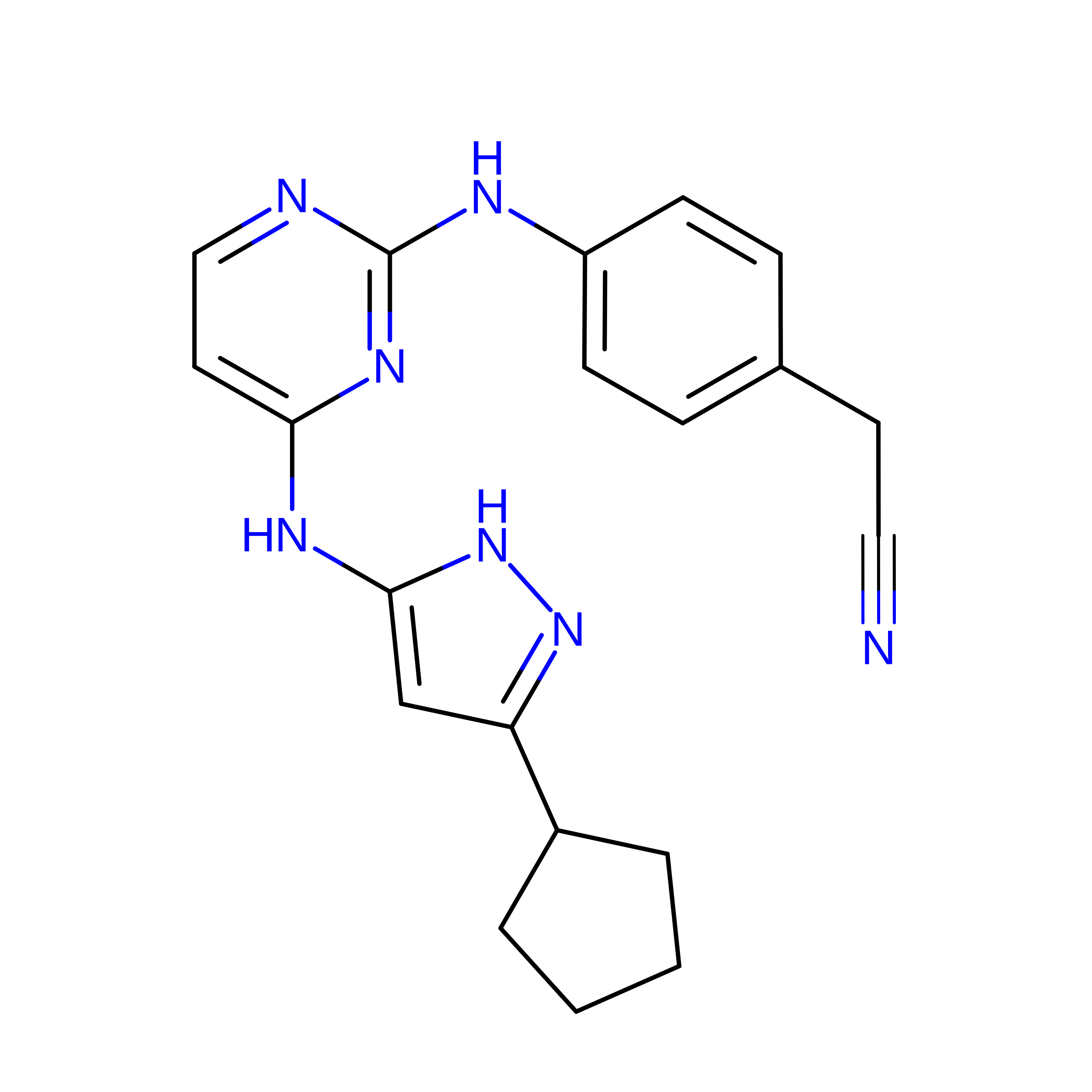
B [auth A][4-({4-[(3-cyclopentyl-1H-pyrazol-5-yl)amino]pyrimidin-2-yl}amino)phenyl]acetonitrile
C20 H21 N7
VKAOLAKWGBXOCQ-UHFFFAOYSA-N
ZN

Query on ZN


Download:Ideal Coordinates CCD File
C [auth A],
D [auth A]
ZINC ION
Zn
PTFCDOFLOPIGGS-UHFFFAOYSA-N
EDO

Query on EDO


Download:Ideal Coordinates CCD File
F [auth A],
G [auth A]
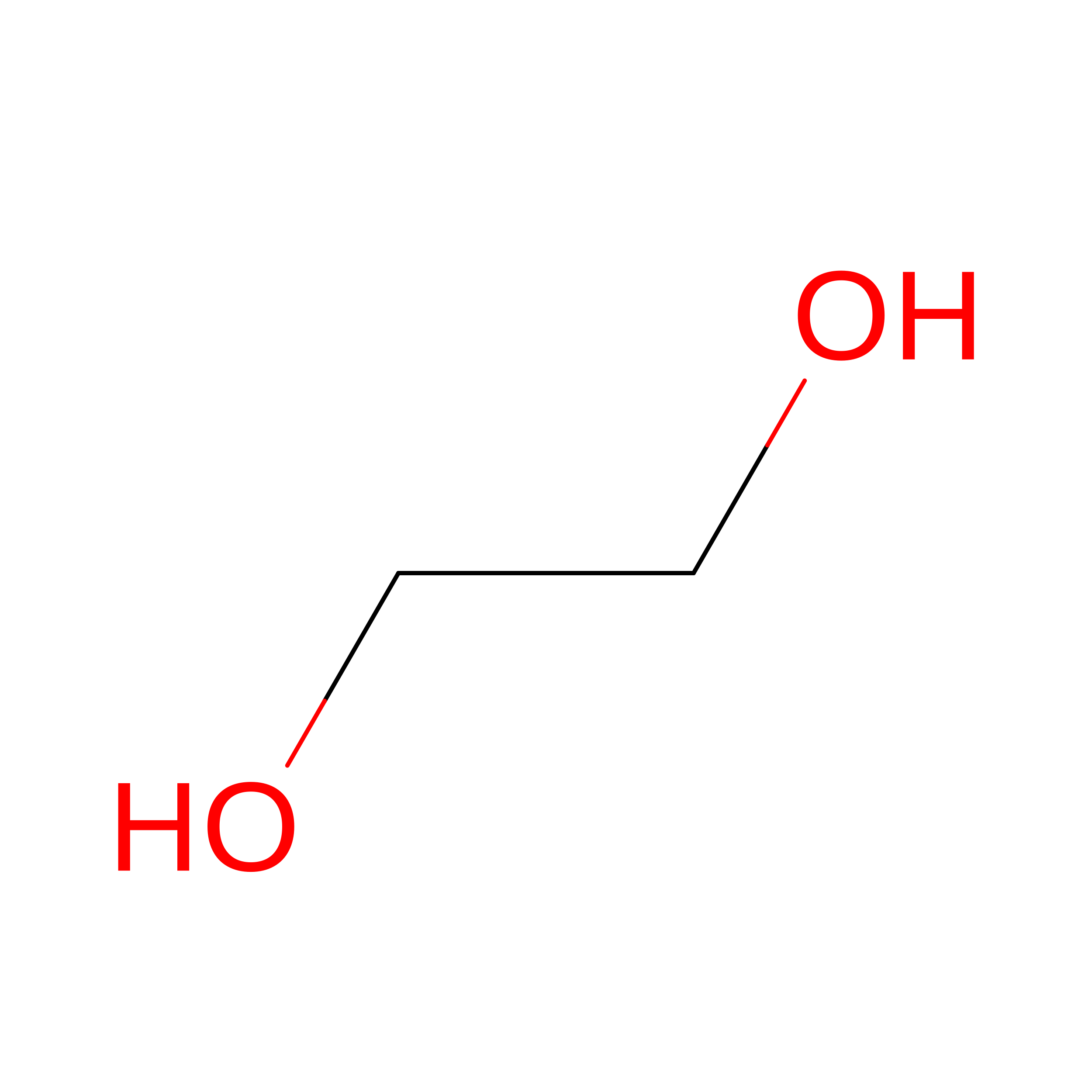
1,2-ETHANEDIOL
C2 H6 O2
LYCAIKOWRPUZTN-UHFFFAOYSA-N
NA

Query on NA


Download:Ideal Coordinates CCD File
E [auth A]SODIUM ION
Na
FKNQFGJONOIPTF-UHFFFAOYSA-N

Experimental Data & Validation

Experimental Data

  • Method: X-RAY DIFFRACTION
  • Resolution: 2.20 Å
  • R-Value Free:  0.262 (Depositor), 0.269 (DCC) 
  • R-Value Work:  0.214 (Depositor), 0.223 (DCC) 
  • R-Value Observed: 0.217 (Depositor) 
Space Group: P 31 2 1
Unit Cell:
Length ( Å )Angle ( ˚ )
a = 63.93α = 90
b = 63.93β = 90
c = 163.63γ = 120
Software Package:
Software NamePurpose
REFMACrefinement
MOSFLMdata reduction
Aimlessdata scaling
PHASERphasing

Structure Validation

View Full Validation Report


Ligand Structure Quality Assessment 


Entry History 

Revision History  (Full details and data files)

  • Version 1.0: 2013-03-20
    Type: Initial release
  • Version 1.1: 2018-01-24
    Changes: Database references, Structure summary
  • Version 1.2: 2022-03-30
    Changes: Database references, Derived calculations, Other
  • Version 1.3: 2023-12-20
    Changes: Data collection, Refinement description