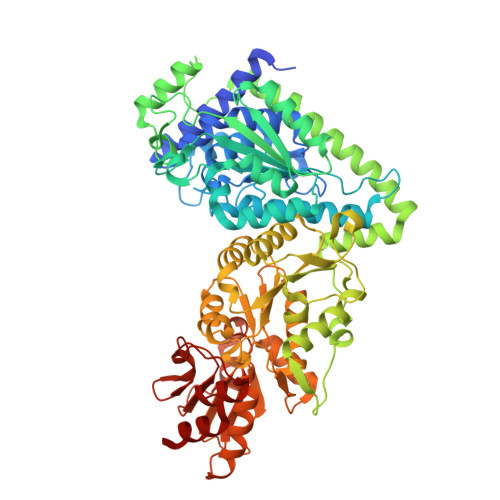
4C7V | pdb_00004c7v

Apo Transketolase from Lactobacillus salivarius at 2.2A resolution


Experimental Data Snapshot

  • Method: X-RAY DIFFRACTION
  • Resolution: 2.20 Å
  • R-Value Free: 
    0.219 (Depositor), 0.226 (DCC) 
  • R-Value Work: 
    0.162 (Depositor), 0.172 (DCC) 
  • R-Value Observed: 
    0.165 (Depositor) 

wwPDB Validation 3D Report Full Report

Validation slider image for 4C7V

This is version 1.3 of the entry. See complete history

Literature

High Resolution Crystal Structures of Lactobacillus Salivarius Transketolase in the Presence and Absence of Thiamine Pyrophosphate

Lukacik, P.Lobley, C.M.C.Bumann, M.Arena De Souza, V.Owens, R.J.O'Toole, P.W.Walsh, M.A.

(2015) Acta Crystallogr Sect F Struct Biol Cryst Commun 71: 1327

  • DOI: https://doi.org/10.1107/S2053230X1501657X
  • Primary Citation Related Structures: 
    4C7V, 4C7X

  • PubMed Abstract: 

    Probiotic bacterial strains have been shown to enhance the health of the host through a range of mechanisms including colonization, resistance against pathogens, secretion of antimicrobial compounds and modulation of the activity of the innate immune system. Lactobacillus salivarius UCC118 is a well characterized probiotic strain which survives intestinal transit and has many desirable host-interaction properties. Probiotic bacteria display a wide range of catabolic activities, which determine their competitiveness in vivo. Some lactobacilli are heterofermentative and can metabolize pentoses, using a pathway in which transketolase and transaldolase are key enzymes. L. salivarius UCC118 is capable of pentose utilization because it encodes the key enzymes on a megaplasmid. The crystal structures of the megaplasmid-encoded transketolase with and without the enzyme cofactor thiamine pyrophosphate have been determined. Comparisons with other known transketolase structures reveal a high degree of structural conservation in both the catalytic site and the overall conformation. This work extends structural knowledge of the transketolases to the industrially and commercially important Lactobacillus genus.


  • Organizational Affiliation
    • Diamond Light Source, Harwell Science and Innovation Campus, Didcot OX11 0DE, England.

Macromolecule Content 

  • Total Structure Weight: 74.54 kDa 
  • Atom Count: 5,363 
  • Modeled Residue Count: 662 
  • Deposited Residue Count: 681 
  • Unique protein chains: 1

Macromolecules

Find similar proteins by:|  3D Structure
Entity ID: 1
MoleculeChains  Sequence LengthOrganismDetailsImage
TRANSKETOLASE681Ligilactobacillus salivarius UCC118Mutation(s): 0 
EC: 2.2.1.1
UniProt
Find proteins for Q1WQU8 (Ligilactobacillus salivarius (strain UCC118))
Explore Q1WQU8 
Go to UniProtKB:  Q1WQU8
Entity Groups
Sequence Clusters30% Identity50% Identity70% Identity90% Identity95% Identity100% Identity
UniProt GroupQ1WQU8
Sequence Annotations
Expand
Reference Sequence

Experimental Data & Validation

Experimental Data

  • Method: X-RAY DIFFRACTION
  • Resolution: 2.20 Å
  • R-Value Free:  0.219 (Depositor), 0.226 (DCC) 
  • R-Value Work:  0.162 (Depositor), 0.172 (DCC) 
  • R-Value Observed: 0.165 (Depositor) 
Space Group: P 32 2 1
Unit Cell:
Length ( Å )Angle ( ˚ )
a = 76.15α = 90
b = 76.15β = 90
c = 194.51γ = 120
Software Package:
Software NamePurpose
REFMACrefinement
xia2data reduction
SCALAdata scaling
MOLREPphasing

Structure Validation

View Full Validation Report


Entry History 

Deposition Data

Revision History  (Full details and data files)

  • Version 1.0: 2014-10-08
    Type: Initial release
  • Version 1.1: 2015-10-14
    Changes: Database references, Structure summary
  • Version 1.2: 2015-10-21
    Changes: Database references
  • Version 1.3: 2024-05-08
    Changes: Data collection, Database references, Other