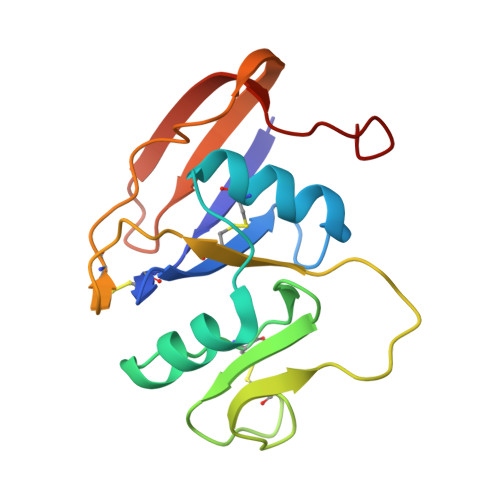
4MRD | pdb_00004mrd

Crystal structure of the murine cd44 hyaluronan binding domain complex with a small molecule


Experimental Data Snapshot

  • Method: X-RAY DIFFRACTION
  • Resolution: 2.55 Å
  • R-Value Free: 
    0.245 (Depositor), 0.251 (DCC) 
  • R-Value Work: 
    0.187 (Depositor), 0.192 (DCC) 
  • R-Value Observed: 
    0.190 (Depositor) 

wwPDB Validation 3D Report Full Report

Validation slider image for 4MRD

This is version 2.1 of the entry. See complete history

Literature

Fragment-Based Identification of an Inducible Binding Site on Cell Surface Receptor CD44 for the Design of Protein-Carbohydrate Interaction Inhibitors.

Liu, L.K.Finzel, B.C.

(2014) J Med Chem 57: 2714-2725

  • DOI: https://doi.org/10.1021/jm5000276
  • Primary Citation Related Structures: 
    4MRD, 4MRE, 4MRF, 4MRG, 4MRH, 4NP2, 4NP3

  • PubMed Abstract: 

    Selective inhibitors of hyaluronan (HA) binding to the cell surface receptor CD44 will have value as probes of CD44-mediated signaling and have potential as therapeutic agents in chronic inflammation, cardiovascular disease, and cancer. Using biophysical binding assays, fragment screening, and crystallographic characterization of complexes with the CD44 HA binding domain, we have discovered an inducible pocket adjacent to the HA binding groove into which small molecules may bind. Iterations of fragment combination and structure-driven design have allowed identification of a series of 1,2,3,4-tetrahydroisoquinolines as the first nonglycosidic inhibitors of the CD44-HA interaction. The affinity of these molecules for the CD44 HA binding domain parallels their ability to interfere with CD44 binding to polymeric HA in vitro. X-ray crystallographic complexes of lead compounds are described and compared to a new complex with a short HA tetrasaccharide, to establish the tetrahydroisoquinoline pharmacophore as an attractive starting point for lead optimization.


  • Organizational Affiliation
    • Department of Medicinal Chemistry, University of Minnesota , 308 Harvard Street SE, Minneapolis, Minnesota 55455, United States.

Macromolecule Content 

  • Total Structure Weight: 17.48 kDa 
  • Atom Count: 1,230 
  • Modeled Residue Count: 149 
  • Deposited Residue Count: 149 
  • Unique protein chains: 1

Macromolecules

Find similar proteins by:|  3D Structure
Entity ID: 1
MoleculeChains  Sequence LengthOrganismDetailsImage
CD44 antigen149Mus musculusMutation(s): 0 
Gene Names: Cd44Cd44 Ly-24Ly-24
UniProt
Find proteins for P15379 (Mus musculus)
Explore P15379 
Go to UniProtKB:  P15379
Entity Groups
Sequence Clusters30% Identity50% Identity70% Identity90% Identity95% Identity100% Identity
UniProt GroupP15379
Sequence Annotations
Expand
Reference Sequence

Oligosaccharides

Help  
Entity ID: 2
MoleculeChains Length2D Diagram GlycosylationD Interactions
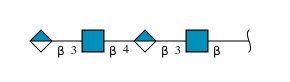
beta-D-glucopyranuronic acid-(1-3)-2-acetamido-2-deoxy-beta-D-glucopyranose-(1-4)-beta-D-glucopyranuronic acid-(1-3)-2-acetamido-2-deoxy-beta-D-glucopyranose
B
4N/A
Glycosylation Resources
GlyTouCan: G48124SB
GlyCosmos: G48124SB
GlyGen: G48124SB

Small Molecules

Ligands 1 Unique
IDChains Name / Formula / InChI Key2D Diagram3D Interactions
SO4

Query on SO4


Download:Ideal Coordinates CCD File
C [auth A]SULFATE ION
O4 S
QAOWNCQODCNURD-UHFFFAOYSA-L

Experimental Data & Validation

Experimental Data

  • Method: X-RAY DIFFRACTION
  • Resolution: 2.55 Å
  • R-Value Free:  0.245 (Depositor), 0.251 (DCC) 
  • R-Value Work:  0.187 (Depositor), 0.192 (DCC) 
  • R-Value Observed: 0.190 (Depositor) 
Space Group: P 1 21 1
Unit Cell:
Length ( Å )Angle ( ˚ )
a = 30.62α = 90
b = 82.28β = 117.92
c = 32.52γ = 90
Software Package:
Software NamePurpose
XSCALEdata scaling
PHASERphasing
REFMACrefinement
PDB_EXTRACTdata extraction
Blu-Icedata collection
XDSdata reduction

Structure Validation

View Full Validation Report


Entry History 

Deposition Data

Revision History  (Full details and data files)

  • Version 1.0: 2014-04-16
    Type: Initial release
  • Version 1.1: 2015-01-28
    Changes: Derived calculations
  • Version 2.0: 2020-07-29
    Type: Remediation
    Reason: Carbohydrate remediation
    Changes: Advisory, Atomic model, Data collection, Derived calculations, Structure summary
  • Version 2.1: 2024-10-16
    Changes: Data collection, Database references, Structure summary