Download Mendeley
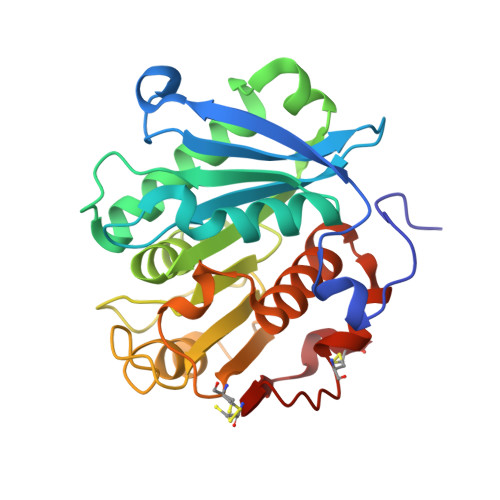
An engineered PET depolymerase to break down and recycle plastic bottles.
Tournier, V., Topham, C.M., Gilles, A., David, B., Folgoas, C., Moya-Leclair, E., Kamionka, E., Desrousseaux, M.L., Texier, H., Gavalda, S., Cot, M., Guemard, E., Dalibey, M., Nomme, J., Cioci, G., Barbe, S., Chateau, M., Andre, I., Duquesne, S., Marty, A.(2020) Nature 580: 216-219
- PubMed: 32269349 Search on PubMed
- DOI: https://doi.org/10.1038/s41586-020-2149-4
- Primary Citation Related Structures:
6THS, 6THT - PubMed Abstract:
Present estimates suggest that of the 359 million tons of plastics produced annually worldwide 1 , 150-200 million tons accumulate in landfill or in the natural environment 2 . Poly(ethylene terephthalate) (PET) is the most abundant polyester plastic, with almost 70 million tons manufactured annually worldwide for use in textiles and packaging 3 . The main recycling process for PET, via thermomechanical means, results in a loss of mechanical properties 4 . Consequently, de novo synthesis is preferred and PET waste continues to accumulate. With a high ratio of aromatic terephthalate units-which reduce chain mobility-PET is a polyester that is extremely difficult to hydrolyse 5 . Several PET hydrolase enzymes have been reported, but show limited productivity 6,7 . Here we describe an improved PET hydrolase that ultimately achieves, over 10 hours, a minimum of 90 per cent PET depolymerization into monomers, with a productivity of 16.7 grams of terephthalate per litre per hour (200 grams per kilogram of PET suspension, with an enzyme concentration of 3 milligrams per gram of PET). This highly efficient, optimized enzyme outperforms all PET hydrolases reported so far, including an enzyme 8,9 from the bacterium Ideonella sakaiensis strain 201-F6 (even assisted by a secondary enzyme 10 ) and related improved variants 11-14 that have attracted recent interest. We also show that biologically recycled PET exhibiting the same properties as petrochemical PET can be produced from enzymatically depolymerized PET waste, before being processed into bottles, thereby contributing towards the concept of a circular PET economy.
- TBI, Université de Toulouse, CNRS, INRAE, INSA, Toulouse, France.
Organizational Affiliation: