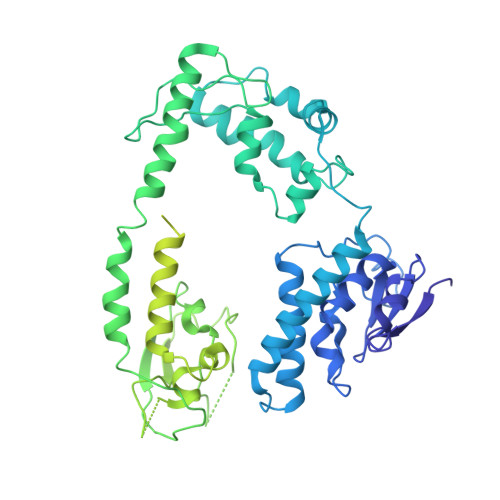
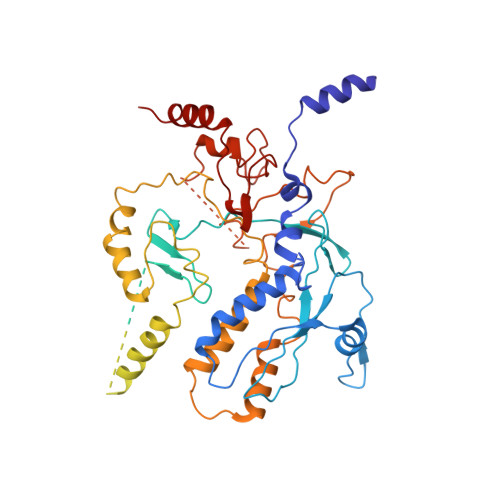
7OGR | pdb_00007ogr

Structure of the apo-state of the bacteriophage PhiKZ non-virion RNA polymerase


Experimental Data Snapshot

  • Method: ELECTRON MICROSCOPY
  • Resolution: 3.00 Å
  • Aggregation State: PARTICLE 
  • Reconstruction Method: SINGLE PARTICLE 

Starting Model: experimental
View more details

wwPDB Validation 3D Report Full Report

Validation slider image for 7OGR

This is version 2.0 of the entry. See complete history

Literature

Structure of the bacteriophage PhiKZ non-virion RNA polymerase.

deYMartin Garrido, N.Orekhova, M.Lai Wan Loong, Y.T.E.Litvinova, A.Ramlaul, K.Artamonova, T.Melnikov, A.S.Serdobintsev, P.Aylett, C.H.S.Yakunina, M.

(2021) Nucleic Acids Res 49: 7732-7739

  • DOI: https://doi.org/10.1093/nar/gkab539
  • Primary Citation Related Structures: 
    7OGP, 7OGR

  • PubMed Abstract: 

    Bacteriophage ΦKZ (PhiKZ) is the archetype of a family of massive bacterial viruses. It is considered to have therapeutic potential as its host, Pseudomonas aeruginosa, is an opportunistic, intrinsically antibiotic resistant, pathogen that kills tens of thousands worldwide each year. ΦKZ is an incredibly interesting virus, expressing many systems that the host already possesses. On infection, it forms a 'nucleus', erecting a barrier around its genome to exclude host endonucleases and CRISPR-Cas systems. ΦKZ infection is independent of the host transcriptional apparatus. It expresses two different multi-subunit RNA polymerases (RNAPs): the virion RNAP (vRNAP) is injected with the viral DNA during infection to transcribe early genes, including those encoding the non-virion RNAP (nvRNAP), which transcribes all further genes. ΦKZ nvRNAP is formed by four polypeptides thought to represent homologues of the eubacterial β/β' subunits, and a fifth with unclear homology, but essential for transcription. We have resolved the structure of ΦKZ nvRNAP to better than 3.0 Å, shedding light on its assembly, homology, and the biological role of the fifth subunit: it is an embedded, integral member of the complex, the position, structural homology and biochemical role of which imply that it has evolved from an ancestral homologue to σ-factor.


  • Organizational Affiliation
    • Section for Structural and Synthetic Biology, Department of Infectious Disease, Imperial College London, London, UK.

Macromolecule Content 

  • Total Structure Weight: 339.46 kDa 
  • Atom Count: 14,135 
  • Modeled Residue Count: 1,775 
  • Deposited Residue Count: 2,981 
  • Unique protein chains: 6

Macromolecules

Find similar proteins by:|  3D Structure
Entity ID: 1
MoleculeChains  Sequence LengthOrganismDetailsImage
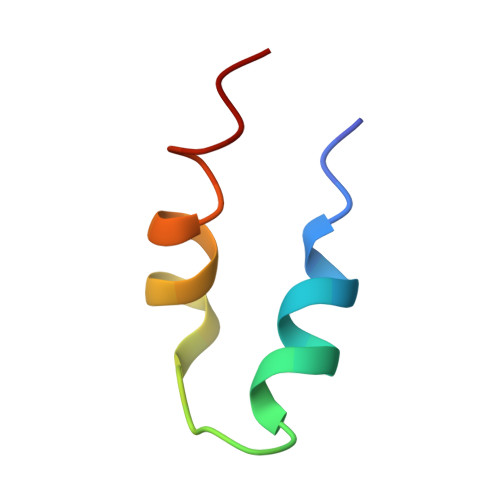
UNK helicesA [auth X]32Pseudomonas phage phiKZMutation(s): 0 
Find similar proteins by:|  3D Structure
Entity ID: 2
MoleculeChains  Sequence LengthOrganismDetailsImage
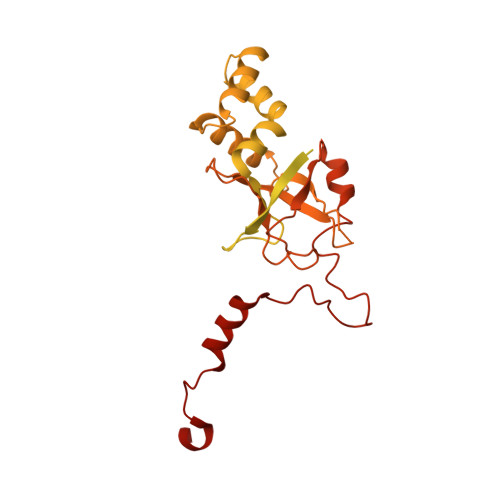
PHIKZ055B [auth A]508Pseudomonas phage phiKZMutation(s): 0 
UniProt
Find proteins for L7T138 (Pseudomonas phage phiKZ)
Explore L7T138 
Go to UniProtKB:  L7T138
Find proteins for Q8SDA7 (Pseudomonas phage phiKZ)
Explore Q8SDA7 
Go to UniProtKB:  Q8SDA7
Entity Groups
Sequence Clusters30% Identity50% Identity70% Identity90% Identity95% Identity100% Identity
UniProt GroupsL7T138Q8SDA7
Sequence Annotations
Expand
Reference Sequence
Find similar proteins by:|  3D Structure
Entity ID: 3
MoleculeChains  Sequence LengthOrganismDetailsImage
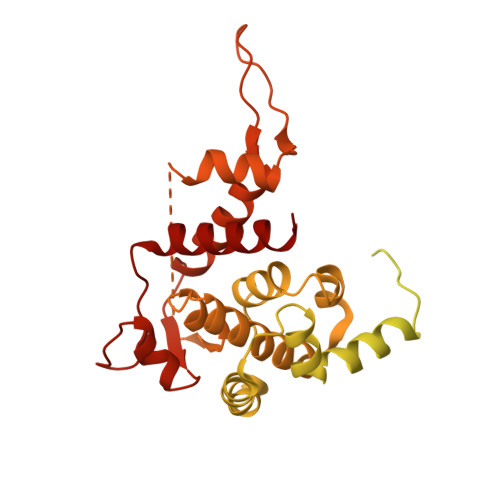
PHIKZ068C [auth B]521Pseudomonas phage phiKZMutation(s): 1 
UniProt
Find proteins for Q8SD94 (Pseudomonas phage phiKZ)
Explore Q8SD94 
Go to UniProtKB:  Q8SD94
Entity Groups
Sequence Clusters30% Identity50% Identity70% Identity90% Identity95% Identity100% Identity
UniProt GroupQ8SD94
Sequence Annotations
Expand
Reference Sequence
Find similar proteins by:|  3D Structure
Entity ID: 4
MoleculeChains  Sequence LengthOrganismDetailsImage
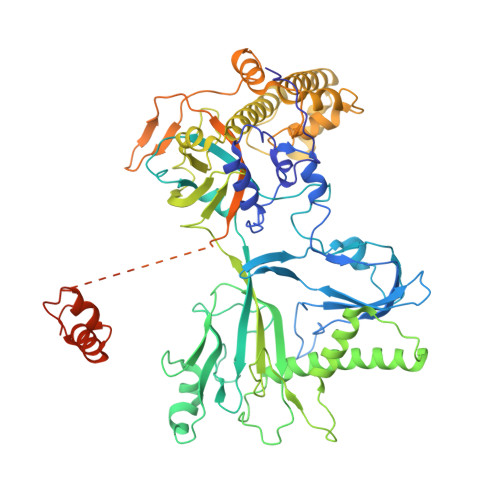
DNA-directed RNA polymeraseD [auth C]700Pseudomonas phage phiKZMutation(s): 0 
EC: 2.7.7.6
UniProt
Find proteins for I7DB36 (Pseudomonas phage PA7)
Explore I7DB36 
Go to UniProtKB:  I7DB36
Find proteins for Q8SD91 (Pseudomonas phage phiKZ)
Explore Q8SD91 
Go to UniProtKB:  Q8SD91
Entity Groups
Sequence Clusters30% Identity50% Identity70% Identity90% Identity95% Identity100% Identity
UniProt GroupsI7DB36Q8SD91
Sequence Annotations
Expand
Reference Sequence
Find similar proteins by:|  3D Structure
Entity ID: 5
MoleculeChains  Sequence LengthOrganismDetailsImage
PHIKZ074E [auth D]677Pseudomonas phage phiKZMutation(s): 0 
UniProt
Find proteins for Q8SD88 (Pseudomonas phage phiKZ)
Explore Q8SD88 
Go to UniProtKB:  Q8SD88
Entity Groups
Sequence Clusters30% Identity50% Identity70% Identity90% Identity95% Identity100% Identity
UniProt GroupQ8SD88
Sequence Annotations
Expand
Reference Sequence
Find similar proteins by:|  3D Structure
Entity ID: 6
MoleculeChains  Sequence LengthOrganismDetailsImage
PHIKZ123F [auth E]543Pseudomonas phage phiKZMutation(s): 1 
UniProt
Find proteins for Q8SD39 (Pseudomonas phage phiKZ)
Explore Q8SD39 
Go to UniProtKB:  Q8SD39
Entity Groups
Sequence Clusters30% Identity50% Identity70% Identity90% Identity95% Identity100% Identity
UniProt GroupQ8SD39
Sequence Annotations
Expand
Reference Sequence

Small Molecules

Ligands 1 Unique
IDChains Name / Formula / InChI Key2D Diagram3D Interactions
ZN

Query on ZN


Download:Ideal Coordinates CCD File
G [auth D]ZINC ION
Zn
PTFCDOFLOPIGGS-UHFFFAOYSA-N

Experimental Data & Validation

Experimental Data

  • Method: ELECTRON MICROSCOPY
  • Resolution: 3.00 Å
  • Aggregation State: PARTICLE 
  • Reconstruction Method: SINGLE PARTICLE 
EM Software:
TaskSoftware PackageVersion
MODEL REFINEMENTPHENIX
RECONSTRUCTIONRELION3

Structure Validation

View Full Validation Report


Entry History 

& Funding Information

Deposition Data


Funding OrganizationLocationGrant Number
Wellcome TrustUnited Kingdom206212/Z/17/Z
Russian Science FoundationRussian Federation19-74-10030

Revision History  (Full details and data files)

  • Version 1.0: 2021-07-07
    Type: Initial release
  • Version 1.1: 2021-07-28
    Changes: Database references
  • Version 2.0: 2023-11-22
    Changes: Advisory, Atomic model, Data collection, Database references, Derived calculations, Non-polymer description, Polymer sequence, Refinement description, Source and taxonomy, Structure summary