Download Mendeley
Redox Engineering of Myoglobin by Cofactor Substitution to Enhance Cyclopropanation Reactivity.
Kagawa, Y., Oohora, K., Himiyama, T., Suzuki, A., Hayashi, T.(2024) Angew Chem Int Ed Engl 63: e202403485-e202403485
- PubMed: 38780472 Search on PubMed
- DOI: https://doi.org/10.1002/anie.202403485
- Primary Citation Related Structures:
8WF5 - PubMed Abstract:
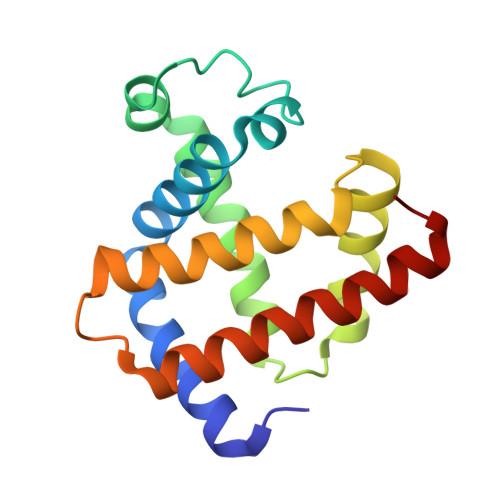
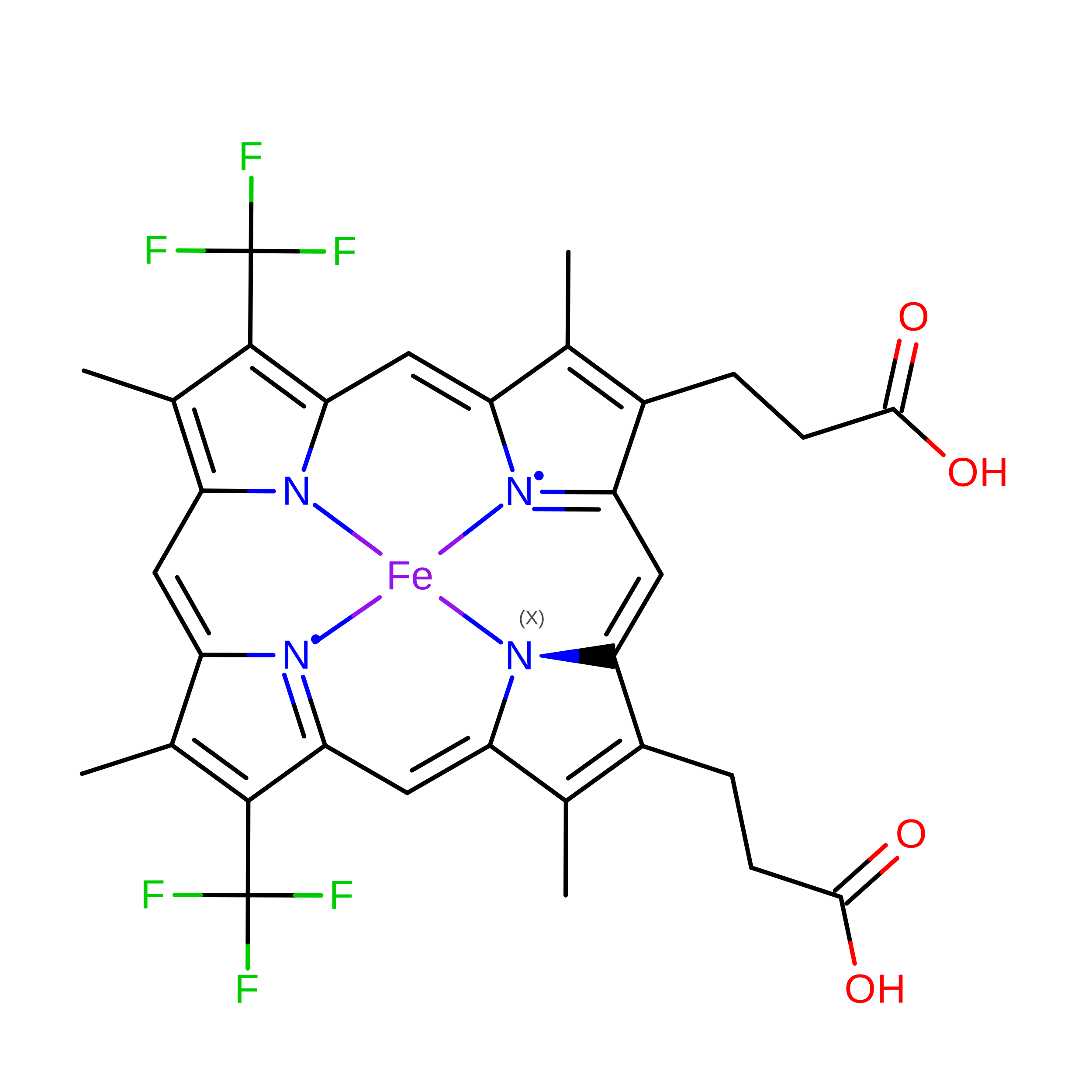
Design of metal cofactor ligands is essential for controlling the reactivity of metalloenzymes. We investigated a carbene transfer reaction catalyzed by myoglobins containing iron porphyrin cofactors with one and two trifluoromethyl groups at peripheral sites (FePorCF 3 and FePor(CF 3 ) 2 , respectively), native heme and iron porphycene (FePc). These four myoglobins show a wide range of Fe(II)/Fe(III) redox potentials in the protein of +147 mV, +87 mV, +42 mV and -198 mV vs. NHE, respectively. Myoglobin reconstituted with FePor(CF 3 ) 2 has a more positive potential, which enhances the reactivity of a carbene intermediate with alkenes, and demonstrates superior cyclopropanation of inert alkenes, such as aliphatic and internal alkenes. In contrast, engineered myoglobin reconstituted with FePc has a more negative redox potential, which accelerates the formation of the intermediate, but has low reactivity for inert alkenes. Mechanistic studies indicate that myoglobin with FePor(CF 3 ) 2 generates an undetectable active intermediate with a radical character. In contrast, this reaction catalyzed by myoglobin with FePc includes a detectable iron-carbene species with electrophilic character. This finding highlights the importance of redox-focused design of the iron porphyrinoid cofactor in hemoproteins to tune the reactivity of the carbene transfer reaction.
- Department of Applied Chemistry, Graduate School of Engineering, Osaka University, Suita, Osaka, 565-0871, Japan.
Organizational Affiliation: