Download Mendeley
Engineered aldehyde dehydrogenases for amide bond formation.
Gao, L., Qiu, X., Yang, J., Hu, K., Li, P., Li, W., Gao, F., Gallou, F., Kleinbeck, F., Lei, X.(2026) Science 391: eadw3365-eadw3365
- PubMed: 41610224 Search on PubMed
- DOI: https://doi.org/10.1126/science.adw3365
- Primary Citation Related Structures:
9JEM, 9JEP, 9JV6, 9JVK, 9JVL, 9JVS, 9JVY, 9JW2 - PubMed Abstract:
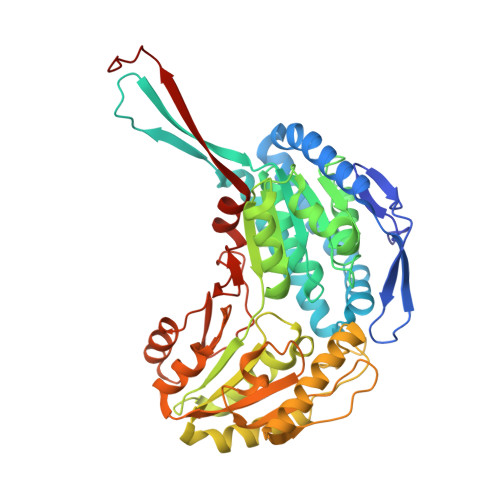
Amide bond formation is widely used in pharmaceutical synthesis, typically involving stoichiometric coupling reagents to activate carboxylic acid substrates for a condensation reaction. As an alternative approach, we repurposed aldehyde dehydrogenases into oxidative amidases by creating a more hydrophobic and spacious catalytic pocket for amines to capture the thioester intermediate. This biocatalyst efficiently facilitates the formation of amide bonds between diverse aldehydes and amines. We also developed a two-step enzymatic cascade to synthesize amides from broadly available aliphatic alcohols. This biocatalytic strategy enabled the redesign of synthetic routes for five drug molecules. Our findings highlight the potential of oxidative amidases in advancing the synthesis of structurally diverse drug molecules through efficient amide bond formation.
- Beijing National Laboratory for Molecular Sciences, Key Laboratory of Bioorganic Chemistry and Molecular Engineering of the Ministry of Education, College of Chemistry and Molecular Engineering, New Cornerstone Science Laboratory, Peking University, Beijing, China.
Organizational Affiliation: