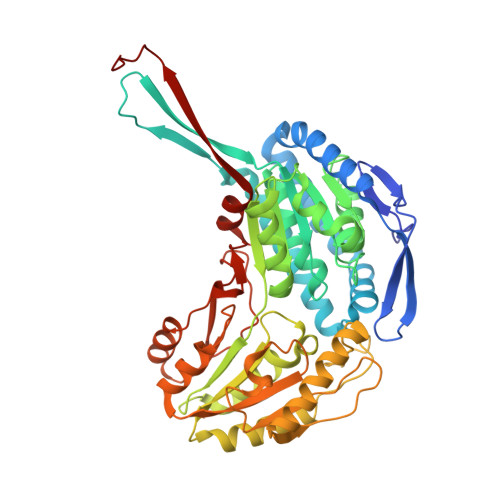
9JVL | pdb_00009jvl

Co-crystal structure of PHBDD-M1-L163G-T234A with N-cyclopropyl-4-methylbenzamide


Experimental Data Snapshot

  • Method: X-RAY DIFFRACTION
  • Resolution: 2.10 Å
  • R-Value Free: 
    0.221 (Depositor), 0.221 (DCC) 
  • R-Value Work: 
    0.180 (Depositor), 0.180 (DCC) 
  • R-Value Observed: 
    0.180 (Depositor) 

Starting Model: in silico
View more details

wwPDB Validation   3D Report Full Report


Ligand Structure Quality Assessment 


This is version 1.2 of the entry. See complete history


Literature

Engineered aldehyde dehydrogenases for amide bond formation.

Gao, L.Qiu, X.Yang, J.Hu, K.Li, P.Li, W.Gao, F.Gallou, F.Kleinbeck, F.Lei, X.

(2026) Science 391: eadw3365-eadw3365

  • DOI: https://doi.org/10.1126/science.adw3365
  • Primary Citation of Related Structures:  
    9JEM, 9JEP, 9JV6, 9JVK, 9JVL, 9JVS, 9JVY, 9JW2

  • PubMed Abstract: 

    Amide bond formation is widely used in pharmaceutical synthesis, typically involving stoichiometric coupling reagents to activate carboxylic acid substrates for a condensation reaction. As an alternative approach, we repurposed aldehyde dehydrogenases into oxidative amidases by creating a more hydrophobic and spacious catalytic pocket for amines to capture the thioester intermediate. This biocatalyst efficiently facilitates the formation of amide bonds between diverse aldehydes and amines. We also developed a two-step enzymatic cascade to synthesize amides from broadly available aliphatic alcohols. This biocatalytic strategy enabled the redesign of synthetic routes for five drug molecules. Our findings highlight the potential of oxidative amidases in advancing the synthesis of structurally diverse drug molecules through efficient amide bond formation.


  • Organizational Affiliation
    • Beijing National Laboratory for Molecular Sciences, Key Laboratory of Bioorganic Chemistry and Molecular Engineering of the Ministry of Education, College of Chemistry and Molecular Engineering, New Cornerstone Science Laboratory, Peking University, Beijing, China.

Macromolecules
Find similar proteins by:  (by identity cutoff)  |  3D Structure
Entity ID: 1
MoleculeChains Sequence LengthOrganismDetailsImage
4-hydroxybenzaldehyde dehydrogenase (NADP(+))
A, B, C, D
493Pseudomonas putidaMutation(s): 2 
Gene Names: pchA
EC: 1.2.1.96
UniProt
Find proteins for Q59702 (Pseudomonas putida)
Explore Q59702 
Go to UniProtKB:  Q59702
Entity Groups  
Sequence Clusters30% Identity50% Identity70% Identity90% Identity95% Identity100% Identity
UniProt GroupQ59702
Sequence Annotations
Expand
  • Reference Sequence
Experimental Data & Validation

Experimental Data

  • Method: X-RAY DIFFRACTION
  • Resolution: 2.10 Å
  • R-Value Free:  0.221 (Depositor), 0.221 (DCC) 
  • R-Value Work:  0.180 (Depositor), 0.180 (DCC) 
  • R-Value Observed: 0.180 (Depositor) 
Space Group: P 1 21 1
Unit Cell:
Length ( Å )Angle ( ˚ )
a = 90.254α = 90
b = 124.895β = 105.69
c = 90.678γ = 90
Software Package:
Software NamePurpose
PHENIXrefinement
HKL-3000data scaling
PHENIXphasing
HKL-3000data reduction

Structure Validation

View Full Validation Report


Ligand Structure Quality Assessment 


Entry History & Funding Information

Deposition Data


Funding OrganizationLocationGrant Number
National Natural Science Foundation of China (NSFC)China--

Revision History  (Full details and data files)

  • Version 1.0: 2026-01-14
    Type: Initial release
  • Version 1.1: 2026-02-18
    Changes: Database references
  • Version 1.2: 2026-03-04
    Changes: Database references