Download Mendeley
MHC restriction is structurally encoded by the T cell receptor germline.
Wang, N., Borowska, M.T., Jude, K.M., Chen, X., Wang, C., Xiang, X., Liu, L.D., Ma, R., Motiani, A., Wilson, S.C., Liu, W., Garcia, K.C.(2026) bioRxiv
- PubMed: 42856299 Search on PubMedSearch on PubMed Central
- DOI: https://doi.org/10.64898/2026.09.24.754241
- PubMed Abstract:
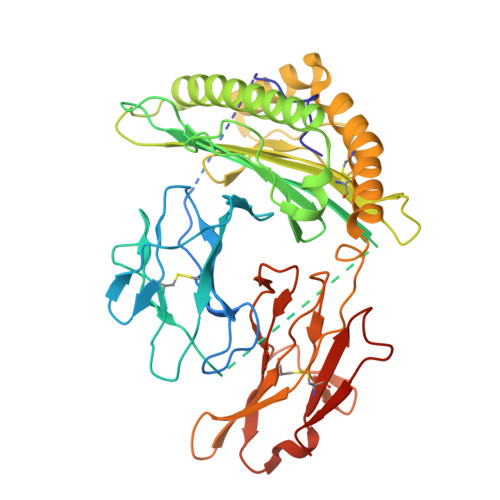
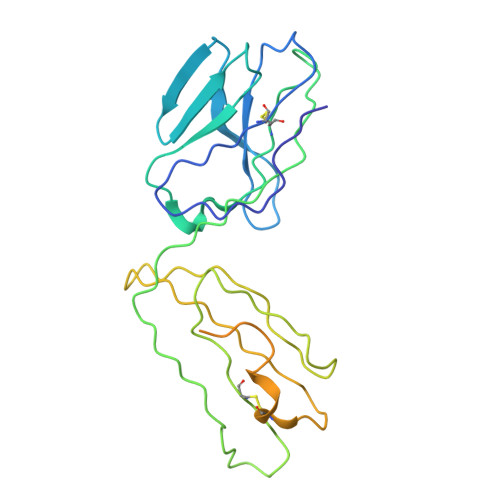
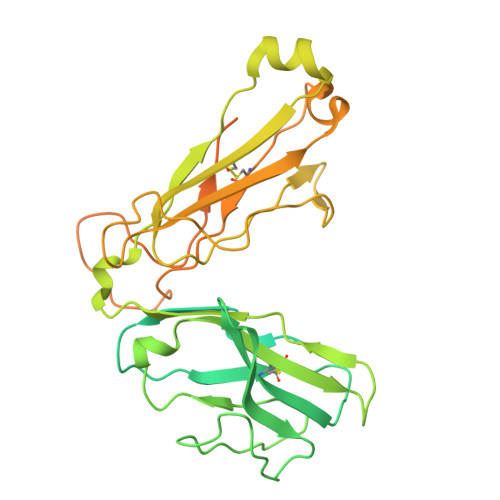
MHC restriction - the requirement for αβ T cell receptors (TCRs) to recognize Major Histocompatibility Complex (MHC) molecules when presenting peptide antigens - is a pillar of adaptive immunity. Here, we provide direct structural evidence for TCR germline-encoded recognition of MHC molecules irrespective of antigenic peptide. We engineered "germline-like" TCRs to eliminate CDR3 specificity for peptide, and a molecular clamping strategy to trap ultra-low-affinity complexes with peptide-MHC for cryo-EM. We find that germline-like TCR/pMHC docking modes are identical to wild-type T cell receptors with intact CDR3 loops, across distinct peptide antigens and MHC alleles. Analysis of human TCR repertoires reveals enrichment of specific V genes and Vα-Vβ pairing patterns associated with HLA-A*02 contexts. Thus, the TCR germline encodes the blueprint for MHC restriction, providing a sequence-based framework that could inform computational and AI-driven prediction of TCR specificity.
- Department of Molecular and Cellular Physiology, Stanford University School of Medicine, Stanford, CA, USA.
Organizational Affiliation: