Download Mendeley
Chemical Editing Reveals Atomic-Level Control of Supramolecular Structure in Self-Assembling Peptides.
Das, A., Zia, A., Eastep, G.N., Wang, F., Conticello, V.P.(2026) J Am Chem Soc 148: 40186-40197
- PubMed: 42938080 Search on PubMedSearch on PubMed Central
- DOI: https://doi.org/10.1021/jacs.6c11510
- Primary Citation Related Structures:
13FM, 13MF - PubMed Abstract:
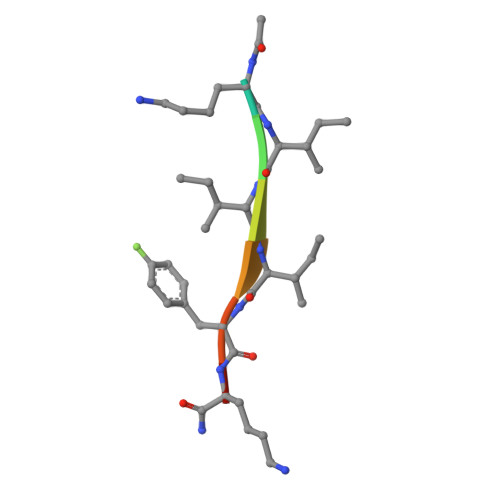
Can replacement of single atoms within amino acid sequences redirect peptide self-assembly into different supramolecular structures? To address this question, we investigated a compositionally similar class of bola-amphiphilic peptides that were designed to self-assemble into filamentous nanostructures. The chemical differences between these peptides were confined to minimally perturbative substitutions on a phenylalanine side chain at a single site within the sequence. Cryo-EM structural analysis of five peptide filaments at near-atomic resolution revealed the presence of distinct supramolecular architectures between the different peptides. Despite sharing a common cross-β framework, the filament structures displayed distinct helical symmetries, protofilament organizations, and steric zipper interfaces. We hypothesize that the observed structural divergence between filaments arises from subtle changes in side-chain polarity and solvent interactions that remodel peptide packing at structural interfaces within cross-sectional amyloid layers. These findings demonstrate that the supramolecular structural landscape of self-assembling peptides is sensitive to atomic-level substitution and suggest that chemical editing provides a strategy for interrogating and potentially controlling biomolecular assembly. These results further highlight a fundamental limitation in the predictive design of peptide-based materials in that subtle chemical modifications in local composition can produce disproportionate changes in higher-order structure.
- Department of Chemistry, Emory University, Atlanta, Georgia30322, United States.
Organizational Affiliation: