1A40 | pdb_00001a40

PHOSPHATE-BINDING PROTEIN WITH ALA 197 REPLACED WITH TRP


Experimental Data Snapshot

  • Method: X-RAY DIFFRACTION
  • Resolution: 1.70 Å
  • R-Value Free: 
    0.269 (Depositor) 
  • R-Value Work: 
    0.203 (Depositor), 0.194 (DCC) 
  • R-Value Observed: 
    0.203 (Depositor) 

Starting Model: experimental
View more details

wwPDB Validation 3D Report Full Report

Validation slider image for 1A40

This is version 1.5 of the entry. See complete history

Literature

Dominant role of local dipolar interactions in phosphate binding to a receptor cleft with an electronegative charge surface: equilibrium, kinetic, and crystallographic studies.

Ledvina, P.S.Tsai, A.L.Wang, Z.Koehl, E.Quiocho, F.A.

(1998) Protein Sci 7: 2550-2559

  • DOI: https://doi.org/10.1002/pro.5560071208
  • Primary Citation Related Structures: 
    1A40

  • PubMed Abstract: 

    Stringent specificity and complementarity between the receptor, a periplasmic phosphate-binding protein (PBP) with a two-domain structure, and the completely buried and dehydrated phosphate are achieved by hydrogen bonding or dipolar interactions. We recently found that the surface charge potential of the cleft between the two domains that contains the anion binding site is intensely electronegative. This novel finding prompted the study reported here of the effect of ionic strength on the equilibrium and rapid kinetics of phosphate binding. To facilitate this study, Ala197, located on the edge of the cleft, was replaced by a Trp residue (A197W PBP) to generate a fluorescence reporter group. The A197W PBP-phosphate complex retains wild-type Kd and X-ray structure beyond the replacement residue. The Kd (0.18 microM) at no salt is increased by 20-fold at greater than 0.30 M NaCl. Stopped-flow fluorescence kinetic studies indicate a two-step binding process: (1) The phosphate (L) binds, at near diffusion-controlled rate, to the open cleft form (Po) of PBP to produce an intermediate, PoL. This rate decreases with increasing ionic strength. (2) The intermediate isomerizes to the closed-conformation form, PcL. The results indicate that the high specificity, affinity, and rate of phosphate binding are not influenced by the noncomplementary electronegative surface potential of the cleft. That binding depends almost entirely on local dipolar interactions with the receptor has important ramification in electrostatic interactions in protein structures and in ligand recognition.


  • Organizational Affiliation
    • Howard Hughes Medical Institute, Baylor College of Medicine, Houston, Texas 77030, USA.

Macromolecule Content 

  • Total Structure Weight: 34.67 kDa 
  • Atom Count: 2,862 
  • Modeled Residue Count: 321 
  • Deposited Residue Count: 321 
  • Unique protein chains: 1

Macromolecules

Find similar proteins by:|  3D Structure
Entity ID: 1
MoleculeChains  Sequence LengthOrganismDetailsImage
PHOSPHATE-BINDING PERIPLASMIC PROTEIN PRECURSOR321Escherichia coliMutation(s): 1 
UniProt
Find proteins for P0AG82 (Escherichia coli (strain K12))
Explore P0AG82 
Go to UniProtKB:  P0AG82
Entity Groups
Sequence Clusters30% Identity50% Identity70% Identity90% Identity95% Identity100% Identity
UniProt GroupP0AG82
Sequence Annotations
Expand
Reference Sequence

Small Molecules

Ligands 1 Unique
IDChains Name / Formula / InChI Key2D Diagram3D Interactions
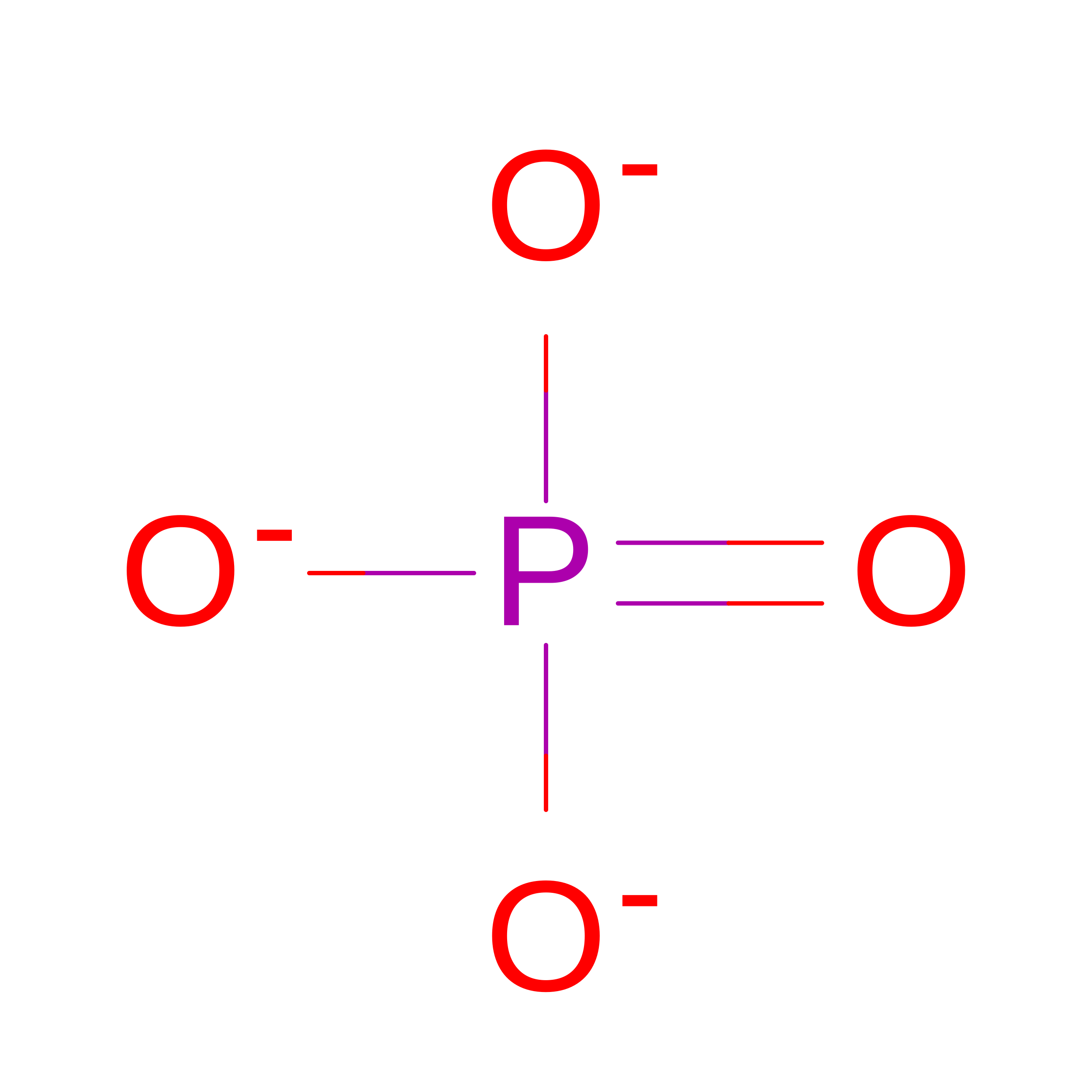
PO4

Query on PO4


Download:Ideal Coordinates CCD File
B [auth A]PHOSPHATE ION
O4 P
NBIIXXVUZAFLBC-UHFFFAOYSA-K

Experimental Data & Validation

Experimental Data

  • Method: X-RAY DIFFRACTION
  • Resolution: 1.70 Å
  • R-Value Free:  0.269 (Depositor) 
  • R-Value Work:  0.203 (Depositor), 0.194 (DCC) 
  • R-Value Observed: 0.203 (Depositor) 
Space Group: P 21 21 21
Unit Cell:
Length ( Å )Angle ( ˚ )
a = 41.41α = 90
b = 62.76β = 90
c = 122.73γ = 90
Software Package:
Software NamePurpose
X-PLORmodel building
X-PLORrefinement
DENZOdata reduction
SCALEPACKdata scaling
X-PLORphasing

Structure Validation

View Full Validation Report


Entry History 

Deposition Data

Revision History  (Full details and data files)

  • Version 1.0: 1999-03-23
    Type: Initial release
  • Version 1.1: 2008-03-24
    Changes: Version format compliance
  • Version 1.2: 2011-07-13
    Changes: Version format compliance
  • Version 1.3: 2021-11-03
    Changes: Database references, Derived calculations, Other
  • Version 1.4: 2023-08-02
    Changes: Refinement description
  • Version 1.5: 2024-05-22
    Changes: Data collection