1AC5 | pdb_00001ac5

CRYSTAL STRUCTURE OF KEX1(DELTA)P, A PROHORMONE-PROCESSING CARBOXYPEPTIDASE FROM SACCHAROMYCES CEREVISIAE


Experimental Data Snapshot

  • Method: X-RAY DIFFRACTION
  • Resolution: 2.40 Å
  • R-Value Free: 
    0.250 (Depositor), 0.247 (DCC) 
  • R-Value Work: 
    0.195 (Depositor), 0.200 (DCC) 
  • R-Value Observed: 
    0.195 (Depositor) 

Starting Model: experimental
View more details

wwPDB Validation 3D Report Full Report

Validation slider image for 1AC5

Ligand Structure Quality Assessment 


This is version 2.2 of the entry. See complete history

Literature

Crystal structure of Kex1deltap, a prohormone-processing carboxypeptidase from Saccharomyces cerevisiae.

Shilton, B.H.Thomas, D.Y.Cygler, M.

(1997) Biochemistry 36: 9002-9012

  • DOI: https://doi.org/10.1021/bi970433n
  • Primary Citation Related Structures: 
    1AC5

  • PubMed Abstract: 

    Kex1p is a prohormone-processing serine carboxypeptidase found in Saccharomyces cerevisiae. In contrast to yeast serine carboxypeptidase (CPD-Y) and wheat serine carboxypeptidase II (CPDW-II), Kex1p displays a very narrow specificity for lysyl or arginyl residues at the C-terminus of the substrate. The structure of Kex1Deltap, an enzyme that lacks the acidic domain and membrane-spanning portion of Kex1p, has been solved by a combination of molecular replacement and multiple isomorphous replacement and refined to a resolution of 2.4 A. The S1' site of Kex1Deltap is sterically restricted compared to those from CPD-Y or CPDW-II; it also contains two acidic groups that are well positioned to interact with the basic group of a lysine or arginine side chain. The high specificity of Kex1p can therefore be explained by a combination of steric and electronic factors. The structure of the S1 site of Kex1Deltap is also well suited for binding of a lysine or arginine side chain, and the enzyme may therefore exhibit a preference for these residues at P1.


  • Organizational Affiliation
    • Biotechnology Research Institute, National Research Council, 6100 Royalmount Avenue, Montréal, Québec H4P 2R2, Canada.

Macromolecule Content 

  • Total Structure Weight: 54.92 kDa 
  • Atom Count: 4,057 
  • Modeled Residue Count: 483 
  • Deposited Residue Count: 483 
  • Unique protein chains: 1

Macromolecules

Find similar proteins by:|  3D Structure
Entity ID: 1
MoleculeChains  Sequence LengthOrganismDetailsImage
KEX1(DELTA)P483Saccharomyces cerevisiaeMutation(s): 0 
EC: 3.4.16.6
UniProt
Find proteins for P09620 (Saccharomyces cerevisiae (strain ATCC 204508 / S288c))
Explore P09620 
Go to UniProtKB:  P09620
Entity Groups
Sequence Clusters30% Identity50% Identity70% Identity90% Identity95% Identity100% Identity
UniProt GroupP09620
Glycosylation
Glycosylation Sites: 2Go to GlyGen: P09620-1
Sequence Annotations
Expand
Reference Sequence

Oligosaccharides

Help  
Entity ID: 2
MoleculeChains Length2D Diagram GlycosylationD Interactions
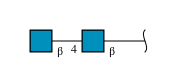
2-acetamido-2-deoxy-beta-D-glucopyranose-(1-4)-2-acetamido-2-deoxy-beta-D-glucopyranose
B
2N-Glycosylation
Glycosylation Resources
GlyTouCan: G42666HT
GlyCosmos: G42666HT
GlyGen: G42666HT

Small Molecules

Ligands 1 Unique
IDChains Name / Formula / InChI Key2D Diagram3D Interactions
NAG

Query on NAG


Download:Ideal Coordinates CCD File
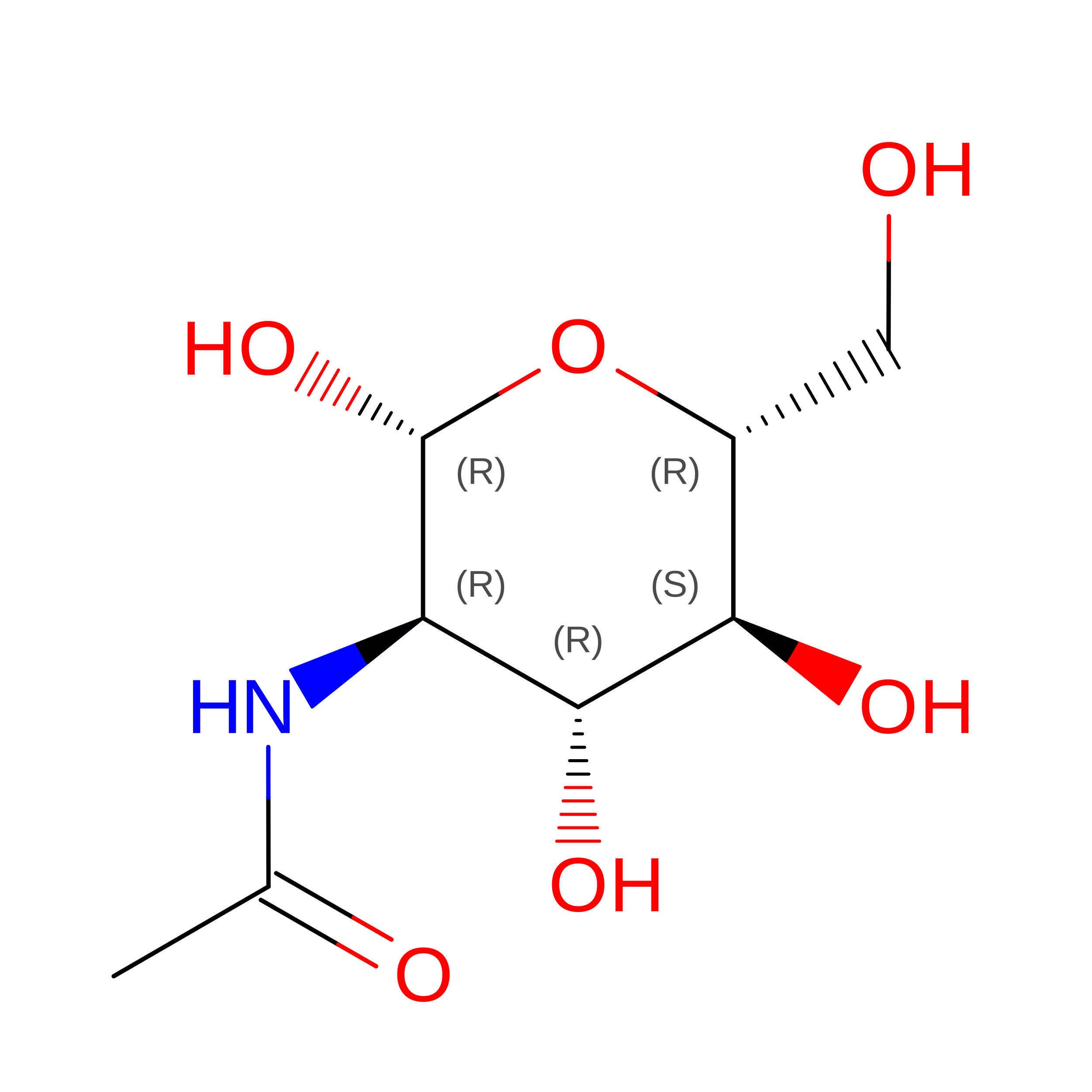
C [auth A]2-acetamido-2-deoxy-beta-D-glucopyranose
C8 H15 N O6
OVRNDRQMDRJTHS-FMDGEEDCSA-N

Experimental Data & Validation

Experimental Data

  • Method: X-RAY DIFFRACTION
  • Resolution: 2.40 Å
  • R-Value Free:  0.250 (Depositor), 0.247 (DCC) 
  • R-Value Work:  0.195 (Depositor), 0.200 (DCC) 
  • R-Value Observed: 0.195 (Depositor) 
Space Group: P 21 21 21
Unit Cell:
Length ( Å )Angle ( ˚ )
a = 57.15α = 90
b = 83.05β = 90
c = 111.11γ = 90
Software Package:
Software NamePurpose
DENZOdata reduction
SCALEPACKdata scaling
X-PLORmodel building
X-PLORrefinement
X-PLORphasing

Structure Validation

View Full Validation Report


Ligand Structure Quality Assessment 


Entry History 

Deposition Data

Revision History  (Full details and data files)

  • Version 1.0: 1997-05-15
    Type: Initial release
  • Version 1.1: 2008-03-04
    Changes: Version format compliance
  • Version 1.2: 2011-07-13
    Changes: Non-polymer description, Version format compliance
  • Version 2.0: 2020-07-29
    Type: Remediation
    Reason: Carbohydrate remediation
    Changes: Atomic model, Data collection, Derived calculations, Structure summary
  • Version 2.1: 2023-08-02
    Changes: Database references, Refinement description, Structure summary
  • Version 2.2: 2024-10-23
    Changes: Data collection, Structure summary