1E3D | pdb_00001e3d

[NiFe] Hydrogenase from Desulfovibrio desulfuricans ATCC 27774


Experimental Data Snapshot

  • Method: X-RAY DIFFRACTION
  • Resolution: 1.80 Å
  • R-Value Free: 
    0.223 (Depositor) 
  • R-Value Work: 
    0.158 (DCC) 
  • R-Value Observed: 
    0.167 (Depositor) 

Starting Model: experimental
View more details

wwPDB Validation 3D Report Full Report

Validation slider image for 1E3D

This is version 2.3 of the entry. See complete history

Literature

[Nife] Hydrogenase from Desulfovibrio Desulfuricans Atcc 27774: Gene Sequencing, Three-Dimensional Structure Determination and Refinement at 1.8 A and Modelling Studies of its Interaction with the Tetrahaem Cytochrome C3.

Matias, P.M.Soares, C.M.Saraiva, L.M.Coelho, R.Morais, J.Le Gall, J.Carrondo, M.A.

(2001) J Biol Inorg Chem 6: 63-81

  • DOI: https://doi.org/10.1007/s007750000167
  • Primary Citation Related Structures: 
    1E3D

  • PubMed Abstract: 

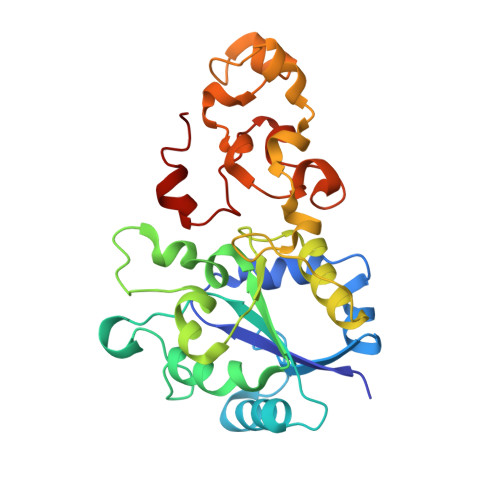
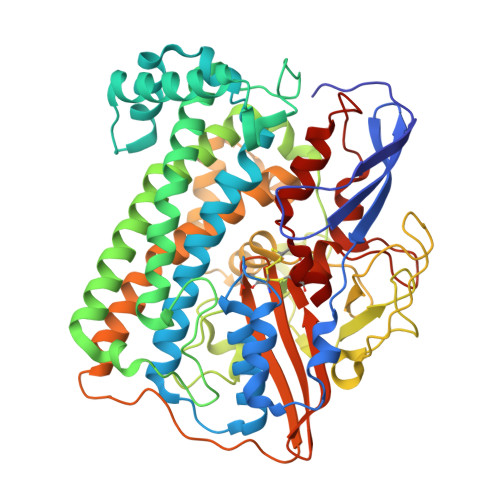
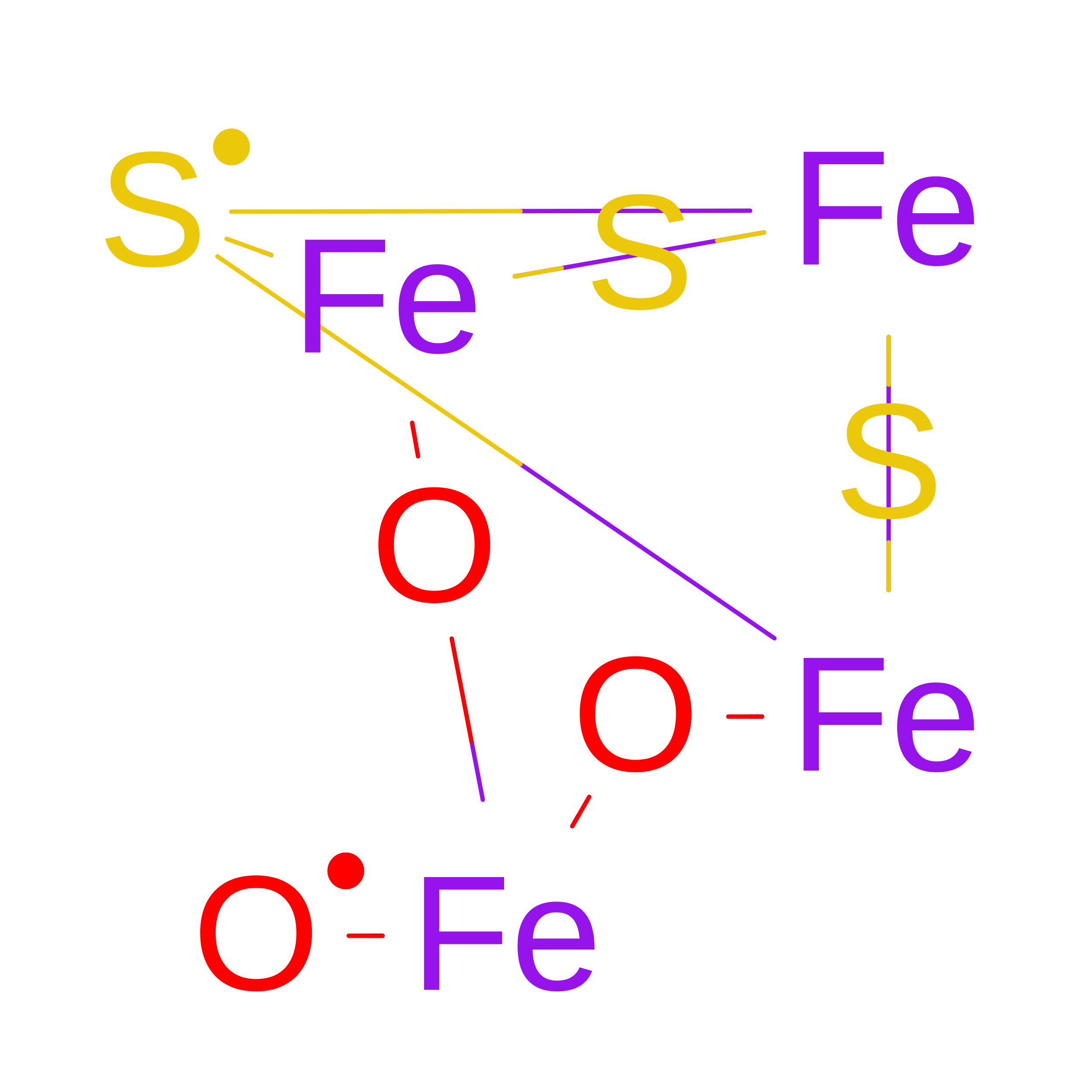
    The primary and three-dimensional structures of a [NiFe] hydrogenase isolated from D. desulfitricans ATCC 27774 were determined, by nucleotide analysis and single-crystal X-ray crystallography. The three-dimensional structural model was refined to R=0.167 and Rfree=0.223 using data to 1.8 A resolution. Two unique structural features are observed: the [4Fe-4S] cluster nearest the [NiFe] centre has been modified [4Fe-3S-3O] by loss of one sulfur atom and inclusion of three oxygen atoms; a three-fold disorder was observed for Cys536 which binds to the nickel atom in the [NiFe] centre. Also, the bridging sulfur atom that caps the active site was found to have partial occupancy, thus corresponding to a partly activated enzyme. These structural features may have biological relevance. In particular, the two less-populated rotamers of Cys536 may be involved in the activation process of the enzyme, as well as in the catalytic cycle. Molecular modelling studies were carried out on the interaction between this [NiFe] hydrogenase and its physiological partner, the tetrahaem cytochrome c3 from the same organism. The lowest energy docking solutions were found to correspond to an interaction between the haem IV region in tetrahaem cytochrome c3 with the distal [4Fe-4S] cluster in [NiFe] hydrogenase. This interaction should correspond to efficient electron transfer and be physiologically relevant, given the proximity of the two redox centres and the fact that electron transfer decay coupling calculations show high coupling values and a short electron transfer pathway. On the other hand, other docking solutions have been found that, despite showing low electron transfer efficiency, may give clues on possible proton transfer mechanisms between the two molecules.


  • Organizational Affiliation
    • Instituto de Tecnologia Química e Biológica, Universidade Nova de Lisboa, Oeiras, Portugal.

Macromolecule Content 

  • Total Structure Weight: 180.06 kDa 
  • Atom Count: 13,845 
  • Modeled Residue Count: 1,598 
  • Deposited Residue Count: 1,616 
  • Unique protein chains: 2

Macromolecules

Find similar proteins by:|  3D Structure
Entity ID: 1
MoleculeChains  Sequence LengthOrganismDetailsImage
[NiFe] hydrogenase small subunit
A, C
266Desulfovibrio desulfuricansMutation(s): 0 
EC: 1.12.2.1
UniProt
Find proteins for Q9L869 (Desulfovibrio desulfuricans)
Explore Q9L869 
Go to UniProtKB:  Q9L869
Entity Groups
Sequence Clusters30% Identity50% Identity70% Identity90% Identity95% Identity100% Identity
UniProt GroupQ9L869
Sequence Annotations
Expand
Reference Sequence
Find similar proteins by:|  3D Structure
Entity ID: 2
MoleculeChains  Sequence LengthOrganismDetailsImage
[NiFe] hydrogenase large subunit
B, D
542Desulfovibrio desulfuricansMutation(s): 0 
EC: 1.12.2.1
UniProt
Find proteins for Q9L868 (Desulfovibrio desulfuricans)
Explore Q9L868 
Go to UniProtKB:  Q9L868
Entity Groups
Sequence Clusters30% Identity50% Identity70% Identity90% Identity95% Identity100% Identity
UniProt GroupQ9L868
Sequence Annotations
Expand
Reference Sequence

Small Molecules

Ligands 6 Unique
IDChains Name / Formula / InChI Key2D Diagram3D Interactions
FSX

Query on FSX


Download:Ideal Coordinates CCD File
G [auth A],
N [auth C]
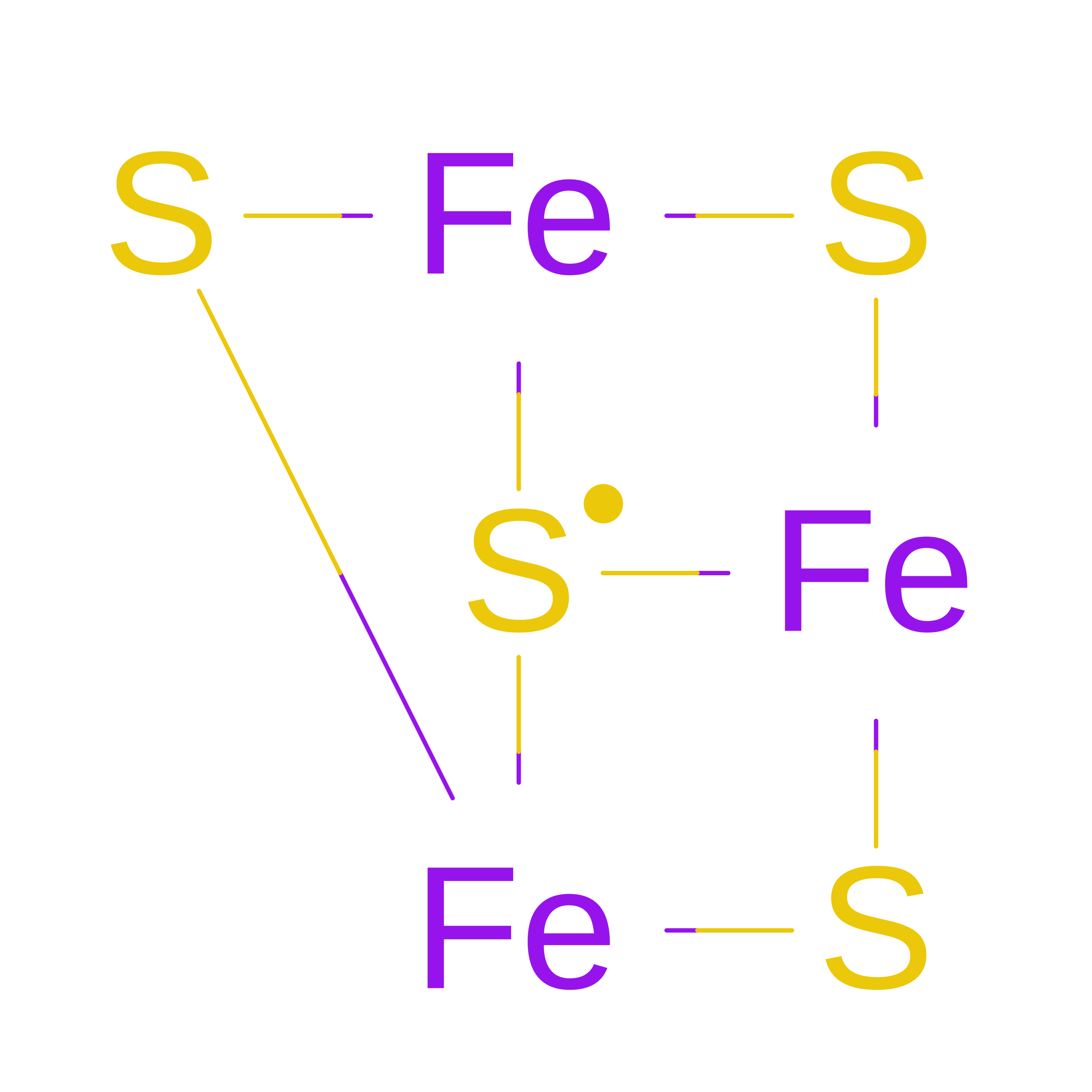
BIS-(MU-2-OXO),[(MU-3--SULFIDO)-BIS(MU-2--SULFIDO)-TRIS(CYS-S)-TRI-IRON] (AQUA)(GLU-O)IRON(II)
Fe4 O3 S3
BIOGFUMNBIDAOG-UHFFFAOYSA-M
SF4

Query on SF4


Download:Ideal Coordinates CCD File
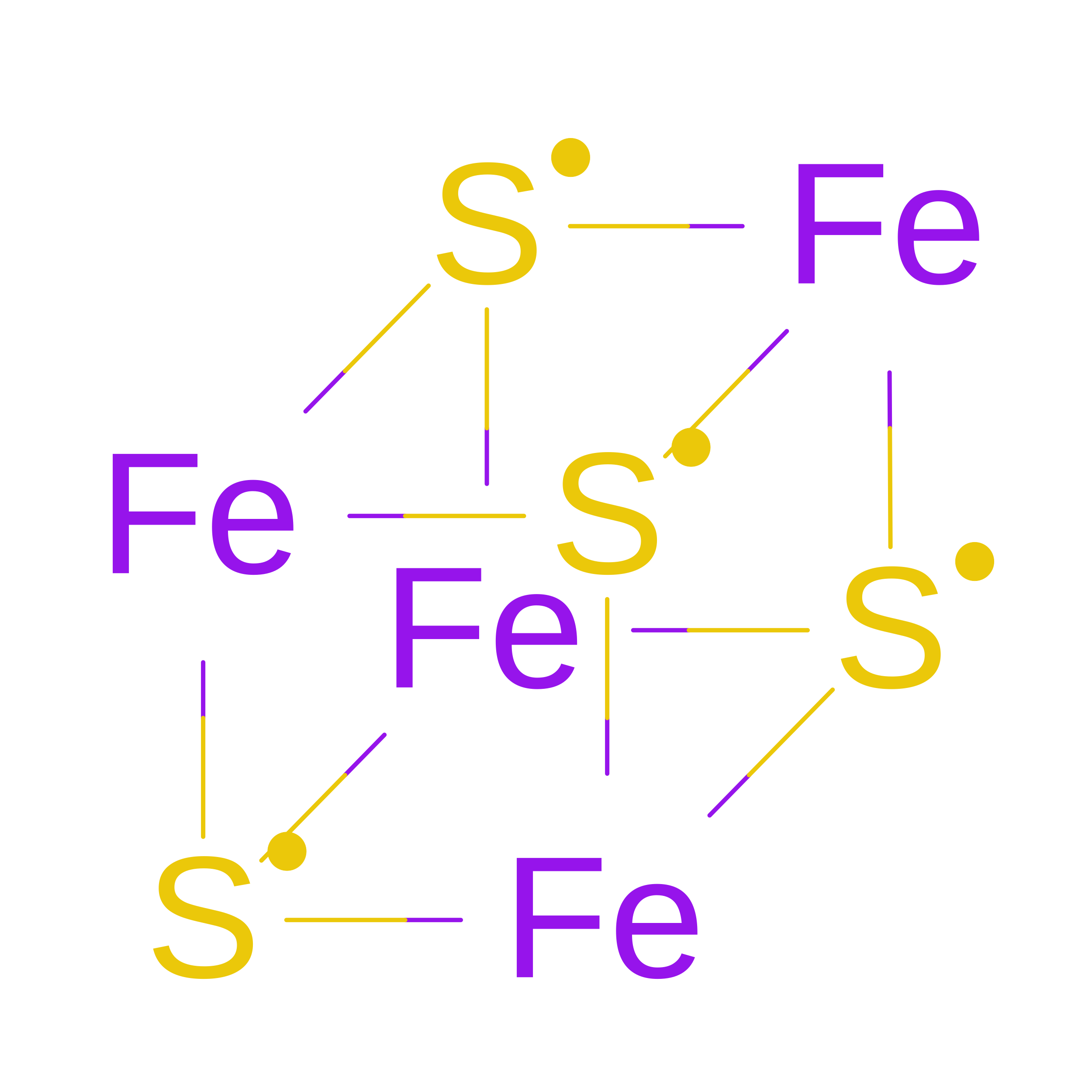
F [auth A],
M [auth C]
IRON/SULFUR CLUSTER
Fe4 S4
LJBDFODJNLIPKO-UHFFFAOYSA-N
F3S

Query on F3S


Download:Ideal Coordinates CCD File
E [auth A],
L [auth C]
FE3-S4 CLUSTER
Fe3 S4
FCXHZBQOKRZXKS-UHFFFAOYSA-N
FNE

Query on FNE


Download:Ideal Coordinates CCD File
I [auth B],
P [auth D]
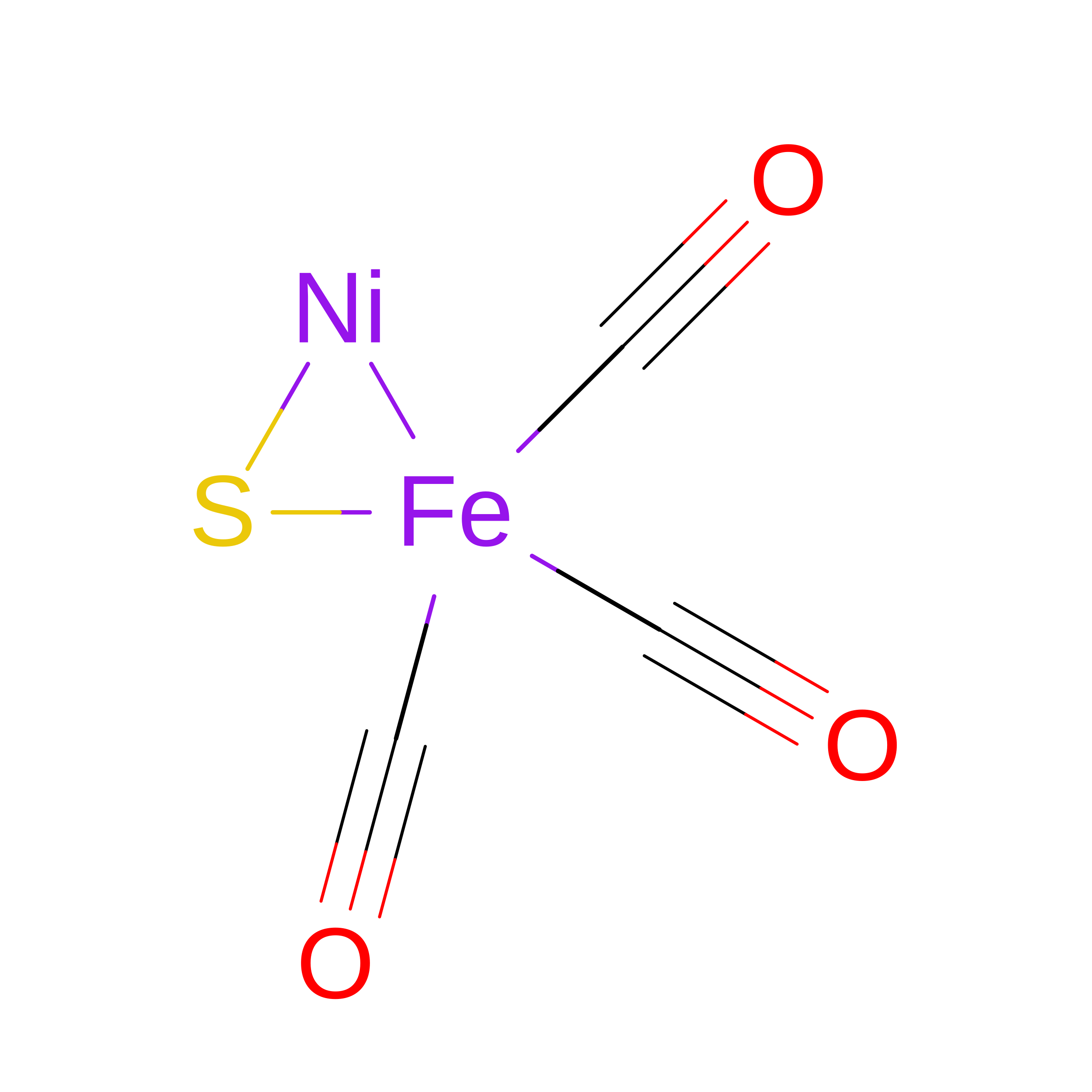
(MU-SULPHIDO)-BIS(MU-CYS,S)-[TRICARBONYLIRON-DI-(CYS,S)NICKEL(II)](FE-NI)
C3 Fe Ni O3 S
RSNJUOPWNIKDNA-UHFFFAOYSA-N
H2S

Query on H2S


Download:Ideal Coordinates CCD File
H [auth A],
K [auth B],
O [auth C],
R [auth D]
HYDROSULFURIC ACID
H2 S
RWSOTUBLDIXVET-UHFFFAOYSA-N
MG

Query on MG


Download:Ideal Coordinates CCD File
J [auth B],
Q [auth D]
MAGNESIUM ION
Mg
JLVVSXFLKOJNIY-UHFFFAOYSA-N

Experimental Data & Validation

Experimental Data

  • Method: X-RAY DIFFRACTION
  • Resolution: 1.80 Å
  • R-Value Free:  0.223 (Depositor) 
  • R-Value Work:  0.158 (DCC) 
  • R-Value Observed: 0.167 (Depositor) 
Space Group: P 1 21 1
Unit Cell:
Length ( Å )Angle ( ˚ )
a = 64.09α = 90
b = 169.98β = 92.8
c = 72.62γ = 90
Software Package:
Software NamePurpose
SHELXL-97refinement
DENZOdata reduction
SCALEPACKdata scaling
AMoREphasing

Structure Validation

View Full Validation Report


Entry History 

Deposition Data

Revision History  (Full details and data files)

  • Version 1.0: 2001-06-14
    Type: Initial release
  • Version 1.1: 2011-05-08
    Changes: Version format compliance
  • Version 1.2: 2011-07-13
    Changes: Version format compliance
  • Version 2.0: 2018-06-13
    Changes: Advisory, Atomic model, Data collection, Database references, Source and taxonomy, Structure summary
  • Version 2.1: 2023-12-13
    Changes: Advisory, Data collection, Database references, Derived calculations, Other, Refinement description
  • Version 2.2: 2025-10-01
    Changes: Advisory, Derived calculations, Structure summary
  • Version 2.3: 2025-12-17
    Changes: Structure summary