1EDR | pdb_00001edr

MOLECULAR AND CRYSTAL STRUCTURE OF D(CGCGMO6AATTCGCG) AT 1.6 ANGSTROM


Experimental Data Snapshot

  • Method: X-RAY DIFFRACTION
  • Resolution: 1.60 Å
  • R-Value Free: 
    0.270 (Depositor) 
  • R-Value Work: 
    0.211 (Depositor) 
  • R-Value Observed: 
    0.218 (Depositor) 

wwPDB Validation 3D Report Full Report

Validation slider image for 1EDR

This is version 1.3 of the entry. See complete history

Literature

Crystallographic studies on damaged DNAs. II. N(6)-methoxyadenine can present two alternate faces for Watson-Crick base-pairing, leading to pyrimidine transition mutagenesis.

Chatake, T.Hikima, T.Ono, A.Ueno, Y.Matsuda, A.Takenaka, A.

(1999) J Mol Biology 294: 1223-1230

  • DOI: https://doi.org/10.1006/jmbi.1999.3304
  • Primary Citation Related Structures: 
    1EDR, 457D

  • PubMed Abstract: 

    In a previous paper, 2'-deoxy-N(6)-methoxyadenosine (mo(6)A) was shown to form a mismatch base-pair with 2'-deoxycytidine with a Watson-Crick-type geometry. To fully understand the structural basis of genetic mutations with damaged DNA, it is necessary to examine whether the methoxylated adenine residue still has the ability to form the regular Watson-Crick pairing with a thymine residue. Therefore, a DNA dodecamer with the sequence d(CGCGmo(6)AATTCGCG) has been synthesized and its crystal structure determined. The methoxylation has no significant effect on the overall DNA conformation, which is that of a standard B-form duplex. The methoxylated adenine moieties adopt the amino tautomer with an anti conformation around the C(6)-N(6) bond to the N(1) atom, and they form a Watson-Crick base-pair with thymine residues on the opposite strand, similar to an unmodified adenine residue. It is concluded that methoxylated adenine can present two alternate faces for base-pairing, thanks to the amino<-->imino tautomerism allowed by methoxylation. Based on this property, two gene transition routes are proposed.


  • Organizational Affiliation
    • Graduate School of Bioscience and Biotechnology, Tokyo Institute of Technology, Nagatsuda, Midori-ku, Yokohama, 226-8501, Japan.

Macromolecule Content 

  • Total Structure Weight: 7.61 kDa 
  • Atom Count: 631 
  • Modeled Residue Count: 24 
  • Deposited Residue Count: 24 
  • Unique nucleic acid chains: 1

Macromolecules

Find similar nucleic acids by:  Sequence
Entity ID: 1
MoleculeChains LengthOrganismImage
5'-D(*CP*GP*CP*GP*(A47)AP*AP*TP*TP*CP*GP*CP*G)-3'
A, B
12N/A
Sequence Annotations
Expand
Reference Sequence

Small Molecules

Ligands 2 Unique
IDChains Name / Formula / InChI Key2D Diagram3D Interactions
SPM

Query on SPM


Download:Ideal Coordinates CCD File
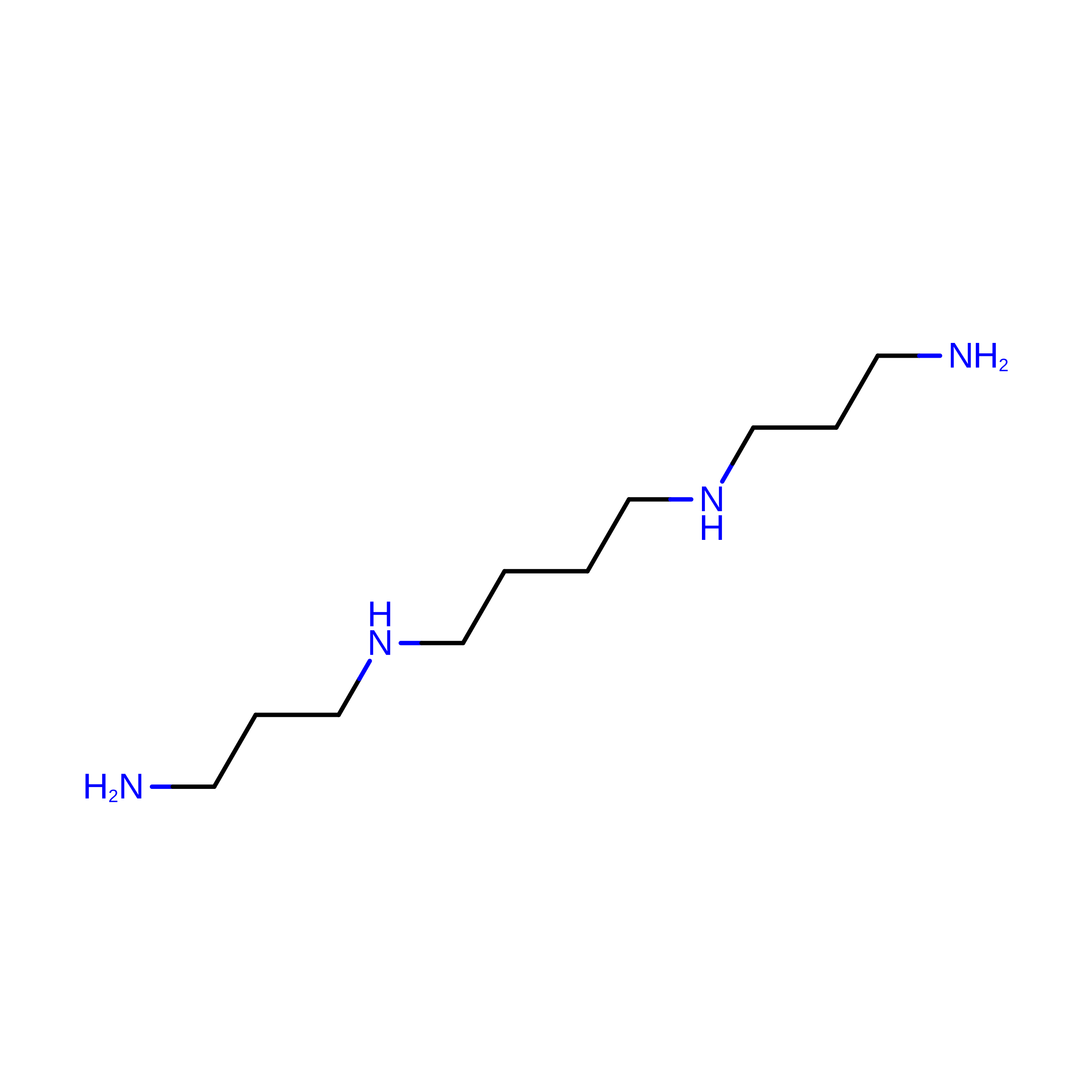
D [auth B]SPERMINE
C10 H26 N4
PFNFFQXMRSDOHW-UHFFFAOYSA-N
MG

Query on MG


Download:Ideal Coordinates CCD File
C [auth A]MAGNESIUM ION
Mg
JLVVSXFLKOJNIY-UHFFFAOYSA-N

Experimental Data & Validation

Experimental Data

  • Method: X-RAY DIFFRACTION
  • Resolution: 1.60 Å
  • R-Value Free:  0.270 (Depositor) 
  • R-Value Work:  0.211 (Depositor) 
  • R-Value Observed: 0.218 (Depositor) 
Space Group: P 21 21 21
Unit Cell:
Length ( Å )Angle ( ˚ )
a = 25.5α = 90
b = 39.8β = 90
c = 66.5γ = 90
Software Package:
Software NamePurpose
AMoREphasing
X-PLORrefinement
DENZOdata reduction
CCP4data scaling
SCALAdata scaling

Structure Validation

View Full Validation Report


Entry History 

Deposition Data

Revision History  (Full details and data files)

  • Version 1.0: 2000-02-16
    Type: Initial release
  • Version 1.1: 2008-04-27
    Changes: Version format compliance
  • Version 1.2: 2011-07-13
    Changes: Version format compliance
  • Version 1.3: 2024-02-07
    Changes: Data collection, Database references, Derived calculations