1JGU | pdb_00001jgu

STRUCTURAL BASIS FOR DISFAVORED ELIMINATION REACTION IN CATALYTIC ANTIBODY 1D4


Experimental Data Snapshot

  • Method: X-RAY DIFFRACTION
  • Resolution: 1.80 Å
  • R-Value Free: 
    0.229 (Depositor), 0.281 (DCC) 
  • R-Value Work: 
    0.209 (Depositor), 0.254 (DCC) 
  • R-Value Observed: 
    0.209 (Depositor) 

wwPDB Validation 3D Report Full Report

Validation slider image for 1JGU

Ligand Structure Quality Assessment 


This is version 1.4 of the entry. See complete history

Literature

Structural basis for a disfavored elimination reaction in catalytic antibody 1D4.

Larsen, N.A.Heine, A.Crane, L.Cravatt, B.F.Lerner, R.A.Wilson, I.A.

(2001) J Mol Biology 314: 93-102

  • DOI: https://doi.org/10.1006/jmbi.2001.5112
  • Primary Citation Related Structures: 
    1JGU, 1JGV

  • PubMed Abstract: 

    Murine antibody 1D4 selectively catalyzes a highly disfavored beta-elimination reaction. Crystal structures of unliganded 1D4 and 1D4 in complex with a transition-state analog (TSA) have elucidated a possible general base mode of catalysis. The structures of the unliganded and liganded Fabs were determined to 1.80 and 1.85 A resolution, respectively. The structure of the complex reveals a binding pocket with high shape complementarity to the TSA, which is recruited to coerce the substrate into the sterically demanding, eclipsed conformation that is required for catalysis. A histidine residue and two water molecules are likely involved in the catalysis. The structure supports either a concerted E2 or stepwise E1cB-like mechanism for elimination. Finally, the liganded 1D4 structure shows minor conformational rearrangements in CDR H2, indicative of induced-fit binding of the hapten. 1D4 has pushed the boundaries of antibody-mediated catalysis into the realm of disfavored reactions and, hence, represents an important milestone in the development of this technology.


  • Organizational Affiliation
    • Department of Molecular Biology, The Scripps Research Institute, 10550 North Torrey Pines Rd., La Jolla, CA 92037, USA.

Macromolecule Content 

  • Total Structure Weight: 48.01 kDa 
  • Atom Count: 3,707 
  • Modeled Residue Count: 437 
  • Deposited Residue Count: 437 
  • Unique protein chains: 2

Macromolecules

Find similar proteins by:|  3D Structure
Entity ID: 1
MoleculeChains  Sequence LengthOrganismDetailsImage
Antibody Light ChainA [auth L]220Mus musculusMutation(s): 0 
UniProt
Find proteins for Q52L64 (Mus musculus)
Explore Q52L64 
Go to UniProtKB:  Q52L64
Entity Groups
Sequence Clusters30% Identity50% Identity70% Identity90% Identity95% Identity100% Identity
UniProt GroupQ52L64
Sequence Annotations
Expand
Reference Sequence
Find similar proteins by:|  3D Structure
Entity ID: 2
MoleculeChains  Sequence LengthOrganismDetailsImage
Antibody Heavy ChainB [auth H]217Mus musculusMutation(s): 0 
UniProt
Find proteins for Q91Z05 (Mus musculus)
Explore Q91Z05 
Go to UniProtKB:  Q91Z05
Entity Groups
Sequence Clusters30% Identity50% Identity70% Identity90% Identity95% Identity100% Identity
UniProt GroupQ91Z05
Sequence Annotations
Expand
Reference Sequence

Small Molecules

Ligands 2 Unique
IDChains Name / Formula / InChI Key2D Diagram3D Interactions
HBC

Query on HBC


Download:Ideal Coordinates CCD File
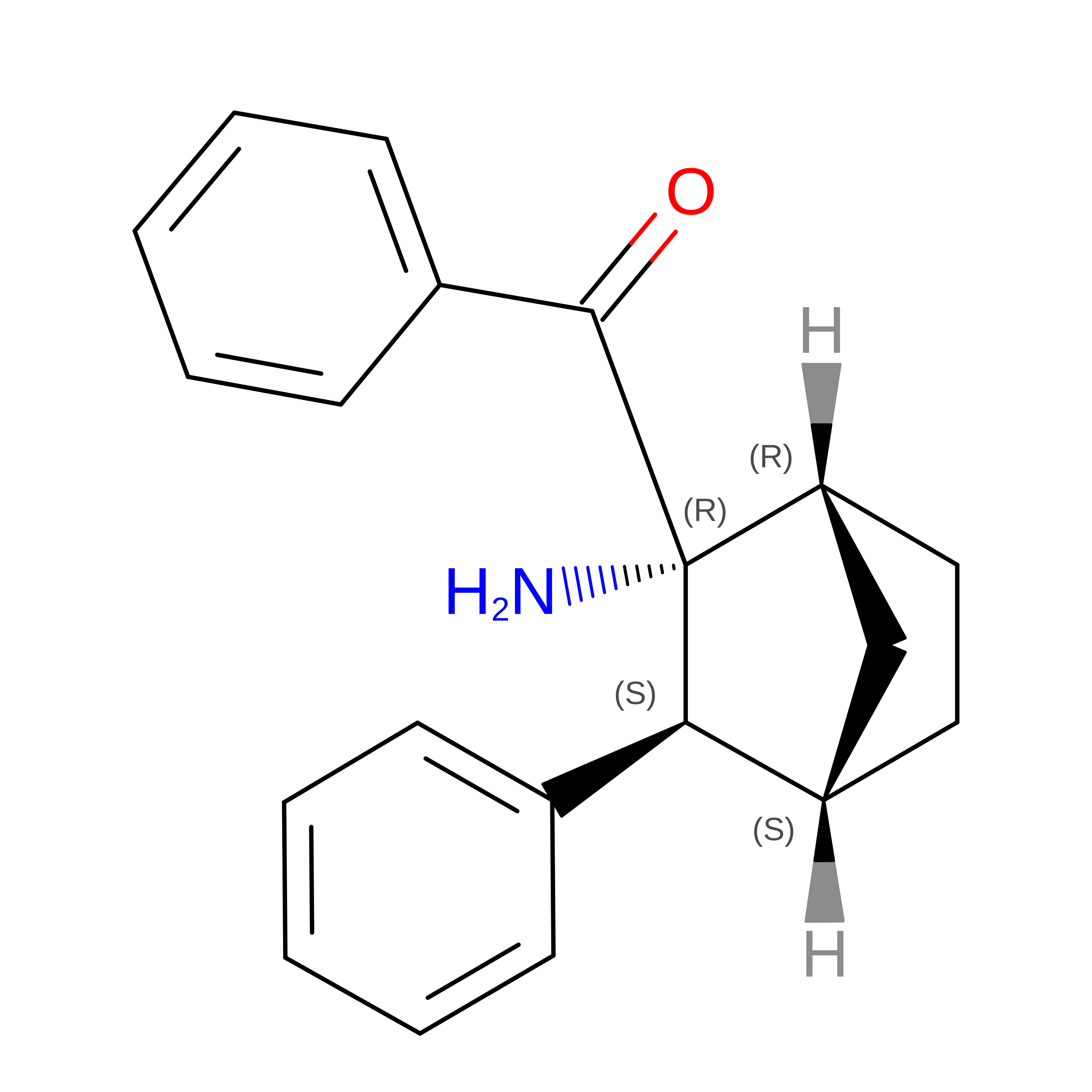
D [auth H](2-AMINO-3-PHENYL-BICYCLO[2.2.1]HEPT-2-YL)-PHENYL-METHANONE
C20 H21 N O
XJQDTOANLAPEIM-JRBPQWBISA-N
OH

Query on OH


Download:Ideal Coordinates CCD File
C [auth H]HYDROXIDE ION
H O
XLYOFNOQVPJJNP-UHFFFAOYSA-M

Experimental Data & Validation

Experimental Data

  • Method: X-RAY DIFFRACTION
  • Resolution: 1.80 Å
  • R-Value Free:  0.229 (Depositor), 0.281 (DCC) 
  • R-Value Work:  0.209 (Depositor), 0.254 (DCC) 
  • R-Value Observed: 0.209 (Depositor) 
Space Group: P 1 21 1
Unit Cell:
Length ( Å )Angle ( ˚ )
a = 68.37α = 90
b = 48.63β = 106.77
c = 69.37γ = 90
Software Package:
Software NamePurpose
DENZOdata reduction
SCALEPACKdata scaling
AMoREphasing
CNSrefinement

Structure Validation

View Full Validation Report


Ligand Structure Quality Assessment 


Entry History 

Deposition Data

Revision History  (Full details and data files)

  • Version 1.0: 2001-12-05
    Type: Initial release
  • Version 1.1: 2008-04-27
    Changes: Version format compliance
  • Version 1.2: 2011-07-13
    Changes: Version format compliance
  • Version 1.3: 2018-01-31
    Changes: Experimental preparation
  • Version 1.4: 2024-11-13
    Changes: Data collection, Database references, Derived calculations, Structure summary