Download Mendeley
The Structure of a Binary complex between a Mammalian Mevalonate Kinase and ATP: Insights into the Reaction Mechanism and Human Inherited Disease
Fu, Z., Wang, M., Potter, D., Mizioko, H.M., Kim, J.J.(2002) J Biol Chem 277: 18134-18142
- PubMed: 11877411 Search on PubMed
- DOI: https://doi.org/10.1074/jbc.M200912200
- Primary Citation Related Structures:
1KVK - PubMed Abstract:
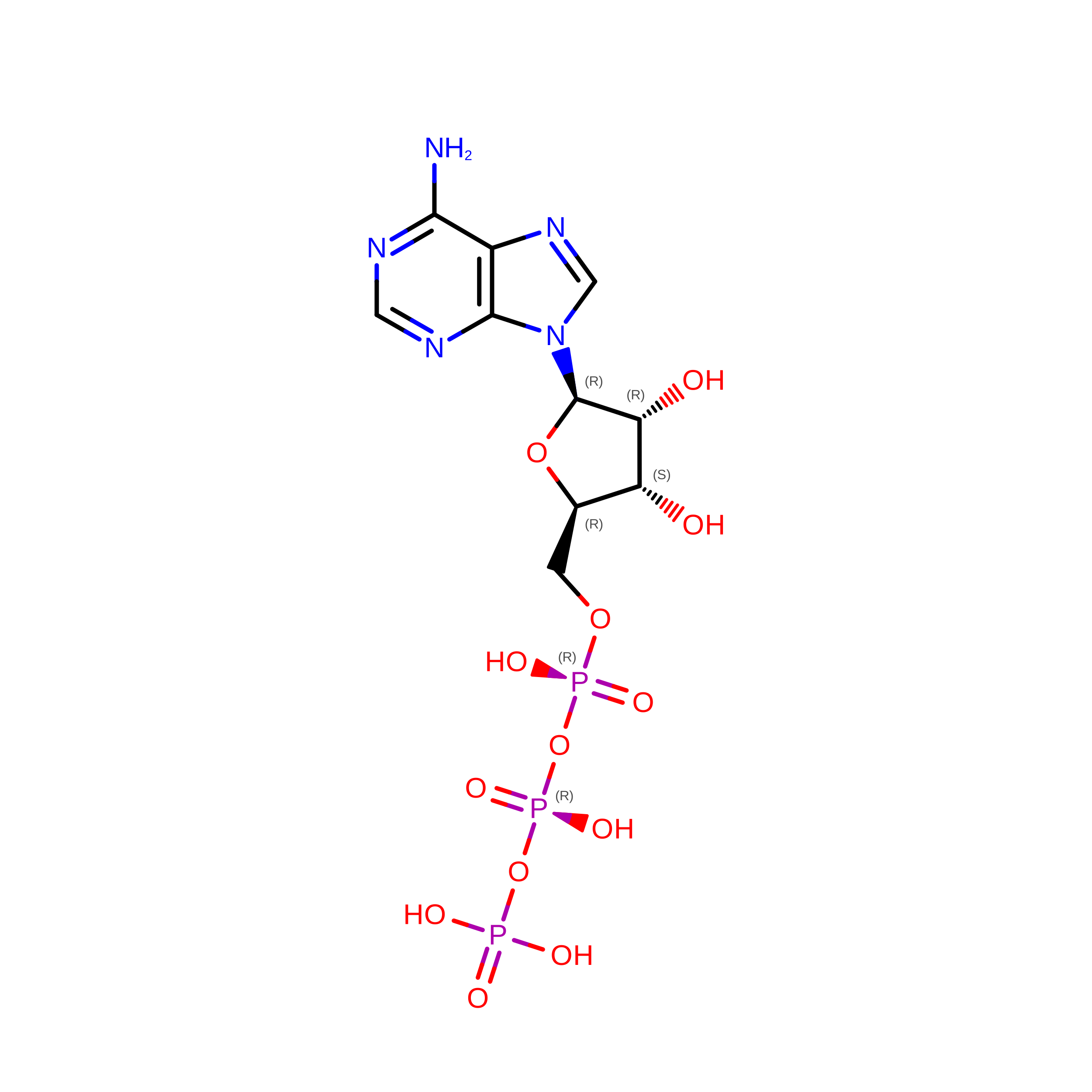
Mevalonate kinase catalyzes the ATP-dependent phosphorylation of mevalonic acid to form mevalonate 5-phosphate, a key intermediate in the pathways of isoprenoids and sterols. Deficiency in mevalonate kinase activity has been linked to mevalonic aciduria and hyperimmunoglobulinemia D/periodic fever syndrome (HIDS). The crystal structure of rat mevalonate kinase in complex with MgATP has been determined at 2.4-A resolution. Each monomer of this dimeric protein is composed of two domains with its active site located at the domain interface. The enzyme-bound ATP adopts an anti conformation, in contrast to the syn conformation reported for Methanococcus jannaschii homoserine kinase. The Mg(2+) ion is coordinated to both beta- and gamma-phosphates of ATP and side chains of Glu(193) and Ser(146). Asp(204) is making a salt bridge with Lys(13), which in turn interacts with the gamma-phosphate. A model of mevalonic acid can be placed near the gamma-phosphoryl group of ATP; thus, the C5 hydroxyl is located within 4 A from Asp(204), Lys(13), and the gamma-phosphoryl of ATP. This arrangement of residues strongly suggests: 1) Asp(204) abstracts the proton from C5 hydroxyl of mevalonate; 2) the penta-coordinated gamma-phosphoryl group may be stabilized by Mg(2+), Lys(13), and Glu(193); and 3) Lys(13) is likely to influence the pK(a) of the C5 hydroxyl of the substrate. V377I and I268T are the most common mutations found in patients with HIDS. Val(377) is located over 18 A away from the active site and a conservative replacement with Ile is unlikely to yield an inactive or unstable protein. Ile-268 is located at the dimer interface, and its Thr substitution may disrupt dimer formation.
- Department of Biochemistry, Medical College of Wisconsin, Milwaukee, Wisconsin 53226, USA.
Organizational Affiliation: