1MBB | pdb_00001mbb

OXIDOREDUCTASE


Experimental Data Snapshot

  • Method: X-RAY DIFFRACTION
  • Resolution: 2.30 Å
  • R-Value Free: 
    0.324 (Depositor) 
  • R-Value Work: 
    0.238 (Depositor) 
  • R-Value Observed: 
    0.238 (Depositor) 

wwPDB Validation 3D Report Full Report

Validation slider image for 1MBB

This is version 1.3 of the entry. See complete history

Literature

(E)-enolbutyryl-UDP-N-acetylglucosamine as a mechanistic probe of UDP-N-acetylenolpyruvylglucosamine reductase (MurB).

Lees, W.J.Benson, T.E.Hogle, J.M.Walsh, C.T.

(1996) Biochemistry 35: 1342-1351

  • DOI: https://doi.org/10.1021/bi952287w
  • Primary Citation Related Structures: 
    1MBB

  • PubMed Abstract: 

    UDP-N-acetylenolpyruvylglucosamine reductase (MurB), a peptidoglycan biosynthetic enzyme from Escherichia coli, reduces both (E)- and (Z)-isomers of enolbutyryl-UDP-GlcNAc, C4 analogs of the physiological C3 enolpyruvyl substrate, to UDP-methyl-N-acetylmuramic acid in the presence of NADPH. The X-ray crystal structure of the (E)-enolbutyryl-UDP-GlcNAc-MurB complex is similar to that of the enolpyruvyl-UDP-GlcNAc-MurB complex. In both structures the groups thought to be involved in hydride transfer to C3 and protonation at C2 of the enol ether substrate are arranged anti relative to the enol double bond. The stereochemical outcome of reduction of (E)-enolbutyryl-UDP-GlcNAc by NADPD in D2O is thus predicted to yield a (2R,3R)-dideuterio product. This was validated by conversion of the 2,3-dideuterio-UDP-methyl-N-acetylmuramic acid product to 2,3-dideuterio-2-hydroxybutyrate, which was shown to be (2R) by enzymatic analysis and (3R) by NMR comparison to authentic (2R,3R)- and (2R,3S)-2,3-dideuterio-2-hydroxybutyrate. Remarkably, the (E)-enolbutyryl-UDP-GlcNAc was found to partition between reduction to UDP-methyl-N-acetylmuramic and isomerization to the (Z)-substrate isomer in the MurB active site, indicative of a C2 carbanion/enol species that is sufficiently long-lived to rotate around the C2-C3 single bond during catalysis.


  • Organizational Affiliation
    • Department of Biological Chemistry and Molecular Pharmacology, Harvard Medical School, Boston, Massachusetts 02115, USA.

Macromolecule Content 

  • Total Structure Weight: 39.37 kDa 
  • Atom Count: 2,871 
  • Modeled Residue Count: 340 
  • Deposited Residue Count: 342 
  • Unique protein chains: 1

Macromolecules

Find similar proteins by:|  3D Structure
Entity ID: 1
MoleculeChains  Sequence LengthOrganismDetailsImage
URIDINE DIPHOSPHO-N-ACETYLENOLPYRUVYLGLUCOSAMINE REDUCTASE342Escherichia coliMutation(s): 0 
EC: 1.1.1.158 (PDB Primary Data), 1.3.1.98 (UniProt)
UniProt
Find proteins for P08373 (Escherichia coli (strain K12))
Explore P08373 
Go to UniProtKB:  P08373
Entity Groups
Sequence Clusters30% Identity50% Identity70% Identity90% Identity95% Identity100% Identity
UniProt GroupP08373
Sequence Annotations
Expand
Reference Sequence

Small Molecules

Ligands 2 Unique
IDChains Name / Formula / InChI Key2D Diagram3D Interactions
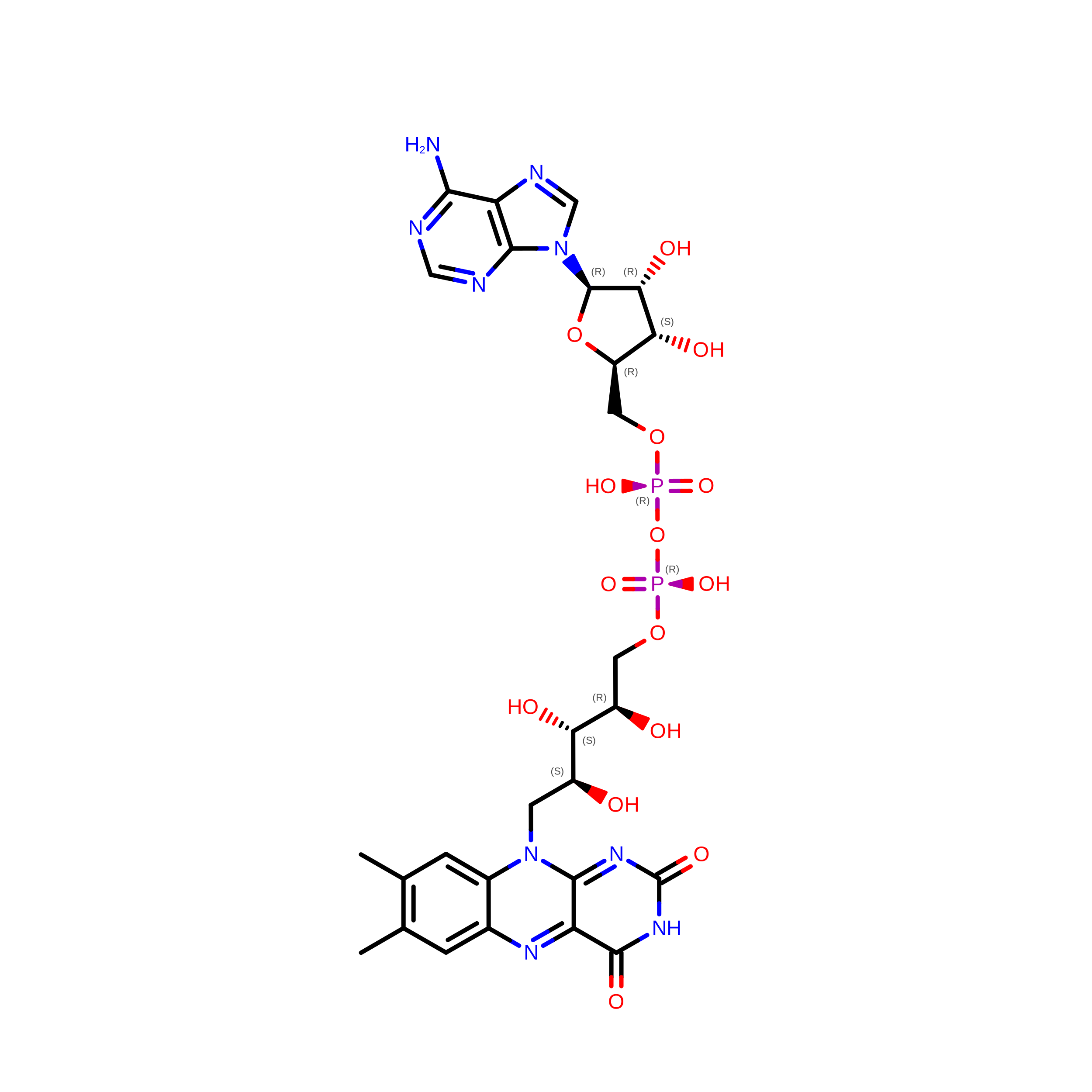
FAD

Query on FAD


Download:Ideal Coordinates CCD File
C [auth A]FLAVIN-ADENINE DINUCLEOTIDE
C27 H33 N9 O15 P2
VWWQXMAJTJZDQX-UYBVJOGSSA-N
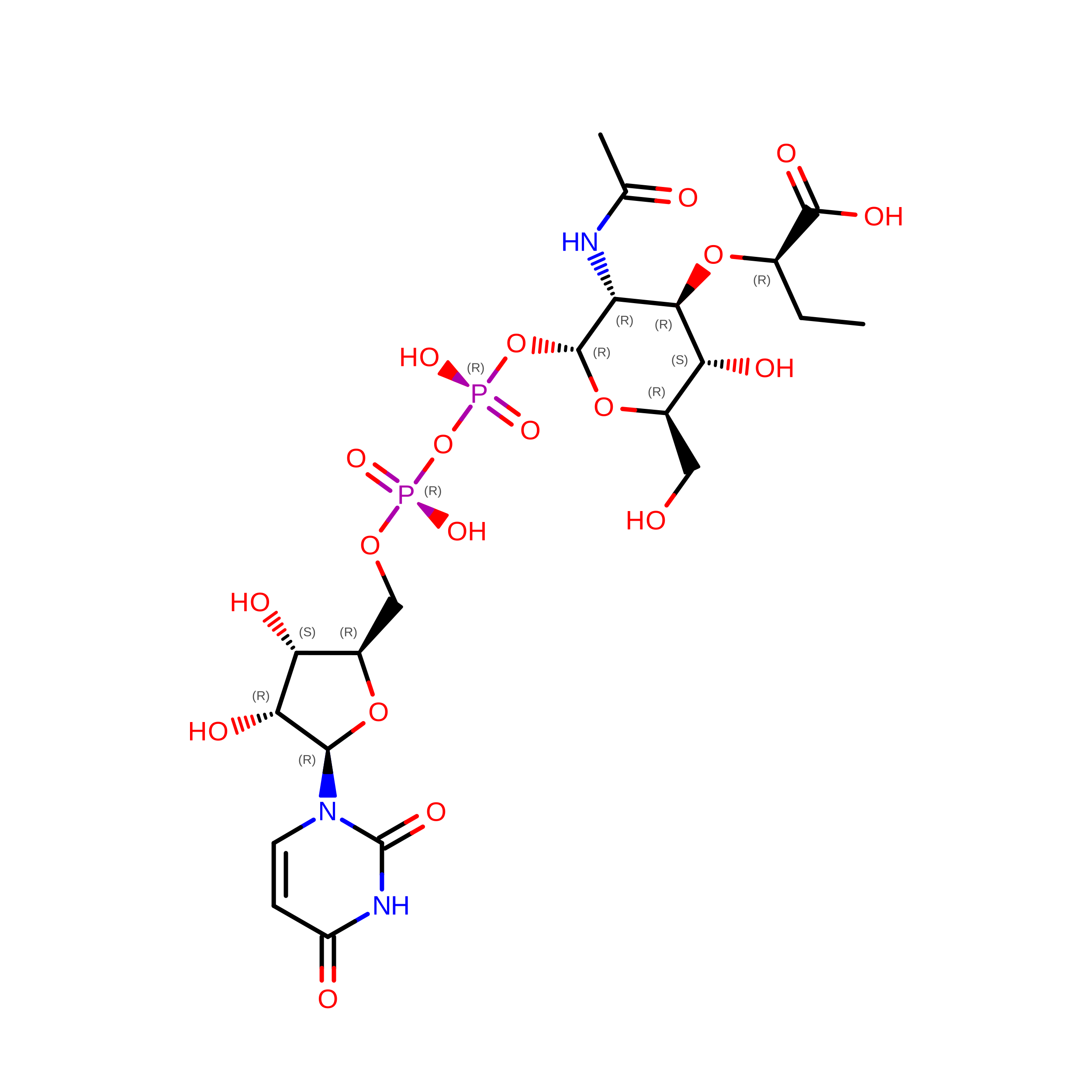
EEB

Query on EEB


Download:Ideal Coordinates CCD File
B [auth A]URIDINE-DIPHOSPHATE-3(N-ACETYLGLUCOSAMINYL)BUTYRIC ACID
C21 H33 N3 O19 P2
DFCARJAECCPPGB-LHYXAPFASA-N

Experimental Data & Validation

Experimental Data

  • Method: X-RAY DIFFRACTION
  • Resolution: 2.30 Å
  • R-Value Free:  0.324 (Depositor) 
  • R-Value Work:  0.238 (Depositor) 
  • R-Value Observed: 0.238 (Depositor) 
Space Group: P 43 21 2
Unit Cell:
Length ( Å )Angle ( ˚ )
a = 50α = 90
b = 50β = 90
c = 264.3γ = 90
Software Package:
Software NamePurpose
X-PLORmodel building
X-PLORrefinement
X-PLORphasing

Structure Validation

View Full Validation Report


Entry History 

Deposition Data

Revision History  (Full details and data files)

  • Version 1.0: 1996-10-14
    Type: Initial release
  • Version 1.1: 2008-03-24
    Changes: Version format compliance
  • Version 1.2: 2011-07-13
    Changes: Version format compliance
  • Version 1.3: 2024-02-14
    Changes: Data collection, Database references, Derived calculations, Other