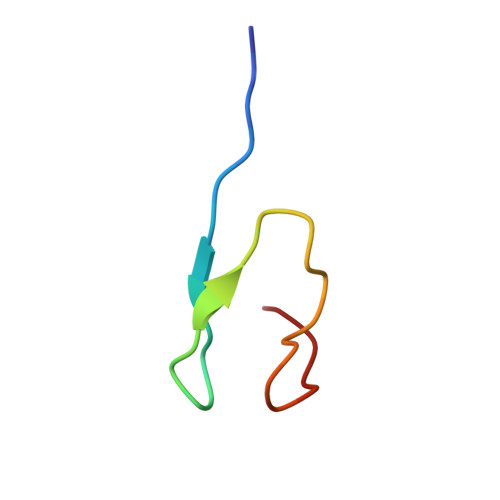
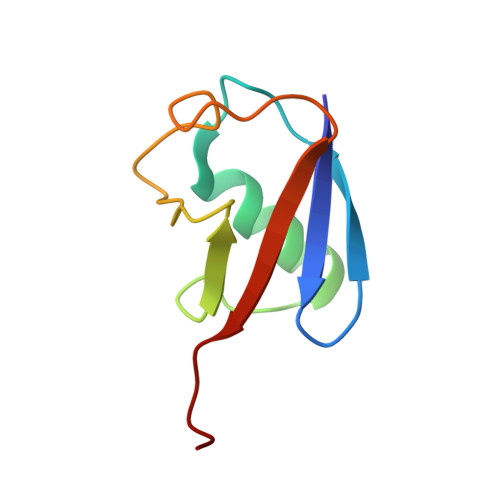
1Q5W | pdb_00001q5w

Ubiquitin Recognition by Npl4 Zinc-Fingers


Experimental Data Snapshot

  • Method: SOLUTION NMR
  • Conformers Calculated: 200 
  • Conformers Submitted: 20 
  • Selection Criteria: structures with the least restraint violations,structures with the lowest energy,target function 

wwPDB Validation 3D Report Full Report

Validation slider image for 1Q5W

This is version 1.4 of the entry. See complete history

Literature

Ubiquitin interactions of NZF zinc fingers.

Alam, S.L.Sun, J.Payne, M.Welch, B.D.Blake, B.K.Davis, D.R.Meyer, H.H.Emr, S.D.Sundquist, W.I.

(2004) EMBO J 23: 1411-1421

  • DOI: https://doi.org/10.1038/sj.emboj.7600114
  • Primary Citation Related Structures: 
    1Q5W

  • PubMed Abstract: 

    Ubiquitin (Ub) functions in many different biological pathways, where it typically interacts with proteins that contain modular Ub recognition domains. One such recognition domain is the Npl4 zinc finger (NZF), a compact zinc-binding module found in many proteins that function in Ub-dependent processes. We now report the solution structure of the NZF domain from Npl4 in complex with Ub. The structure reveals that three key NZF residues (13TF14/M25) surrounding the zinc coordination site bind the hydrophobic 'Ile44' surface of Ub. Mutations in the 13TF14/M25 motif inhibit Ub binding, and naturally occurring NZF domains that lack the motif do not bind Ub. However, substitution of the 13TF14/M25 motif into the nonbinding NZF domain from RanBP2 creates Ub-binding activity, demonstrating the versatility of the NZF scaffold. Finally, NZF mutations that inhibit Ub binding by the NZF domain of Vps36/ESCRT-II also inhibit sorting of ubiquitylated proteins into the yeast vacuole. Thus, the NZF is a versatile protein recognition domain that is used to bind ubiquitylated proteins during vacuolar protein sorting, and probably many other biological processes.


  • Organizational Affiliation
    • Department of Biochemistry, University of Utah, Salt Lake City, UT, USA. alam@wsu.edu

Macromolecule Content 

  • Total Structure Weight: 12.02 kDa 
  • Atom Count: 833 
  • Modeled Residue Count: 107 
  • Deposited Residue Count: 107 
  • Unique protein chains: 2

Macromolecules

Find similar proteins by:|  3D Structure
Entity ID: 1
MoleculeChains  Sequence LengthOrganismDetailsImage
homolog of yeast nuclear protein localization 431Rattus norvegicusMutation(s): 0 
Gene Names: NPL4
UniProt
Find proteins for Q9ES54 (Rattus norvegicus)
Explore Q9ES54 
Go to UniProtKB:  Q9ES54
Entity Groups
Sequence Clusters30% Identity50% Identity70% Identity90% Identity95% Identity100% Identity
UniProt GroupQ9ES54
Sequence Annotations
Expand
Reference Sequence
Find similar proteins by:|  3D Structure
Entity ID: 2
MoleculeChains  Sequence LengthOrganismDetailsImage
Ubiquitin76Homo sapiensMutation(s): 0 
Gene Names: (UBA52 OR UBCEP2) AND UBB AND UBC AND (UBA80 OR UBCEP1 OR RPS27A)
UniProt & NIH Common Fund Data Resources
Find proteins for P0CG48 (Homo sapiens)
Explore P0CG48 
Go to UniProtKB:  P0CG48
PHAROS:  P0CG48
GTEx:  ENSG00000150991 
Entity Groups
Sequence Clusters30% Identity50% Identity70% Identity90% Identity95% Identity100% Identity
UniProt GroupP0CG48
Sequence Annotations
Expand
Reference Sequence

Small Molecules

Ligands 1 Unique
IDChains Name / Formula / InChI Key2D Diagram3D Interactions
ZN

Query on ZN


Download:Ideal Coordinates CCD File
C [auth A]ZINC ION
Zn
PTFCDOFLOPIGGS-UHFFFAOYSA-N

Experimental Data & Validation

Experimental Data

  • Method: SOLUTION NMR
  • Conformers Calculated: 200 
  • Conformers Submitted: 20 
  • Selection Criteria: structures with the least restraint violations,structures with the lowest energy,target function 

Structure Validation

View Full Validation Report


Entry History 

Deposition Data

Revision History  (Full details and data files)

  • Version 1.0: 2004-03-30
    Type: Initial release
  • Version 1.1: 2008-04-29
    Changes: Version format compliance
  • Version 1.2: 2011-07-13
    Changes: Version format compliance
  • Version 1.3: 2022-03-02
    Changes: Data collection, Database references, Derived calculations
  • Version 1.4: 2024-05-22
    Changes: Data collection