1UIH | pdb_00001uih

ANALYSIS OF THE STABILIZATION OF HEN LYSOZYME WITH THE HELIX DIPOLE AND CHARGED SIDE CHAINS


Experimental Data Snapshot

  • Method: X-RAY DIFFRACTION
  • Resolution: 1.75 Å
  • R-Value Work: 
    0.168 (Depositor), 0.185 (DCC) 
  • R-Value Observed: 
    0.168 (Depositor) 

Starting Model: experimental
View more details

wwPDB Validation 3D Report Full Report

Validation slider image for 1UIH

This is version 2.2 of the entry. See complete history

Literature

Fluctuations in free or substrate-complexed lysozyme and a mutant of it detected on x-ray crystallography and comparison with those detected on NMR.

Ohmura, T.Motoshima, H.Ueda, T.Imoto, T.

(2002) J Biochem 131: 701-704

  • DOI: https://doi.org/10.1093/oxfordjournals.jbchem.a003154
  • Primary Citation Related Structures: 
    1UIA, 1UIB, 1UIH

  • PubMed Abstract: 

    A mutant lysozyme in which Arg14 and His15 were deleted together exhibited higher activity toward glycol chitin than the wild-type lysozyme. Moreover, the mutant lysozyme, which is less stable than the wild-type lysozyme by 7 degrees C, showed a shift of temperature dependence of activity to the low temperature side compared with the wild-type lysozyme [Protein Eng. 7, 743-748 (1994)]. In the free enzyme, the internal motion of the mutant lysozyme was similar to that of the wild-type. The internal motions of the wild-type and mutant lysozymes in the enzyme-substrate complex increased more than those in the free enzymes. Moreover, the increased internal motions of the substrate-complexed mutant lysozyme were greater than those of the substrate-complexed wild-type lysozyme in several residues [J. Mol. Biol. 286, 1547-1565 (1999)]. The structure of the mutant lysozyme was very similar to that of the wild-type lysozyme. Both structures were also alike in the complex of the trimer of N-acetyl-D-glucosamine. The mobility from B-factors agreed to some degree with that from order parameters in the regions showing great mobility of the protein, but this was not the case in the regions showing fast motion. However, we came to the same conclusion that the increased activity of the mutant lysozyme is due to the increase in the fluctuation of the lysozyme molecule. B-factor and order parameter do not always exhibit harmony because the time-scale of the analysis of mobility is different. However, they are not incompatible but complementary for detecting precise protein motions.


  • Organizational Affiliation
    • Graduate School of Pharmaceutical Sciences, Kyushu University, Fukuoka 812-8582, Japan.

Macromolecule Content 

  • Total Structure Weight: 14.96 kDa 
  • Atom Count: 1,132 
  • Modeled Residue Count: 129 
  • Deposited Residue Count: 129 
  • Unique protein chains: 1

Macromolecules

Find similar proteins by:|  3D Structure
Entity ID: 1
MoleculeChains  Sequence LengthOrganismDetailsImage
LYSOZYME129Gallus gallusMutation(s): 0 
Gene Names: HEN LYSOZYME
EC: 3.2.1.17
UniProt
Find proteins for P00698 (Gallus gallus)
Explore P00698 
Go to UniProtKB:  P00698
Entity Groups
Sequence Clusters30% Identity50% Identity70% Identity90% Identity95% Identity100% Identity
UniProt GroupP00698
Sequence Annotations
Expand
Reference Sequence

Oligosaccharides

Help  
Entity ID: 2
MoleculeChains Length2D Diagram GlycosylationD Interactions
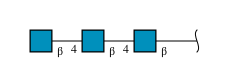
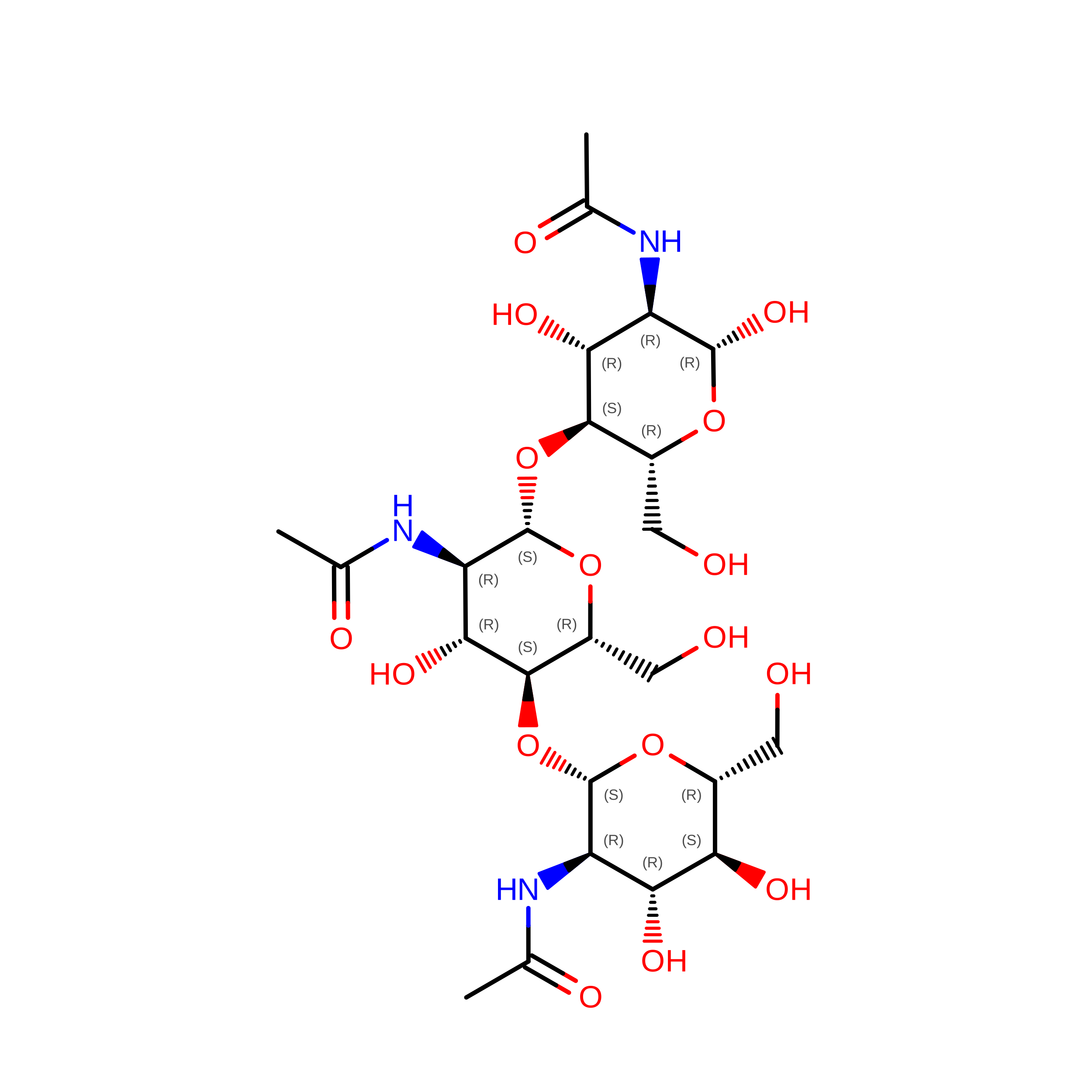
2-acetamido-2-deoxy-beta-D-glucopyranose-(1-4)-2-acetamido-2-deoxy-beta-D-glucopyranose-(1-4)-2-acetamido-2-deoxy-beta-D-glucopyranose
B
3N/A
Glycosylation Resources
GlyTouCan: G47362BJ
GlyCosmos: G47362BJ
GlyGen: G47362BJ

Biologically Interesting Molecules (External Reference) 

1 Unique

Experimental Data & Validation

Experimental Data

  • Method: X-RAY DIFFRACTION
  • Resolution: 1.75 Å
  • R-Value Work:  0.168 (Depositor), 0.185 (DCC) 
  • R-Value Observed: 0.168 (Depositor) 
Space Group: P 43 21 2
Unit Cell:
Length ( Å )Angle ( ˚ )
a = 78.81α = 90
b = 78.81β = 90
c = 38.27γ = 90
Software Package:
Software NamePurpose
PROCESSdata collection
PROCESSdata reduction
X-PLORmodel building
X-PLORrefinement
PROCESSdata scaling
X-PLORphasing

Structure Validation

View Full Validation Report


Entry History 

Deposition Data

Revision History  (Full details and data files)

  • Version 1.0: 1997-11-26
    Type: Initial release
  • Version 1.1: 2008-03-24
    Changes: Version format compliance
  • Version 1.2: 2011-07-13
    Changes: Non-polymer description, Version format compliance
  • Version 2.0: 2020-07-29
    Type: Remediation
    Reason: Carbohydrate remediation
    Changes: Atomic model, Data collection, Derived calculations, Other, Structure summary
  • Version 2.1: 2023-08-09
    Changes: Database references, Refinement description, Structure summary
  • Version 2.2: 2024-11-20
    Changes: Data collection, Structure summary