1Y2F | pdb_00001y2f

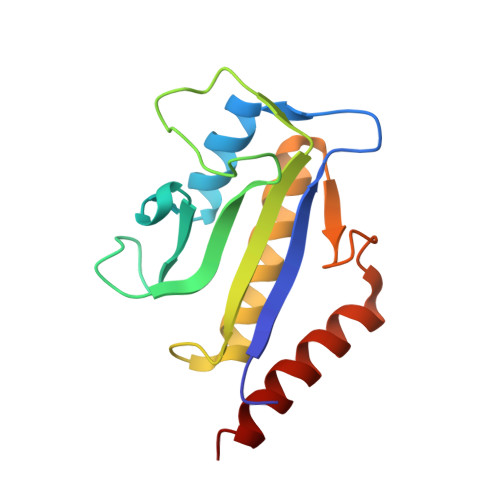
Crystal Structure of ZipA with an inhibitor


Experimental Data Snapshot

  • Method: X-RAY DIFFRACTION
  • Resolution: 2.00 Å
  • R-Value Free: 
    0.228 (Depositor) 
  • R-Value Work: 
    0.225 (Depositor) 
  • R-Value Observed: 
    0.225 (Depositor) 

Starting Model: experimental
View more details

wwPDB Validation 3D Report Full Report

Validation slider image for 1Y2F

This is version 1.3 of the entry. See complete history

Literature

A shape-based 3-D scaffold hopping method and its application to a bacterial protein-protein interaction

Rush, T.S.Grant, J.A.Mosyak, L.Nicholls, A.

(2005) J Med Chem 48: 1489-1495

  • DOI: https://doi.org/10.1021/jm040163o
  • Primary Citation Related Structures: 
    1Y2F, 1Y2G

  • PubMed Abstract: 

    In this paper, we describe the first prospective application of the shape-comparison program ROCS (Rapid Overlay of Chemical Structures) to find new scaffolds for small molecule inhibitors of the ZipA-FtsZ protein-protein interaction, a proposed antibacterial target. The shape comparisons are made relative to the crystallographically determined, bioactive conformation of a high-throughput screening (HTS) hit. The use of ROCS led to the identification of a set of novel, weakly binding inhibitors with scaffolds presenting synthetic opportunities to further optimize biological affinity and lacking development issues associated with the HTS lead. These ROCS-identified scaffolds would have been missed using other structural similarity approaches such as ISIS 2D fingerprints. X-ray crystallographic analysis of one of the new inhibitors bound to ZipA reveals that the shape comparison approach very accurately predicted the binding mode. These experimental results validate this use of ROCS for chemotype switching or "lead hopping" and suggest that it is of general interest for lead identification in drug discovery endeavors.


  • Organizational Affiliation
    • Department of Chemical & Screening Sciences, Wyeth Research, 87 Cambridge Park Drive, Cambridge, MA 02140, USA. trush@wyeth.com

Macromolecule Content 

  • Total Structure Weight: 15.96 kDa 
  • Atom Count: 1,341 
  • Modeled Residue Count: 139 
  • Deposited Residue Count: 139 
  • Unique protein chains: 1

Macromolecules

Find similar proteins by:|  3D Structure
Entity ID: 1
MoleculeChains  Sequence LengthOrganismDetailsImage
Cell division protein zipA139Escherichia coliMutation(s): 0 
UniProt
Find proteins for P77173 (Escherichia coli (strain K12))
Explore P77173 
Go to UniProtKB:  P77173
Entity Groups
Sequence Clusters30% Identity50% Identity70% Identity90% Identity95% Identity100% Identity
UniProt GroupP77173
Sequence Annotations
Expand
Reference Sequence

Small Molecules

Ligands 1 Unique
IDChains Name / Formula / InChI Key2D Diagram3D Interactions
WAI

Query on WAI


Download:Ideal Coordinates CCD File
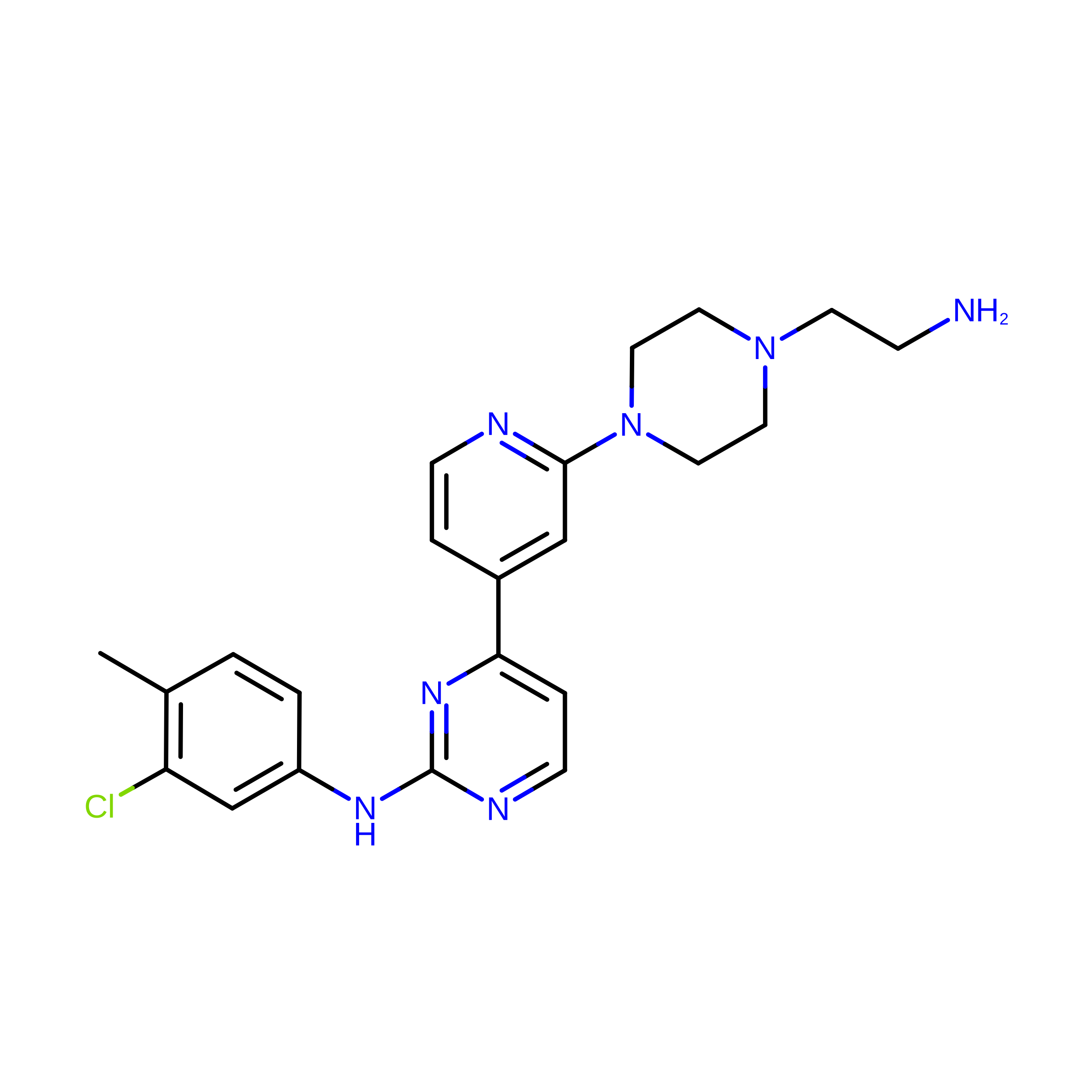
B [auth A]4-{2-[4-(2-AMINOETHYL)PIPERAZIN-1-YL]PYRIDIN-4-YL}-N-(3-CHLORO-4-METHYLPHENYL)PYRIMIDIN-2-AMINE
C22 H26 Cl N7
RHOOHUMOHVIXEF-UHFFFAOYSA-N

Experimental Data & Validation

Experimental Data

  • Method: X-RAY DIFFRACTION
  • Resolution: 2.00 Å
  • R-Value Free:  0.228 (Depositor) 
  • R-Value Work:  0.225 (Depositor) 
  • R-Value Observed: 0.225 (Depositor) 
Space Group: P 21 21 21
Unit Cell:
Length ( Å )Angle ( ˚ )
a = 44.973α = 90
b = 50.614β = 90
c = 84.399γ = 90
Software Package:
Software NamePurpose
CNSrefinement
AMoREphasing

Structure Validation

View Full Validation Report


Entry History 

Deposition Data

Revision History  (Full details and data files)

  • Version 1.0: 2005-03-01
    Type: Initial release
  • Version 1.1: 2008-04-30
    Changes: Version format compliance
  • Version 1.2: 2011-07-13
    Changes: Version format compliance
  • Version 1.3: 2023-08-23
    Changes: Data collection, Database references, Derived calculations, Refinement description