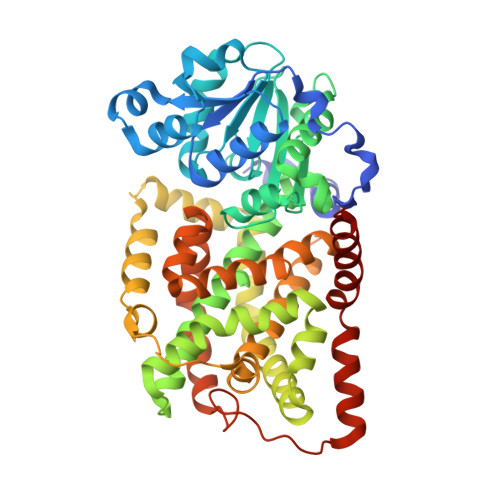
1YRL | pdb_00001yrl

Escherichia coli ketol-acid reductoisomerase


Experimental Data Snapshot

  • Method: X-RAY DIFFRACTION
  • Resolution: 2.60 Å
  • R-Value Free: 
    0.266 (Depositor), 0.263 (DCC) 
  • R-Value Work: 
    0.223 (Depositor), 0.221 (DCC) 
  • R-Value Observed: 
    0.227 (Depositor) 

Starting Model: experimental
View more details

wwPDB Validation 3D Report Full Report

Validation slider image for 1YRL

This is version 1.4 of the entry. See complete history

Literature

The crystal structure of a bacterial class II ketol-acid reductoisomerase: domain conservation and evolution

Tyagi, R.Duquerroy, S.Navaza, J.Guddat, L.W.Duggleby, R.G.

(2005) Protein Sci 14: 3089-3100

  • DOI: https://doi.org/10.1110/ps.051791305
  • Primary Citation Related Structures: 
    1YRL

  • PubMed Abstract: 

    Ketol-acid reductoisomerase (KARI; EC 1.1.1.86) catalyzes two steps in the biosynthesis of branched-chain amino acids. Amino acid sequence comparisons across species reveal that there are two types of this enzyme: a short form (Class I) found in fungi and most bacteria, and a long form (Class II) typical of plants. Crystal structures of each have been reported previously. However, some bacteria such as Escherichia coli possess a long form, where the amino acid sequence differs appreciably from that found in plants. Here, we report the crystal structure of the E. coli enzyme at 2.6 A resolution, the first three-dimensional structure of any bacterial Class II KARI. The enzyme consists of two domains, one with mixed alpha/beta structure, which is similar to that found in other pyridine nucleotide-dependent dehydrogenases. The second domain is mainly alpha-helical and shows strong evidence of internal duplication. Comparison of the active sites between KARI of E. coli, Pseudomonas aeruginosa, and spinach shows that most residues occupy conserved positions in the active site. E. coli KARI was crystallized as a tetramer, the likely biologically active unit. This contrasts with P. aeruginosa KARI, which forms a dodecamer, and spinach KARI, a dimer. In the E. coli KARI tetramer, a novel subunit-to-subunit interacting surface is formed by a symmetrical pair of bulbous protrusions.


  • Organizational Affiliation
    • School of Molecular and Microbial Sciences, The University of Queensland, Brisbane, QLD 4072, Australia.

Macromolecule Content 

  • Total Structure Weight: 217.38 kDa 
  • Atom Count: 14,904 
  • Modeled Residue Count: 1,875 
  • Deposited Residue Count: 1,964 
  • Unique protein chains: 1

Macromolecules

Find similar proteins by:|  3D Structure
Entity ID: 1
MoleculeChains  Sequence LengthOrganismDetailsImage
Ketol-acid reductoisomerase
A, B, C, D
491Escherichia coliMutation(s): 0 
Gene Names: ilvC
EC: 1.1.1.86
UniProt
Find proteins for P05793 (Escherichia coli (strain K12))
Explore P05793 
Go to UniProtKB:  P05793
Entity Groups
Sequence Clusters30% Identity50% Identity70% Identity90% Identity95% Identity100% Identity
UniProt GroupP05793
Sequence Annotations
Expand
Reference Sequence

Small Molecules

Ligands 1 Unique
IDChains Name / Formula / InChI Key2D Diagram3D Interactions
SO4

Query on SO4


Download:Ideal Coordinates CCD File
E [auth A]
F [auth A]
G [auth A]
H [auth A]
I [auth B]
E [auth A],
F [auth A],
G [auth A],
H [auth A],
I [auth B],
J [auth C],
K [auth D],
L [auth D],
M [auth D]
SULFATE ION
O4 S
QAOWNCQODCNURD-UHFFFAOYSA-L

Experimental Data & Validation

Experimental Data

  • Method: X-RAY DIFFRACTION
  • Resolution: 2.60 Å
  • R-Value Free:  0.266 (Depositor), 0.263 (DCC) 
  • R-Value Work:  0.223 (Depositor), 0.221 (DCC) 
  • R-Value Observed: 0.227 (Depositor) 
Space Group: P 63
Unit Cell:
Length ( Å )Angle ( ˚ )
a = 226.882α = 90
b = 226.882β = 90
c = 118.853γ = 120
Software Package:
Software NamePurpose
CrystalCleardata reduction
AMoREphasing
CNSrefinement
CrystalCleardata scaling

Structure Validation

View Full Validation Report


Entry History 

Deposition Data

Revision History  (Full details and data files)

  • Version 1.0: 2005-10-11
    Type: Initial release
  • Version 1.1: 2008-04-30
    Changes: Version format compliance
  • Version 1.2: 2011-07-13
    Changes: Version format compliance
  • Version 1.3: 2017-10-11
    Changes: Refinement description
  • Version 1.4: 2023-10-25
    Changes: Data collection, Database references, Derived calculations, Refinement description