1J0Y | pdb_00001j0y

Beta-amylase from Bacillus cereus var. mycoides in complex with glucose


Experimental Data Snapshot

  • Method: X-RAY DIFFRACTION
  • Resolution: 2.10 Å
  • R-Value Free: 
    0.236 (Depositor), 0.237 (DCC) 
  • R-Value Work: 
    0.179 (Depositor), 0.179 (DCC) 

Starting Model: experimental
View more details

wwPDB Validation 3D Report Full Report

Validation slider image for 1J0Y

Ligand Structure Quality Assessment 


This is version 1.5 of the entry. See complete history

Literature

Crystal Structures of beta-Amylase from Bacillus cereus var. mycoides in Complexes with Substrate Analogs and Affinity-Labeling Reagents

Oyama, T.Miyake, H.Kusunoki, M.Nitta, Y.

(2003) J Biochem 133: 467-474

  • DOI: https://doi.org/10.1093/jb/mvg061
  • Primary Citation Related Structures: 
    1J0Y, 1J0Z, 1J10, 1J11, 1J12

  • PubMed Abstract: 

    The crystal structures of beta-amylase from Bacillus cereus var. mycoides in complexes with five inhibitors were solved. The inhibitors used were three substrate analogs, i.e. glucose, maltose (product), and a synthesized compound, O-alpha-D-glucopyranosyl-(1-->4)-O-alpha-D-glucopyranosyl-(1-->4)-D-xylopyranose (GGX), and two affinity-labeling reagents with an epoxy alkyl group at the reducing end of glucose. For all inhibitors, one molecule was bound at the active site cleft and the non-reducing end glucose of the four inhibitors except GGX was located at subsite 1, accompanied by a large conformational change of the flexible loop (residues 93-97), which covered the bound inhibitor. In addition, another molecule of maltose or GGX was bound about 30 A away from the active site. A large movement of residues 330 and 331 around subsite 3 was also observed upon the binding of GGX at subsites 3 to 5. Two affinity-labeling reagents, alpha-EPG and alpha-EBG, were covalently bound to a catalytic residue (Glu-172). A substrate recognition mechanism for the beta-amylase was discussed based on the modes of binding of these inhibitors in the active site cleft.


  • Organizational Affiliation
    • Laboratory of Enzyme Chemistry, Graduate School of Agriculture and Biological Science, Osaka Prefecture University, Sakai, Osaka 599-8531. nitta@biochem.osakafu-u.ac.jp

Macromolecule Content 

  • Total Structure Weight: 234.32 kDa 
  • Atom Count: 17,163 
  • Modeled Residue Count: 2,064 
  • Deposited Residue Count: 2,064 
  • Unique protein chains: 1

Macromolecules

Find similar proteins by:|  3D Structure
Entity ID: 1
MoleculeChains  Sequence LengthOrganismDetailsImage
Beta-amylase
A, B, C, D
516Bacillus cereusMutation(s): 0 
EC: 3.2.1.2
UniProt
Find proteins for P36924 (Bacillus cereus)
Explore P36924 
Go to UniProtKB:  P36924
Entity Groups
Sequence Clusters30% Identity50% Identity70% Identity90% Identity95% Identity100% Identity
UniProt GroupP36924
Sequence Annotations
Expand
Reference Sequence

Small Molecules

Ligands 2 Unique
IDChains Name / Formula / InChI Key2D Diagram3D Interactions
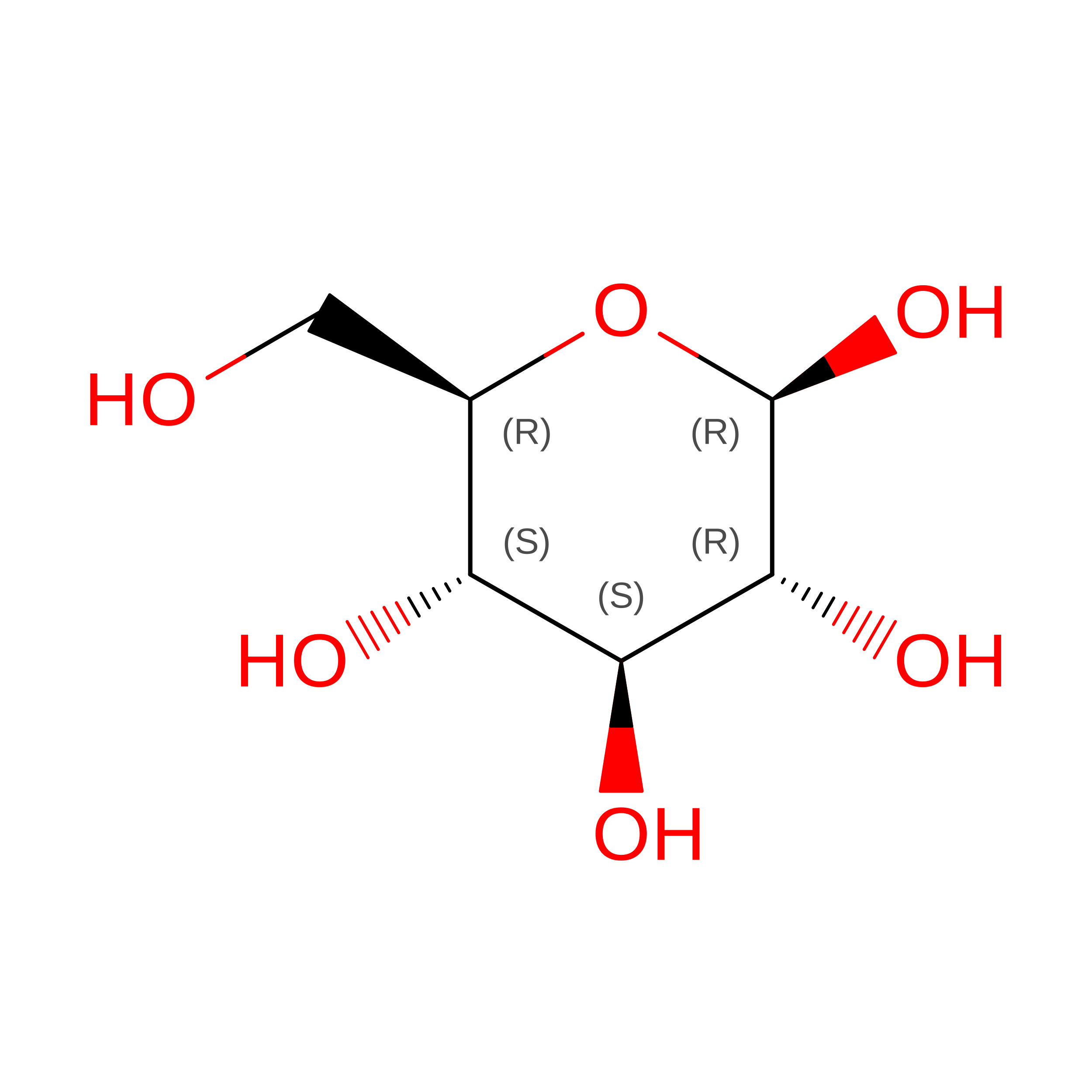
BGC

Query on BGC


Download:Ideal Coordinates CCD File
E [auth A],
G [auth B],
I [auth C],
K [auth D]
beta-D-glucopyranose
C6 H12 O6
WQZGKKKJIJFFOK-VFUOTHLCSA-N
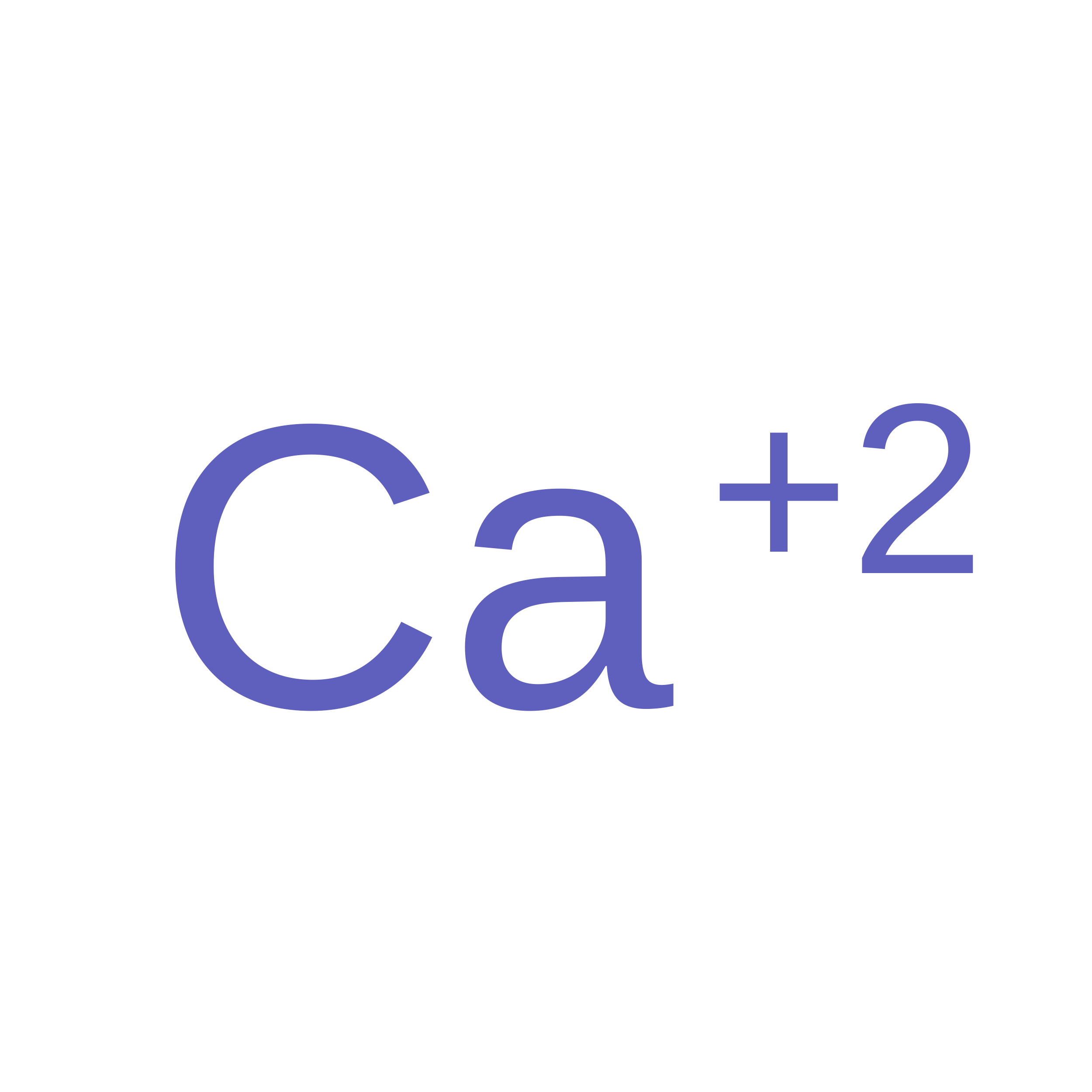
CA

Query on CA


Download:Ideal Coordinates CCD File
F [auth A],
H [auth B],
J [auth C],
L [auth D]
CALCIUM ION
Ca
BHPQYMZQTOCNFJ-UHFFFAOYSA-N

Experimental Data & Validation

Experimental Data

  • Method: X-RAY DIFFRACTION
  • Resolution: 2.10 Å
  • R-Value Free:  0.236 (Depositor), 0.237 (DCC) 
  • R-Value Work:  0.179 (Depositor), 0.179 (DCC) 
Space Group: C 1 2 1
Unit Cell:
Length ( Å )Angle ( ˚ )
a = 177.9α = 90
b = 112.9β = 105.8
c = 146.2γ = 90
Software Package:
Software NamePurpose
DENZOdata reduction
SCALEPACKdata scaling
X-PLORmodel building
X-PLORrefinement
X-PLORphasing

Structure Validation

View Full Validation Report


Ligand Structure Quality Assessment 


Entry History 

Deposition Data

Revision History  (Full details and data files)

  • Version 1.0: 2003-06-17
    Type: Initial release
  • Version 1.1: 2008-04-27
    Changes: Version format compliance
  • Version 1.2: 2011-07-13
    Changes: Version format compliance
  • Version 1.3: 2020-07-29
    Type: Remediation
    Reason: Carbohydrate remediation
    Changes: Data collection, Derived calculations, Structure summary
  • Version 1.4: 2023-10-25
    Changes: Data collection, Database references, Refinement description, Structure summary
  • Version 1.5: 2024-11-06
    Changes: Structure summary