1J10 | pdb_00001j10

beta-amylase from Bacillus cereus var. mycoides in complex with GGX


Experimental Data Snapshot

  • Method: X-RAY DIFFRACTION
  • Resolution: 2.10 Å
  • R-Value Free: 
    0.239 (Depositor), 0.241 (DCC) 
  • R-Value Work: 
    0.189 (Depositor), 0.196 (DCC) 

Starting Model: experimental
View more details

wwPDB Validation 3D Report Full Report

Validation slider image for 1J10

This is version 2.2 of the entry. See complete history

Literature

Crystal Structures of beta-Amylase from Bacillus cereus var. mycoides in Complexes with Substrate Analogs and Affinity-Labeling Reagents

Oyama, T.Miyake, H.Kusunoki, M.Nitta, Y.

(2003) J Biochem 133: 467-474

  • DOI: https://doi.org/10.1093/jb/mvg061
  • Primary Citation Related Structures: 
    1J0Y, 1J0Z, 1J10, 1J11, 1J12

  • PubMed Abstract: 

    The crystal structures of beta-amylase from Bacillus cereus var. mycoides in complexes with five inhibitors were solved. The inhibitors used were three substrate analogs, i.e. glucose, maltose (product), and a synthesized compound, O-alpha-D-glucopyranosyl-(1-->4)-O-alpha-D-glucopyranosyl-(1-->4)-D-xylopyranose (GGX), and two affinity-labeling reagents with an epoxy alkyl group at the reducing end of glucose. For all inhibitors, one molecule was bound at the active site cleft and the non-reducing end glucose of the four inhibitors except GGX was located at subsite 1, accompanied by a large conformational change of the flexible loop (residues 93-97), which covered the bound inhibitor. In addition, another molecule of maltose or GGX was bound about 30 A away from the active site. A large movement of residues 330 and 331 around subsite 3 was also observed upon the binding of GGX at subsites 3 to 5. Two affinity-labeling reagents, alpha-EPG and alpha-EBG, were covalently bound to a catalytic residue (Glu-172). A substrate recognition mechanism for the beta-amylase was discussed based on the modes of binding of these inhibitors in the active site cleft.


  • Organizational Affiliation
    • Laboratory of Enzyme Chemistry, Graduate School of Agriculture and Biological Science, Osaka Prefecture University, Sakai, Osaka 599-8531. nitta@biochem.osakafu-u.ac.jp

Macromolecule Content 

  • Total Structure Weight: 237.39 kDa 
  • Atom Count: 17,298 
  • Modeled Residue Count: 2,064 
  • Deposited Residue Count: 2,064 
  • Unique protein chains: 1

Macromolecules

Find similar proteins by:|  3D Structure
Entity ID: 1
MoleculeChains  Sequence LengthOrganismDetailsImage
Beta-amylase
A, B, C, D
516Bacillus cereusMutation(s): 0 
EC: 3.2.1.2
UniProt
Find proteins for P36924 (Bacillus cereus)
Explore P36924 
Go to UniProtKB:  P36924
Entity Groups
Sequence Clusters30% Identity50% Identity70% Identity90% Identity95% Identity100% Identity
UniProt GroupP36924
Sequence Annotations
Expand
Reference Sequence

Oligosaccharides

Help  
Entity ID: 2
MoleculeChains Length2D Diagram GlycosylationD Interactions
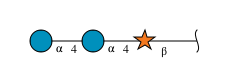
alpha-D-glucopyranose-(1-4)-alpha-D-glucopyranose-(1-4)-beta-D-xylopyranose
E, F, G, H, J
E, F, G, H, J, K, L
3N/A
Glycosylation Resources
GlyTouCan: G00915BA
GlyCosmos: G00915BA
Entity ID: 3
MoleculeChains Length2D Diagram GlycosylationD Interactions
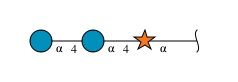
alpha-D-glucopyranose-(1-4)-alpha-D-glucopyranose-(1-4)-alpha-D-xylopyranose
I
3N/A
Glycosylation Resources
GlyTouCan: G63258XF
GlyCosmos: G63258XF

Experimental Data & Validation

Experimental Data

  • Method: X-RAY DIFFRACTION
  • Resolution: 2.10 Å
  • R-Value Free:  0.239 (Depositor), 0.241 (DCC) 
  • R-Value Work:  0.189 (Depositor), 0.196 (DCC) 
Space Group: C 1 2 1
Unit Cell:
Length ( Å )Angle ( ˚ )
a = 177.9α = 90
b = 112.9β = 105.8
c = 146.2γ = 90
Software Package:
Software NamePurpose
DENZOdata reduction
SCALEPACKdata scaling
X-PLORmodel building
X-PLORrefinement
X-PLORphasing

Structure Validation

View Full Validation Report


Entry History 

Deposition Data

Revision History  (Full details and data files)

  • Version 1.0: 2003-06-17
    Type: Initial release
  • Version 1.1: 2008-04-27
    Changes: Version format compliance
  • Version 1.2: 2011-07-13
    Changes: Version format compliance
  • Version 2.0: 2020-07-29
    Type: Remediation
    Reason: Carbohydrate remediation
    Changes: Advisory, Atomic model, Data collection, Derived calculations, Structure summary
  • Version 2.1: 2023-10-25
    Changes: Advisory, Data collection, Database references, Derived calculations, Refinement description, Structure summary
  • Version 2.2: 2024-11-13
    Changes: Structure summary