Download Mendeley
Structural basis of beta-arrestin coupling and transducer selectivity in PAC1R.
Zhang, M., Li, X., Yuan, Q.N., Hu, W., Xu, H.E., Zhao, L.H.(2026) Acta Pharmacol Sin
- PubMed: 42706324 Search on PubMedSearch on PubMed Central
- DOI: https://doi.org/10.1038/s41401-026-01924-4
- Primary Citation Related Structures:
27EM - PubMed Abstract:
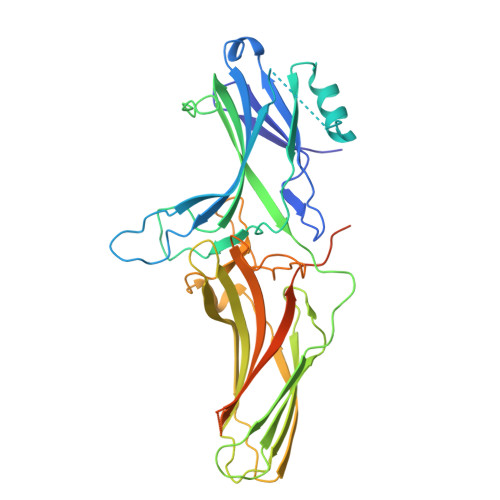
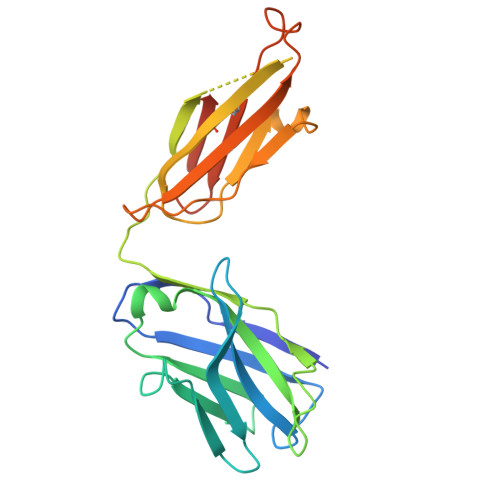
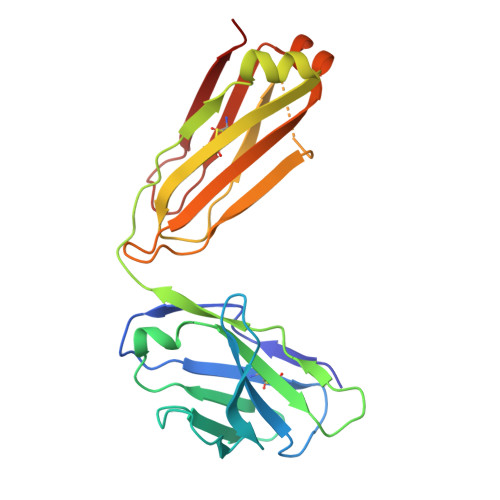
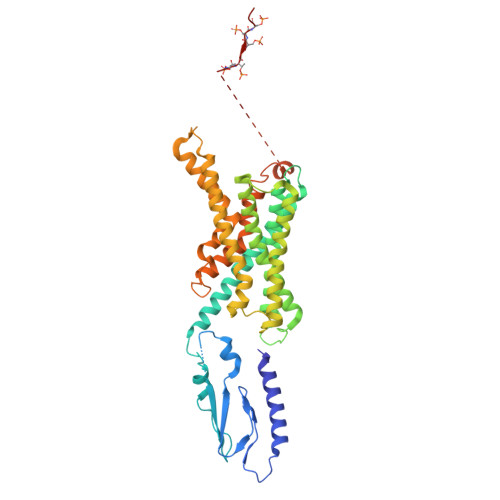
The pituitary adenylate cyclase-activating polypeptide receptor (PAC1R) is a class B G protein-coupled receptor (GPCR) that engages both G proteins and β-arrestins to mediate diverse signaling responses, yet how PAC1R adopts distinct intracellular conformations to achieve this transducer selectivity remains poorly understood. Here, we report the cryo-electron microscopy structure of PAC1R in complex with β-arrestin 1 (βarr1), revealing a core-engaged conformation. Comparison with the G s -bound PAC1R structure shows that βarr1 engagement is associated with remodeling of the intracellular transmembrane bundle, including TM5 reorientation and inward movement of TM6, resulting in a receptor core geometry distinct from that of the G protein-bound state. Comparison with the βarr1-bound parathyroid hormone receptor 1 (PTH1R) structure further reveals both conserved and receptor-specific features of βarr1 engagement. Although outward displacement of the TM5 cytoplasmic end is observed in both PAC1R-βarr1 and PTH1R-βarr1 complexes, its specific direction and the resulting TM5-TM6 rearrangements differ between receptors, correlating with distinct βarr1 finger loop orientations within the receptor core. Together, these findings suggest that β-arrestin core engagement by class B GPCRs is accompanied by receptor-specific intracellular remodeling that may contribute to transducer selectivity in PAC1R.
- State Key Laboratory of Drug Research, Shanghai Institute of Materia Medica, Chinese Academy of Sciences, Shanghai, 201203, China.
Organizational Affiliation: