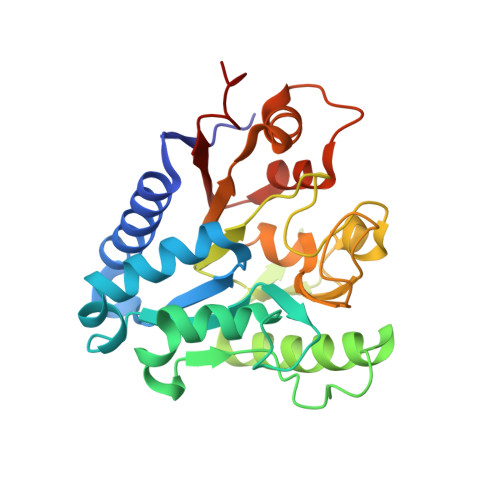
2J0E | pdb_00002j0e

Three dimensional structure and catalytic mechanism of 6- phosphogluconolactonase from Trypanosoma brucei


Experimental Data Snapshot

  • Method: X-RAY DIFFRACTION
  • Resolution: 2.10 Å
  • R-Value Free: 
    0.246 (Depositor) 
  • R-Value Work: 
    0.206 (Depositor) 
  • R-Value Observed: 
    0.206 (Depositor) 

wwPDB Validation 3D Report Full Report

Validation slider image for 2J0E

This is version 1.3 of the entry. See complete history

Literature

Three Dimensional Structure and Implications for the Catalytic Mechanism of 6-Phosphogluconolactonase from Trypanosoma Brucei.

Delarue, M.Duclert-Savatier, N.Miclet, E.Haouz, A.Giganti, D.Ouazzani, J.Lopez, P.Nilges, M.Stoven, V.

(2007) J Mol Biology 366: 868

  • DOI: https://doi.org/10.1016/j.jmb.2006.11.063
  • Primary Citation Related Structures: 
    2J0E

  • PubMed Abstract: 

    Enzymes from the pentose phosphate pathway (PPP) are potential drug targets for the development of new drugs against Trypanosoma brucei, the causative agent of African sleeping disease: for instance, the 6-phosphogluconate dehydrogenase is currently studied actively for such purposes. Structural and functional studies are necessary to better characterize the associated enzymes and compare them to their human homologues, in order to undertake structure-based drug design studies on such targets. In this context, the crystal structure of 6-phosphogluconolactonase (6PGL) from T. brucei, the second enzyme from PPP, was determined at 2.1 Angstroms resolution. Comparison of its sequence and structure to other related proteins in the 6PGL family with a known structure (Thermotoga maritima Tm6GPL 1PBT and Vibrio cholerae Vc6PGL (1Y89), which have not been discussed in print), or in the glucosamine-6-phosphate-deaminase family (hexameric Escherichia coli 1DEA and monomeric Bacillus subtilis 2BKV), allowed the identification of the 6PGL active site. In addition to the analysis of the crystal structure, 3D NMR interaction studies and docking experiments are reported here. Key residues involved in substrate binding or in catalysis were identified.


  • Organizational Affiliation
    • Unité de Dynamique Structurale des Macromolécules, CNRS URA 2185, Institut Pasteur, 25 Rue du Docteur Roux, 75015 Paris, France. marc.delarue@pasteur.fr

Macromolecule Content 

  • Total Structure Weight: 58.33 kDa 
  • Atom Count: 4,408 
  • Modeled Residue Count: 526 
  • Deposited Residue Count: 532 
  • Unique protein chains: 1

Macromolecules

Find similar proteins by:|  3D Structure
Entity ID: 1
MoleculeChains  Sequence LengthOrganismDetailsImage
6-PHOSPHOGLUCONOLACTONASE
A, B
266Trypanosoma bruceiMutation(s): 0 
EC: 3.1.1.31
UniProt
Find proteins for Q9GRG6 (Trypanosoma brucei)
Explore Q9GRG6 
Go to UniProtKB:  Q9GRG6
Entity Groups
Sequence Clusters30% Identity50% Identity70% Identity90% Identity95% Identity100% Identity
UniProt GroupQ9GRG6
Sequence Annotations
Expand
Reference Sequence

Experimental Data & Validation

Experimental Data

  • Method: X-RAY DIFFRACTION
  • Resolution: 2.10 Å
  • R-Value Free:  0.246 (Depositor) 
  • R-Value Work:  0.206 (Depositor) 
  • R-Value Observed: 0.206 (Depositor) 
Space Group: P 21 21 21
Unit Cell:
Length ( Å )Angle ( ˚ )
a = 70.31α = 90
b = 80.85β = 90
c = 90.31γ = 90
Software Package:
Software NamePurpose
CNSrefinement
MOSFLMdata reduction
SCALEPACKdata scaling
SOLVEphasing

Structure Validation

View Full Validation Report


Entry History 

Deposition Data

Revision History  (Full details and data files)

  • Version 1.0: 2007-01-03
    Type: Initial release
  • Version 1.1: 2011-05-08
    Changes: Version format compliance
  • Version 1.2: 2011-07-13
    Changes: Version format compliance
  • Version 1.3: 2024-05-08
    Changes: Data collection, Database references, Derived calculations, Other