2PF4 | pdb_00002pf4

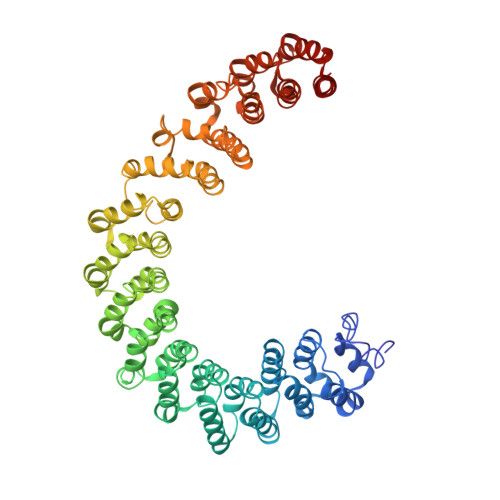
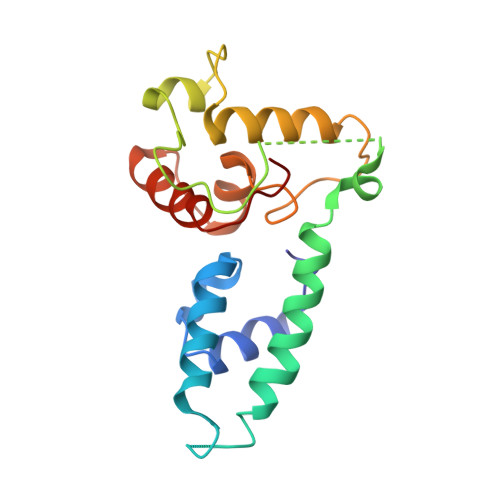
Crystal structure of the full-length simian virus 40 small t antigen complexed with the protein phosphatase 2A Aalpha subunit


Experimental Data Snapshot

  • Method: X-RAY DIFFRACTION
  • Resolution: 3.10 Å
  • R-Value Free: 
    0.304 (Depositor) 
  • R-Value Work: 
    0.244 (Depositor), 0.237 (DCC) 
  • R-Value Observed: 
    0.247 (Depositor) 

Starting Model: experimental
View more details

wwPDB Validation 3D Report Full Report

Validation slider image for 2PF4

This is version 1.4 of the entry. See complete history

Literature

Structural basis of PP2A inhibition by small t antigen.

Cho, U.S.Morrone, S.Sablina, A.A.Arroyo, J.D.Hahn, W.C.Xu, W.

(2007) PLoS Biol 5: e202-e202

  • DOI: https://doi.org/10.1371/journal.pbio.0050202
  • Primary Citation Related Structures: 
    2PF4

  • PubMed Abstract: 

    The SV40 small t antigen (ST) is a potent oncoprotein that perturbs the function of protein phosphatase 2A (PP2A). ST directly interacts with the PP2A scaffolding A subunit and alters PP2A activity by displacing regulatory B subunits from the A subunit. We have determined the crystal structure of full-length ST in complex with PP2A A subunit at 3.1 A resolution. ST consists of an N-terminal J domain and a C-terminal unique domain that contains two zinc-binding motifs. Both the J domain and second zinc-binding motif interact with the intra-HEAT-repeat loops of HEAT repeats 3-7 of the A subunit, which overlaps with the binding site of the PP2A B56 subunit. Intriguingly, the first zinc-binding motif is in a position that may allow it to directly interact with and inhibit the phosphatase activity of the PP2A catalytic C subunit. These observations provide a structural basis for understanding the oncogenic functions of ST.


  • Organizational Affiliation
    • Department of Biological Structure, University of Washington, Seattle, Washington, United States of America.

Macromolecule Content 

  • Total Structure Weight: 344.17 kDa 
  • Atom Count: 22,802 
  • Modeled Residue Count: 2,904 
  • Deposited Residue Count: 3,052 
  • Unique protein chains: 2

Macromolecules

Find similar proteins by:|  3D Structure
Entity ID: 1
MoleculeChains  Sequence LengthOrganismDetailsImage
Serine/threonine-protein phosphatase 2A 65 kDa regulatory subunit A alpha isoform
A, B, C, D
589Mus musculusMutation(s): 0 
Gene Names: Ppp2r1a
UniProt
Find proteins for Q76MZ3 (Mus musculus)
Explore Q76MZ3 
Go to UniProtKB:  Q76MZ3
Entity Groups
Sequence Clusters30% Identity50% Identity70% Identity90% Identity95% Identity100% Identity
UniProt GroupQ76MZ3
Sequence Annotations
Expand
Reference Sequence
Find similar proteins by:|  3D Structure
Entity ID: 2
MoleculeChains  Sequence LengthOrganismDetailsImage
Small T antigen
E, F, G, H
174Betapolyomavirus macacaeMutation(s): 0 
Gene Names: small t antigen
UniProt
Find proteins for P03081 (Simian virus 40)
Explore P03081 
Go to UniProtKB:  P03081
Entity Groups
Sequence Clusters30% Identity50% Identity70% Identity90% Identity95% Identity100% Identity
UniProt GroupP03081
Sequence Annotations
Expand
Reference Sequence

Experimental Data & Validation

Experimental Data

  • Method: X-RAY DIFFRACTION
  • Resolution: 3.10 Å
  • R-Value Free:  0.304 (Depositor) 
  • R-Value Work:  0.244 (Depositor), 0.237 (DCC) 
  • R-Value Observed: 0.247 (Depositor) 
Space Group: P 1
Unit Cell:
Length ( Å )Angle ( ˚ )
a = 94.711α = 115.64
b = 105.501β = 109.55
c = 111.937γ = 94.11
Software Package:
Software NamePurpose
DENZOdata reduction
SCALEPACKdata scaling
PHASERphasing
SHARPphasing
DMphasing
REFMACrefinement
PDB_EXTRACTdata extraction
HKL-2000data reduction
HKL-2000data scaling

Structure Validation

View Full Validation Report


Entry History 

Deposition Data

Revision History  (Full details and data files)

  • Version 1.0: 2007-08-07
    Type: Initial release
  • Version 1.1: 2011-07-13
    Changes: Advisory, Version format compliance
  • Version 1.2: 2013-05-22
    Changes: Database references
  • Version 1.3: 2017-10-18
    Changes: Refinement description
  • Version 1.4: 2023-08-30
    Changes: Data collection, Database references, Derived calculations, Refinement description