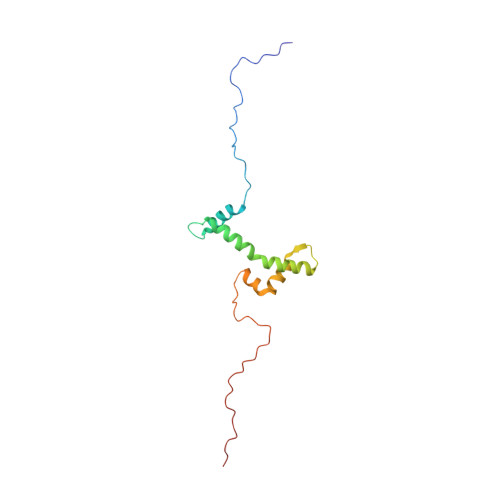
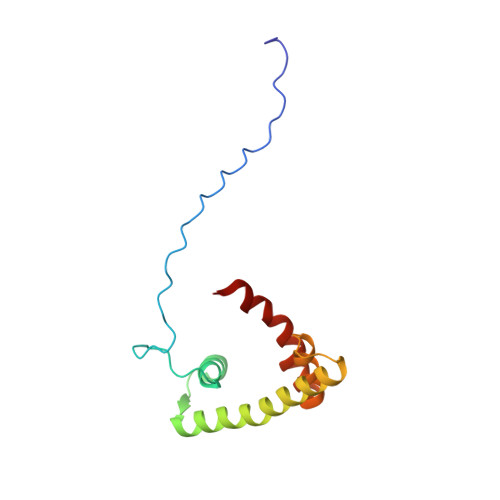
2RVQ | pdb_00002rvq

Solution structure of the isolated histone H2A-H2B heterodimer


Experimental Data Snapshot

  • Method: SOLUTION NMR
  • Conformers Calculated: 10000 
  • Conformers Submitted: 10 
  • Selection Criteria: structures with the lowest energy 

wwPDB Validation 3D Report Full Report

Validation slider image for 2RVQ

This is version 1.1 of the entry. See complete history

Literature

Solution structure of the isolated histone H2A-H2B heterodimer

Moriwaki, Y.Yamane, T.Ohtomo, H.Ikeguchi, M.Kurita, J.Sato, M.Nagadoi, A.Shimojo, H.Nishimura, Y.

(2016) Sci Rep 6: 24999-24999

  • DOI: https://doi.org/10.1038/srep24999
  • Primary Citation Related Structures: 
    2RVQ

  • PubMed Abstract: 

    During chromatin-regulated processes, the histone H2A-H2B heterodimer functions dynamically in and out of the nucleosome. Although detailed crystal structures of nucleosomes have been established, that of the isolated full-length H2A-H2B heterodimer has remained elusive. Here, we have determined the solution structure of human H2A-H2B by NMR coupled with CS-Rosetta. H2A and H2B each contain a histone fold, comprising four α-helices and two β-strands (α1-β1-α2-β2-α3-αC), together with the long disordered N- and C-terminal H2A tails and the long N-terminal H2B tail. The N-terminal αN helix, C-terminal β3 strand, and 310 helix of H2A observed in the H2A-H2B nucleosome structure are disordered in isolated H2A-H2B. In addition, the H2A α1 and H2B αC helices are not well fixed in the heterodimer, and the H2A and H2B tails are not completely random coils. Comparison of hydrogen-deuterium exchange, fast hydrogen exchange, and {(1)H}-(15)N hetero-nuclear NOE data with the CS-Rosetta structure indicates that there is some conformation in the H2A 310 helical and H2B Lys11 regions, while the repression domain of H2B (residues 27-34) exhibits an extended string-like structure. This first structure of the isolated H2A-H2B heterodimer provides insight into its dynamic functions in chromatin.


  • Organizational Affiliation
    • Graduate School of Medical Life Science, Yokohama City University, 1-7-29 Suehiro-cho, Tsurumi-ku, Yokohama 230-0045, Japan.

Macromolecule Content 

  • Total Structure Weight: 28.52 kDa 
  • Atom Count: 2,003 
  • Modeled Residue Count: 262 
  • Deposited Residue Count: 262 
  • Unique protein chains: 2

Macromolecules

Find similar proteins by:|  3D Structure
Entity ID: 1
MoleculeChains  Sequence LengthOrganismDetailsImage
Histone H2A type 1-B/EA [auth C]133Homo sapiensMutation(s): 0 
Gene Names: HIST1H2ABH2AFMHIST1H2AEH2AFA
UniProt & NIH Common Fund Data Resources
Find proteins for P04908 (Homo sapiens)
Explore P04908 
Go to UniProtKB:  P04908
Entity Groups
Sequence Clusters30% Identity50% Identity70% Identity90% Identity95% Identity100% Identity
UniProt GroupP04908
Sequence Annotations
Expand
Reference Sequence
Find similar proteins by:|  3D Structure
Entity ID: 2
MoleculeChains  Sequence LengthOrganismDetailsImage
Histone H2B type 1-JB [auth D]129Homo sapiensMutation(s): 0 
Gene Names: HIST1H2BJH2BFR
UniProt & NIH Common Fund Data Resources
Find proteins for P06899 (Homo sapiens)
Explore P06899 
Go to UniProtKB:  P06899
PHAROS:  P06899
GTEx:  ENSG00000124635 
Entity Groups
Sequence Clusters30% Identity50% Identity70% Identity90% Identity95% Identity100% Identity
UniProt GroupP06899
Sequence Annotations
Expand
Reference Sequence

Experimental Data & Validation

Experimental Data

  • Method: SOLUTION NMR
  • Conformers Calculated: 10000 
  • Conformers Submitted: 10 
  • Selection Criteria: structures with the lowest energy 

Structure Validation

View Full Validation Report


Entry History 

Deposition Data

Revision History  (Full details and data files)

  • Version 1.0: 2016-05-25
    Type: Initial release
  • Version 1.1: 2024-05-01
    Changes: Data collection, Database references