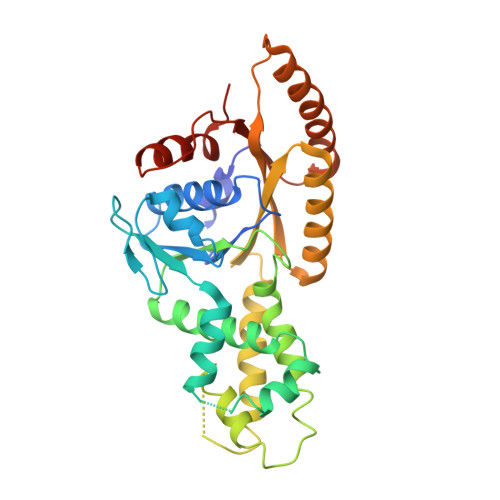
2WOO | pdb_00002woo

Nucleotide-free form of S. pombe Get3


Experimental Data Snapshot

  • Method: X-RAY DIFFRACTION
  • Resolution: 3.01 Å
  • R-Value Free: 
    0.288 (Depositor), 0.274 (DCC) 
  • R-Value Work: 
    0.237 (Depositor), 0.230 (DCC) 
  • R-Value Observed: 
    0.240 (Depositor) 

Starting Model: experimental
View more details

wwPDB Validation 3D Report Full Report

Validation slider image for 2WOO

This is version 1.3 of the entry. See complete history

Literature

The Structural Basis of Tail-Anchored Membrane Protein Recognition by Get3.

Mateja, A.Szlachcic, A.Downing, M.E.Dobosz, M.Mariappan, M.Hegde, R.S.Keenan, R.J.

(2009) Nature 461: 361

  • DOI: https://doi.org/10.1038/nature08319
  • Primary Citation Related Structures: 
    2WOJ, 2WOO

  • PubMed Abstract: 

    Targeting of newly synthesized membrane proteins to the endoplasmic reticulum is an essential cellular process. Most membrane proteins are recognized and targeted co-translationally by the signal recognition particle. However, nearly 5% of membrane proteins are 'tail-anchored' by a single carboxy-terminal transmembrane domain that cannot access the co-translational pathway. Instead, tail-anchored proteins are targeted post-translationally by a conserved ATPase termed Get3. The mechanistic basis for tail-anchored protein recognition or targeting by Get3 is not known. Here we present crystal structures of yeast Get3 in 'open' (nucleotide-free) and 'closed' (ADP.AlF(4)(-)-bound) dimer states. In the closed state, the dimer interface of Get3 contains an enormous hydrophobic groove implicated by mutational analyses in tail-anchored protein binding. In the open state, Get3 undergoes a striking rearrangement that disrupts the groove and shields its hydrophobic surfaces. These data provide a molecular mechanism for nucleotide-regulated binding and release of tail-anchored proteins during their membrane targeting by Get3.


  • Organizational Affiliation
    • Department of Biochemistry & Molecular Biology, The University of Chicago, Gordon Center for Integrative Science, Room W238, 929 East 57th Street, Chicago, Illinois 60637, USA.

Macromolecule Content 

  • Total Structure Weight: 219.68 kDa 
  • Atom Count: 14,115 
  • Modeled Residue Count: 1,818 
  • Deposited Residue Count: 1,974 
  • Unique protein chains: 1

Macromolecules

Find similar proteins by:|  3D Structure
Entity ID: 1
MoleculeChains  Sequence LengthOrganismDetailsImage
ATPASE GET3
A, B, C, D, E
A, B, C, D, E, F
329Schizosaccharomyces pombeMutation(s): 0 
EC: 3.6.3.16 (PDB Primary Data), 3.6 (UniProt)
UniProt
Find proteins for Q9P7F8 (Schizosaccharomyces pombe (strain 972 / ATCC 24843))
Explore Q9P7F8 
Go to UniProtKB:  Q9P7F8
Entity Groups
Sequence Clusters30% Identity50% Identity70% Identity90% Identity95% Identity100% Identity
UniProt GroupQ9P7F8
Sequence Annotations
Expand
Reference Sequence

Experimental Data & Validation

Experimental Data

  • Method: X-RAY DIFFRACTION
  • Resolution: 3.01 Å
  • R-Value Free:  0.288 (Depositor), 0.274 (DCC) 
  • R-Value Work:  0.237 (Depositor), 0.230 (DCC) 
  • R-Value Observed: 0.240 (Depositor) 
Space Group: P 21 21 21
Unit Cell:
Length ( Å )Angle ( ˚ )
a = 73.795α = 90
b = 92.922β = 90
c = 286.468γ = 90
Software Package:
Software NamePurpose
PHENIXrefinement
DENZOdata reduction
SCALEPACKdata scaling
PHASERphasing

Structure Validation

View Full Validation Report


Entry History 

Deposition Data

Revision History  (Full details and data files)

  • Version 1.0: 2009-08-11
    Type: Initial release
  • Version 1.1: 2011-05-08
    Changes: Version format compliance
  • Version 1.2: 2011-07-13
    Changes: Version format compliance
  • Version 1.3: 2023-12-20
    Changes: Data collection, Database references, Derived calculations, Other, Refinement description