3EB4 | pdb_00003eb4

Voltage-dependent K+ channel beta subunit (I211R) in complex with cortisone


Experimental Data Snapshot

  • Method: X-RAY DIFFRACTION
  • Resolution: 2.00 Å
  • R-Value Free: 
    0.256 (Depositor), 0.255 (DCC) 
  • R-Value Work: 
    0.223 (Depositor), 0.223 (DCC) 
  • R-Value Observed: 
    0.223 (Depositor) 

Starting Model: experimental
View more details

wwPDB Validation 3D Report Full Report

Validation slider image for 3EB4

Ligand Structure Quality Assessment 


This is version 1.3 of the entry. See complete history

Literature

Cortisone dissociates the Shaker family K+ channels from their beta subunits.

Pan, Y.Weng, J.Kabaleeswaran, V.Li, H.Cao, Y.Bhosle, R.C.Zhou, M.

(2008) Nat Chem Biol 4: 708-714

  • DOI: https://doi.org/10.1038/nchembio.114
  • Primary Citation Related Structures: 
    3EAU, 3EB3, 3EB4

  • PubMed Abstract: 

    The Shaker family voltage-dependent potassium channels (Kv1) are expressed in a wide variety of cells and are essential for cellular excitability. In humans, loss-of-function mutations of Kv1 channels lead to hyperexcitability and are directly linked to episodic ataxia and atrial fibrillation. All Kv1 channels assemble with beta subunits (Kv betas), and certain Kv betas, for example Kv beta 1, have an N-terminal segment that closes the channel by the N-type inactivation mechanism. In principle, dissociation of Kv beta 1, although never reported, should eliminate inactivation and thus potentiate Kv1 current. We found that cortisone increases rat Kv1 channel activity by binding to Kv beta 1. A crystal structure of the Kv beta-cortisone complex was solved to 1.82-A resolution and revealed novel cortisone binding sites. Further studies demonstrated that cortisone promotes dissociation of Kv beta. The new mode of channel modulation may be explored by native or synthetic ligands to fine-tune cellular excitability.


  • Organizational Affiliation
    • Department of Physiology and Cellular Biophysics, Columbia University College of Physicians and Surgeons, 630 West 168th Street, New York, New York 10032, USA.

Macromolecule Content 

  • Total Structure Weight: 37.72 kDa 
  • Atom Count: 2,802 
  • Modeled Residue Count: 327 
  • Deposited Residue Count: 327 
  • Unique protein chains: 1

Macromolecules

Find similar proteins by:|  3D Structure
Entity ID: 1
MoleculeChains  Sequence LengthOrganismDetailsImage
Voltage-gated potassium channel subunit beta-2327Rattus norvegicusMutation(s): 1 
Gene Names: Kcnab2Ckbeta2Kcnb3
EC: 1.1.1
UniProt
Find proteins for P62483 (Rattus norvegicus)
Explore P62483 
Go to UniProtKB:  P62483
Entity Groups
Sequence Clusters30% Identity50% Identity70% Identity90% Identity95% Identity100% Identity
UniProt GroupP62483
Sequence Annotations
Expand
Reference Sequence

Small Molecules

Ligands 2 Unique
IDChains Name / Formula / InChI Key2D Diagram3D Interactions
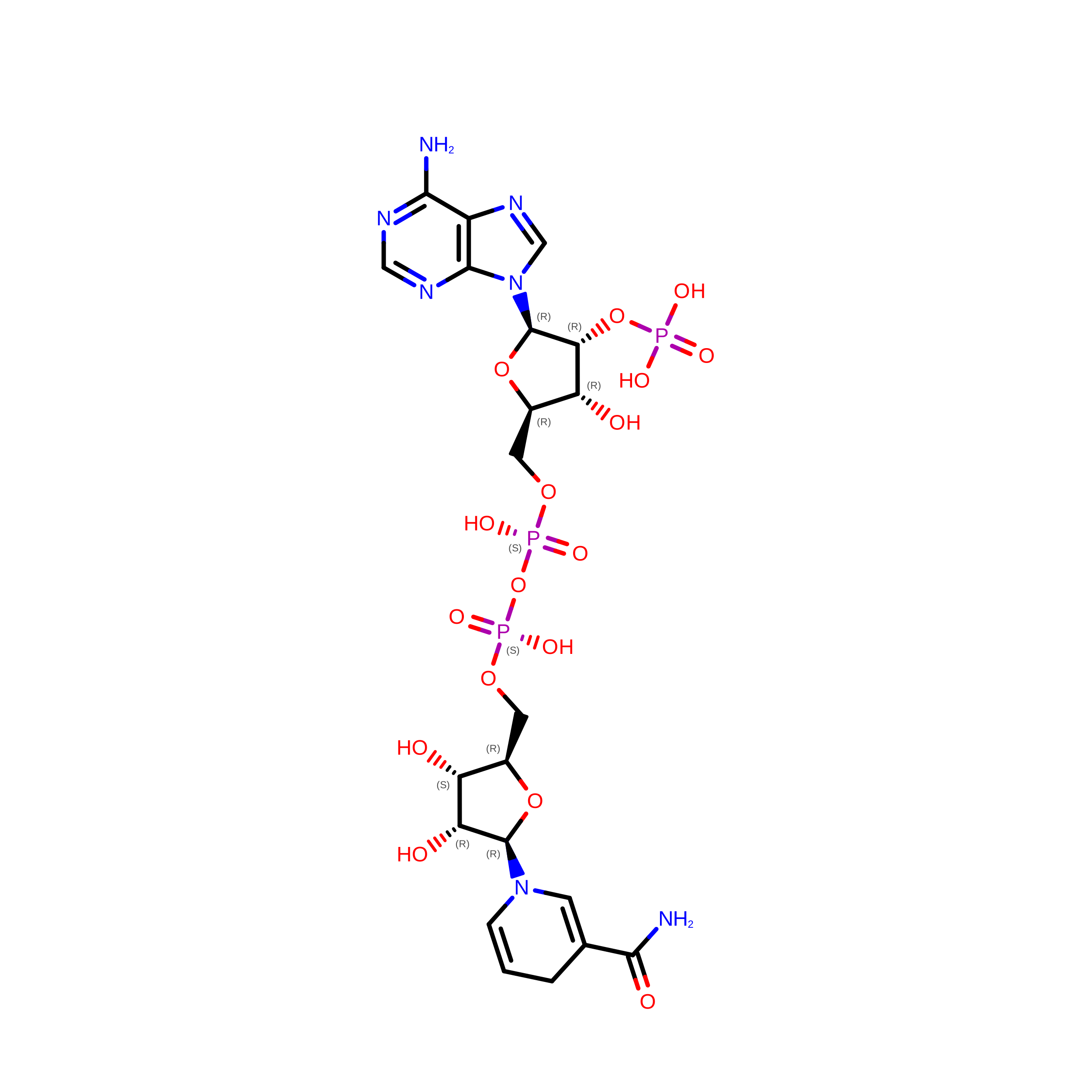
NDP

Query on NDP


Download:Ideal Coordinates CCD File
B [auth A]NADPH DIHYDRO-NICOTINAMIDE-ADENINE-DINUCLEOTIDE PHOSPHATE
C21 H30 N7 O17 P3
ACFIXJIJDZMPPO-NNYOXOHSSA-N
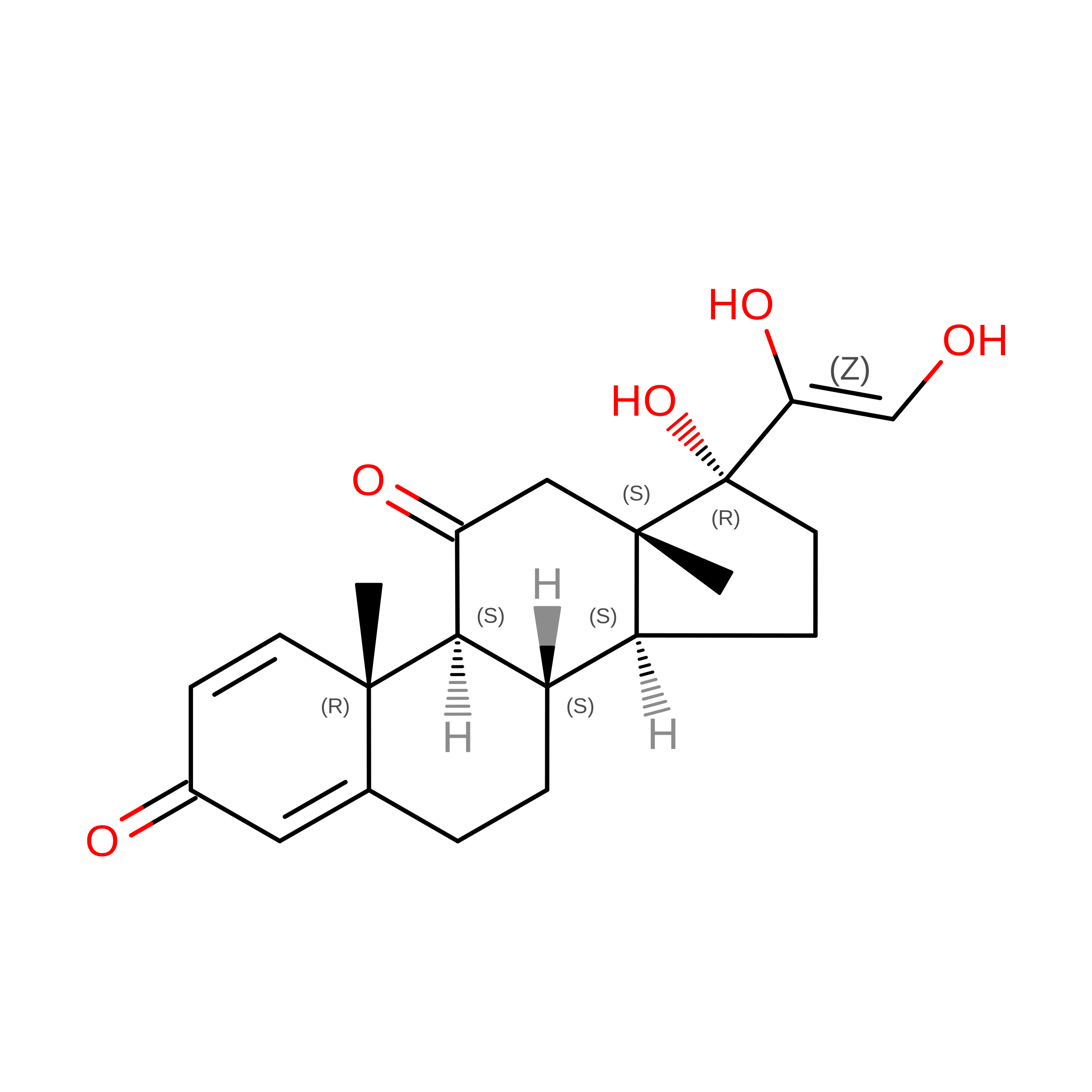
PDN

Query on PDN


Download:Ideal Coordinates CCD File
C [auth A]17,21-DIHYDROXYPREGNA-1,4-DIENE-3,11,20-TRIONE
C21 H26 O5
WZTZVUUYKIOIRV-LMZHSBCYSA-N

Experimental Data & Validation

Experimental Data

  • Method: X-RAY DIFFRACTION
  • Resolution: 2.00 Å
  • R-Value Free:  0.256 (Depositor), 0.255 (DCC) 
  • R-Value Work:  0.223 (Depositor), 0.223 (DCC) 
  • R-Value Observed: 0.223 (Depositor) 
Space Group: I 4 2 2
Unit Cell:
Length ( Å )Angle ( ˚ )
a = 113.26α = 90
b = 113.26β = 90
c = 147.266γ = 90
Software Package:
Software NamePurpose
MAR345dtbdata collection
CNSrefinement
HKL-2000data reduction
SCALEPACKdata scaling
CNSphasing

Structure Validation

View Full Validation Report


Ligand Structure Quality Assessment 


Entry History 

Deposition Data

Revision History  (Full details and data files)

  • Version 1.0: 2008-09-23
    Type: Initial release
  • Version 1.1: 2011-07-13
    Changes: Version format compliance
  • Version 1.2: 2021-10-20
    Changes: Database references, Derived calculations
  • Version 1.3: 2023-08-30
    Changes: Data collection, Refinement description