3GWL | pdb_00003gwl

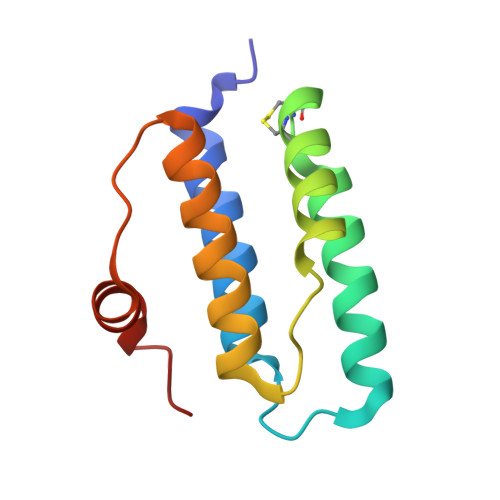
Crystal structure of ASFV pB119L, a viral sulfhydryl oxidase


Experimental Data Snapshot

  • Method: X-RAY DIFFRACTION
  • Resolution: 2.10 Å
  • R-Value Free: 
    0.261 (Depositor), 0.250 (DCC) 
  • R-Value Work: 
    0.218 (Depositor), 0.212 (DCC) 

wwPDB Validation 3D Report Full Report

Validation slider image for 3GWL

Ligand Structure Quality Assessment 


This is version 1.3 of the entry. See complete history

Literature

Dimer interface migration in a viral sulfhydryl oxidase

Hakim, M.Fass, D.

(2009) J Mol Biology 391: 758-768

  • DOI: https://doi.org/10.1016/j.jmb.2009.06.070
  • Primary Citation Related Structures: 
    3GWL, 3GWN

  • PubMed Abstract: 

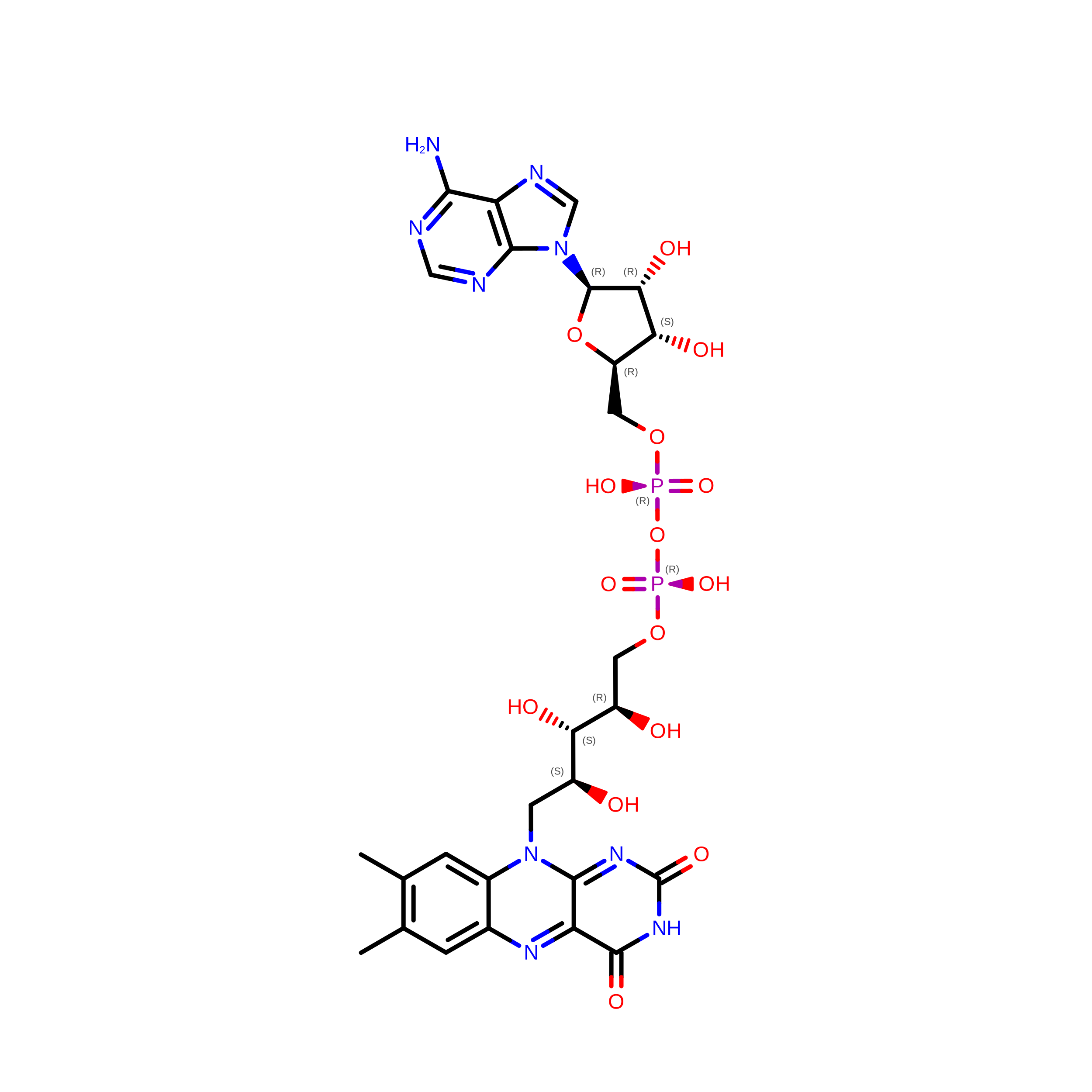
    Large double-stranded DNA viruses, including poxviruses and mimiviruses, encode enzymes to catalyze the formation of disulfide bonds in viral proteins produced in the cell cytosol, an atypical location for oxidative protein folding. These viral disulfide catalysts belong to a family of sulfhydryl oxidases that are dimers of a small five-helix fold containing a Cys-X-X-Cys motif juxtaposed to a flavin adenine dinucleotide cofactor. We report that the sulfhydryl oxidase pB119L from African swine fever virus (ASFV) uses for self-assembly surface different from that observed in homologs from mammals, plants, and fungi. Within a protein family, different packing interfaces for the same oligomerization state are extremely rare. We find that the alternate dimerization mode seen in ASFV pB119L is not characteristic of all viral sulfhydryl oxidases, as the flavin-binding domain from a mimivirus sulfhydryl oxidase assumes the same dimer structure as the known eukaryotic enzymes. ASFV pB119L demonstrates the potential of large double-stranded DNA viruses, which have faster mutation rates than their hosts and the tendency to incorporate host genes, to pioneer new protein folds and self-assembly modes.


  • Organizational Affiliation
    • Department of Structural Biology, Weizmann Institute of Science, Rehovot, Israel.

Macromolecule Content 

  • Total Structure Weight: 27.38 kDa 
  • Atom Count: 2,085 
  • Modeled Residue Count: 208 
  • Deposited Residue Count: 212 
  • Unique protein chains: 1

Macromolecules

Find similar proteins by:|  3D Structure
Entity ID: 1
MoleculeChains  Sequence LengthOrganismDetailsImage
FAD-linked sulfhydryl oxidase
A, B
106African swine fever virus BA71VMutation(s): 0 
Gene Names: 9GLB119LBa71V-073
EC: 1.8.3.2
UniProt
Find proteins for Q65163 (African swine fever virus (strain Badajoz 1971 Vero-adapted))
Explore Q65163 
Go to UniProtKB:  Q65163
Entity Groups
Sequence Clusters30% Identity50% Identity70% Identity90% Identity95% Identity100% Identity
UniProt GroupQ65163
Sequence Annotations
Expand
Reference Sequence

Experimental Data & Validation

Experimental Data

  • Method: X-RAY DIFFRACTION
  • Resolution: 2.10 Å
  • R-Value Free:  0.261 (Depositor), 0.250 (DCC) 
  • R-Value Work:  0.218 (Depositor), 0.212 (DCC) 
Space Group: P 21 21 21
Unit Cell:
Length ( Å )Angle ( ˚ )
a = 46.45α = 90
b = 69β = 90
c = 83.68γ = 90
Software Package:
Software NamePurpose
SOLVEphasing
CNSrefinement
DENZOdata reduction
SCALEPACKdata scaling

Structure Validation

View Full Validation Report


Ligand Structure Quality Assessment 


Entry History 

Deposition Data

Revision History  (Full details and data files)

  • Version 1.0: 2009-07-07
    Type: Initial release
  • Version 1.1: 2011-07-13
    Changes: Version format compliance
  • Version 1.2: 2016-12-07
    Changes: Database references
  • Version 1.3: 2024-11-20
    Changes: Data collection, Database references, Derived calculations, Structure summary