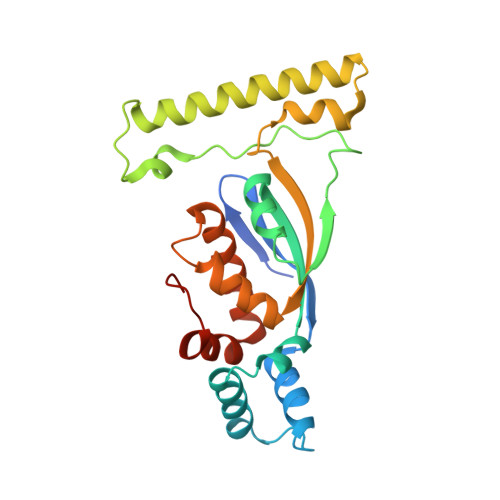
3N0B | pdb_00003n0b

TM0449 mutant crystals grown in loops/micromounts


Experimental Data Snapshot

  • Method: X-RAY DIFFRACTION
  • Resolution: 2.30 Å
  • R-Value Free: 
    0.249 (Depositor), 0.243 (DCC) 
  • R-Value Work: 
    0.198 (Depositor), 0.193 (DCC) 
  • R-Value Observed: 
    0.200 (Depositor) 

Starting Model: experimental
View more details

wwPDB Validation 3D Report Full Report

Validation slider image for 3N0B

Ligand Structure Quality Assessment 


This is version 1.4 of the entry. See complete history

Literature

Diffraction study of protein crystals grown in cryoloops and micromounts.

Berger, M.A.Decker, J.H.Mathews, I.I.

(2010) J Appl Crystallogr 43: 1513-1518

  • DOI: https://doi.org/10.1107/S0021889810040409
  • Primary Citation Related Structures: 
    3MZQ, 3MZR, 3N02, 3N03, 3N0B, 3N0C

  • PubMed Abstract: 

    Protein crystals are usually grown in hanging or sitting drops and generally get transferred to a loop or micromount for cryocooling and data collection. This paper describes a method for growing crystals on cryoloops for easier manipulation of the crystals for data collection. This study also investigates the steps for the automation of this process and describes the design of a new tray for the method. The diffraction patterns and the structures of three proteins grown by both the new method and the conventional hanging-drop method are compared. The new setup is optimized for the automation of the crystal mounting process. Researchers could prepare nanolitre drops under ordinary laboratory conditions by growing the crystals directly in loops or micromounts. As has been pointed out before, higher levels of supersaturation can be obtained in very small volumes, and the new method may help in the exploration of additional crystallization conditions.


  • Organizational Affiliation
    • Stanford Synchrotron Radiation Lightsource, Stanford University, 2575 Sand Hill Road, SSRL MS 99, Menlo Park, CA 94025, USA.

Macromolecule Content 

  • Total Structure Weight: 113.62 kDa 
  • Atom Count: 7,464 
  • Modeled Residue Count: 862 
  • Deposited Residue Count: 928 
  • Unique protein chains: 1

Macromolecules

Find similar proteins by:|  3D Structure
Entity ID: 1
MoleculeChains  Sequence LengthOrganismDetailsImage
Thymidylate synthase thyX
A, B, C, D
232Thermotoga maritimaMutation(s): 2 
Gene Names: thy1thyXtm0449TM_0449
EC: 2.1.1.148
UniProt
Find proteins for Q9WYT0 (Thermotoga maritima (strain ATCC 43589 / DSM 3109 / JCM 10099 / NBRC 100826 / MSB8))
Explore Q9WYT0 
Go to UniProtKB:  Q9WYT0
Entity Groups
Sequence Clusters30% Identity50% Identity70% Identity90% Identity95% Identity100% Identity
UniProt GroupQ9WYT0
Sequence Annotations
Expand
Reference Sequence

Small Molecules

Ligands 2 Unique
IDChains Name / Formula / InChI Key2D Diagram3D Interactions
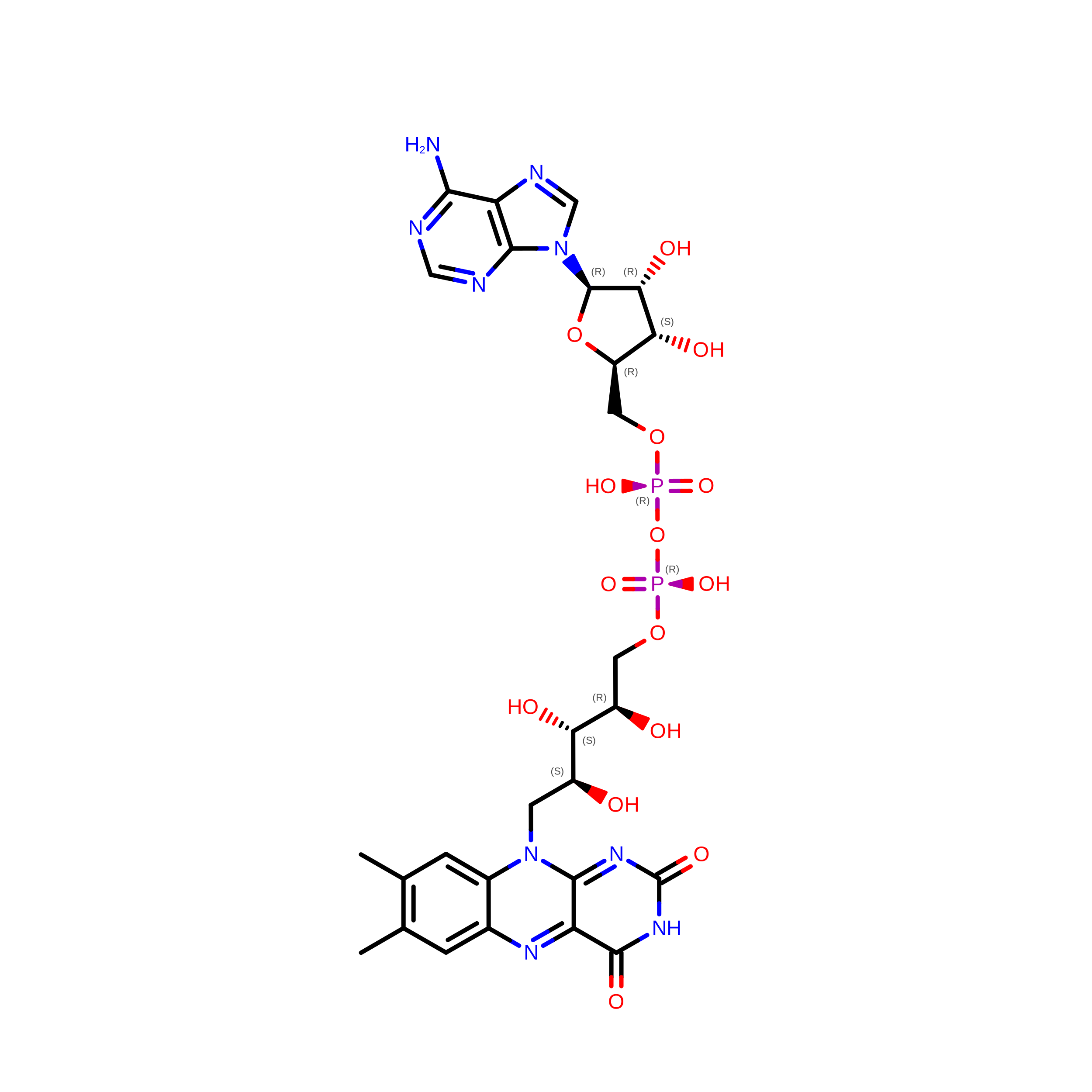
FAD

Query on FAD


Download:Ideal Coordinates CCD File
F [auth A],
H [auth B],
I [auth C],
K [auth D]
FLAVIN-ADENINE DINUCLEOTIDE
C27 H33 N9 O15 P2
VWWQXMAJTJZDQX-UYBVJOGSSA-N
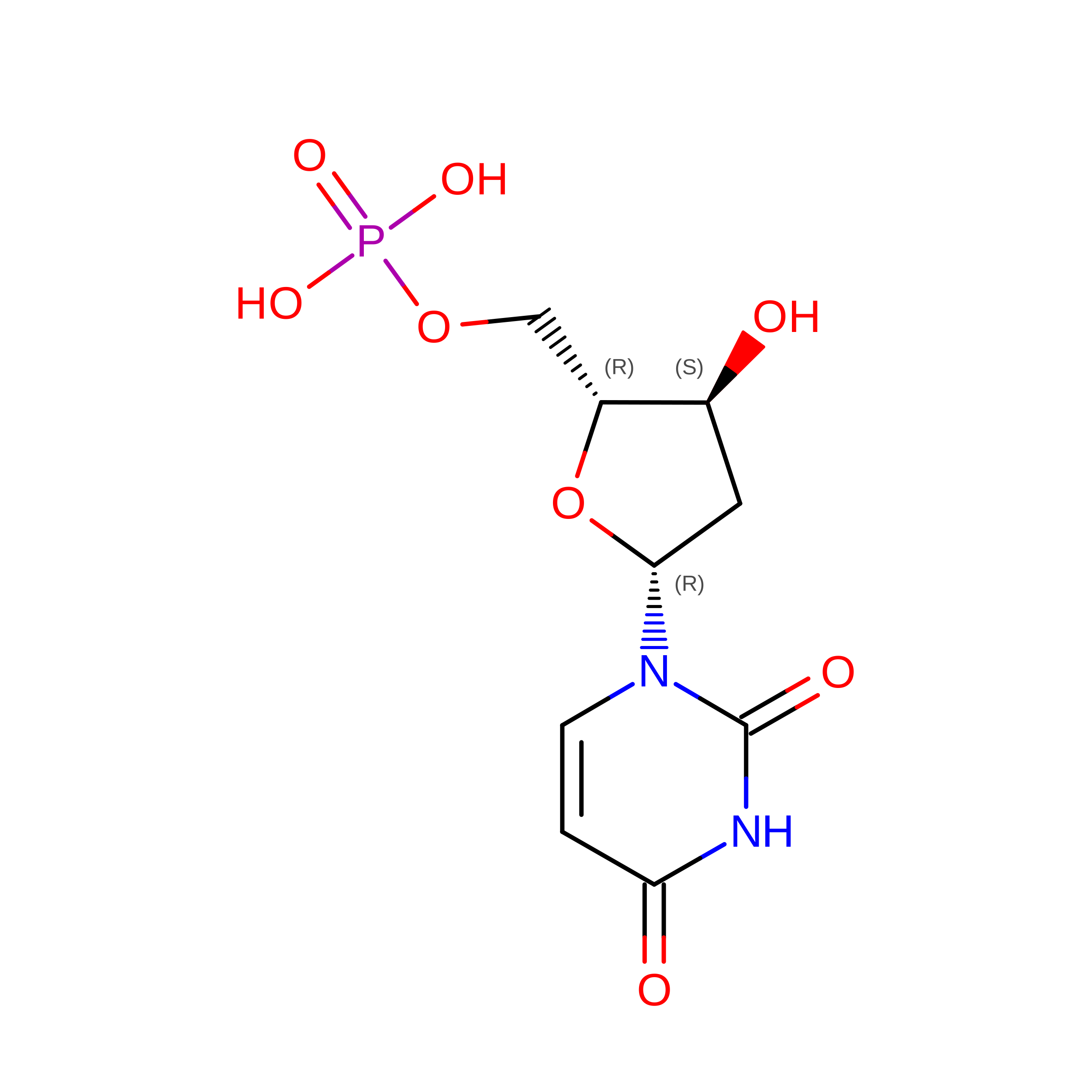
UMP

Query on UMP


Download:Ideal Coordinates CCD File
E [auth A],
G [auth B],
J [auth C],
L [auth D]
2'-DEOXYURIDINE 5'-MONOPHOSPHATE
C9 H13 N2 O8 P
JSRLJPSBLDHEIO-SHYZEUOFSA-N

Experimental Data & Validation

Experimental Data

  • Method: X-RAY DIFFRACTION
  • Resolution: 2.30 Å
  • R-Value Free:  0.249 (Depositor), 0.243 (DCC) 
  • R-Value Work:  0.198 (Depositor), 0.193 (DCC) 
  • R-Value Observed: 0.200 (Depositor) 
Space Group: P 21 21 21
Unit Cell:
Length ( Å )Angle ( ˚ )
a = 54.523α = 90
b = 116.754β = 90
c = 141.053γ = 90
Software Package:
Software NamePurpose
Blu-Icedata collection
REFMACrefinement
MOSFLMdata reduction
SCALAdata scaling

Structure Validation

View Full Validation Report


Ligand Structure Quality Assessment 


Entry History 

Deposition Data

Revision History  (Full details and data files)

  • Version 1.0: 2011-05-25
    Type: Initial release
  • Version 1.1: 2011-07-13
    Changes: Version format compliance
  • Version 1.2: 2012-04-25
    Changes: Database references
  • Version 1.3: 2017-11-08
    Changes: Refinement description
  • Version 1.4: 2023-09-06
    Changes: Data collection, Database references, Derived calculations, Refinement description