3N3I | pdb_00003n3i

Crystal Structure of G48V/C95F tethered HIV-1 Protease/Saquinavir complex


Experimental Data Snapshot

  • Method: X-RAY DIFFRACTION
  • Resolution: 2.50 Å
  • R-Value Free: 
    0.253 (Depositor), 0.260 (DCC) 
  • R-Value Work: 
    0.216 (Depositor), 0.214 (DCC) 
  • R-Value Observed: 
    0.218 (Depositor) 

wwPDB Validation 3D Report Full Report

Validation slider image for 3N3I

Ligand Structure Quality Assessment 


This is version 1.4 of the entry. See complete history

Literature

Insights into the mechanism of drug resistance: X-ray structure analysis of G48V/C95F tethered HIV-1 protease dimer/saquinavir complex

Prashar, V.Bihani, S.C.Das, A.Rao, D.R.Hosur, M.V.

(2010) Biochem Biophys Res Commun 396: 1018-1023

  • DOI: https://doi.org/10.1016/j.bbrc.2010.05.049
  • Primary Citation Related Structures: 
    3N3I

  • PubMed Abstract: 

    The mutation G48V in HIV-1 protease is a major resistance mutation against the drug saquinavir. Recently, G48V mutation is found to co-exist with the mutation C95F in AIDS patients treated with saquinavir. We report here the three-dimensional crystal structure of G48V/C95F tethered HIV-1 protease/saquinavir complex. The structure indicates following as the possible causes of drug resistance: (1) loss of direct van der Waals interactions between saquinavir and enzyme residues PHE-53 and PRO-1081, (2) loss of water-mediated hydrogen bonds between the carbonyl oxygen atoms in saquinavir and amide nitrogen atoms of flap residues 50 and 1050, (3) changes in inter-monomer interactions, which could affect the energetics of domain movements associated with inhibitor-binding, and (4) significant reduction in the stability of the mutant dimer. The present structure also provides a rationale for the clinical observation that the resistance mutations C95F/G48V/V82A occur as a cluster in AIDS patients.


  • Organizational Affiliation
    • Solid State Physics Division, Bhabha Atomic Research Centre, Trombay, Mumbai 400085, India.

Macromolecule Content 

  • Total Structure Weight: 22.75 kDa 
  • Atom Count: 1,638 
  • Modeled Residue Count: 198 
  • Deposited Residue Count: 203 
  • Unique protein chains: 1

Macromolecules

Find similar proteins by:|  3D Structure
Entity ID: 1
MoleculeChains  Sequence LengthOrganismDetailsImage
Protease203HIV-1 M:B_HXB2RMutation(s): 4 
Gene Names: gag-pol
EC: 3.4.23.16
UniProt
Find proteins for P04585 (Human immunodeficiency virus type 1 group M subtype B (isolate HXB2))
Explore P04585 
Go to UniProtKB:  P04585
Entity Groups
Sequence Clusters30% Identity50% Identity70% Identity90% Identity95% Identity100% Identity
UniProt GroupP04585
Sequence Annotations
Expand
Reference Sequence

Small Molecules

Ligands 1 Unique
IDChains Name / Formula / InChI Key2D Diagram3D Interactions
ROC

Query on ROC


Download:Ideal Coordinates CCD File
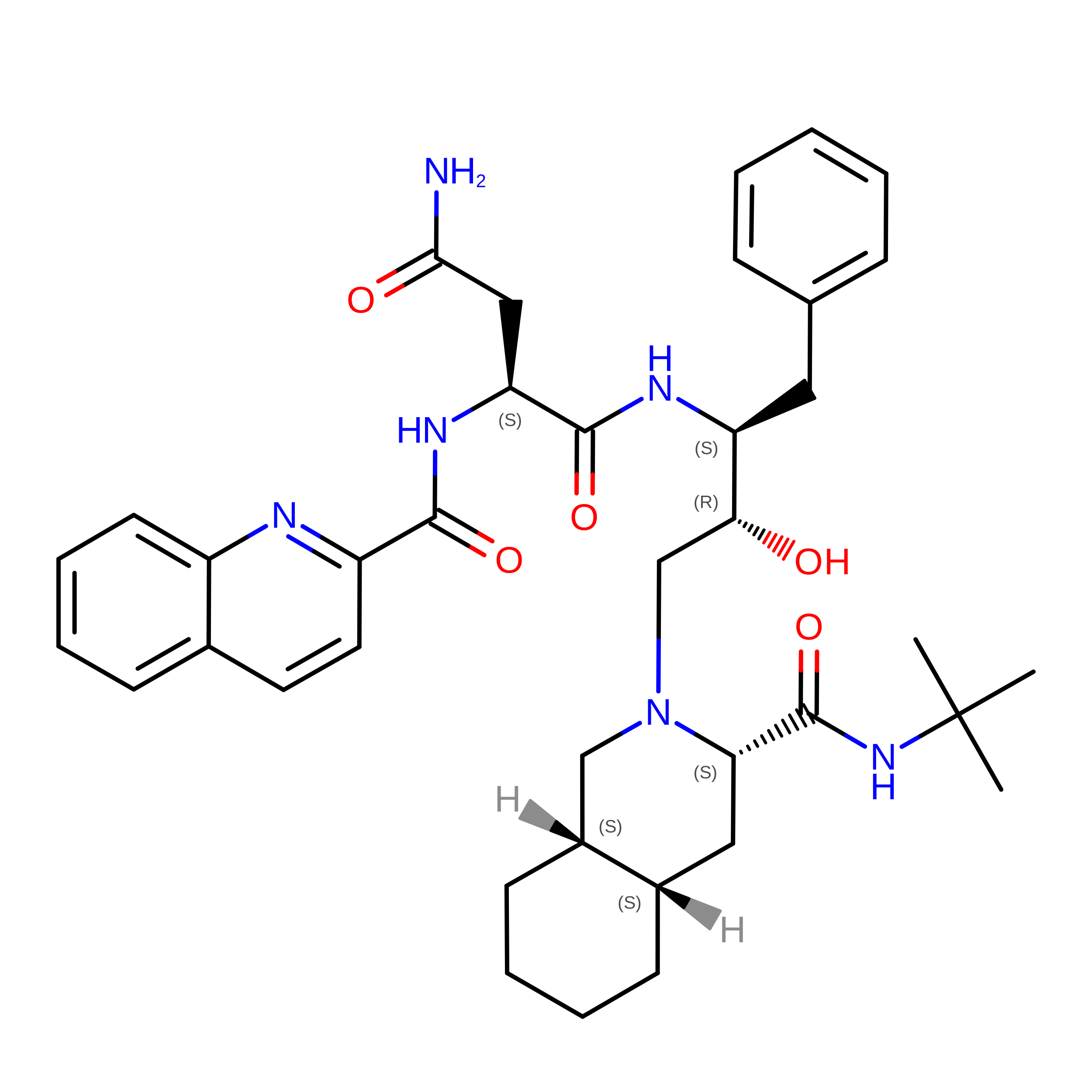
B [auth A](2S)-N-[(2S,3R)-4-[(2S,3S,4aS,8aS)-3-(tert-butylcarbamoyl)-3,4,4a,5,6,7,8,8a-octahydro-1H-isoquinolin-2-yl]-3-hydroxy-1 -phenyl-butan-2-yl]-2-(quinolin-2-ylcarbonylamino)butanediamide
C38 H50 N6 O5
QWAXKHKRTORLEM-UGJKXSETSA-N

Biologically Interesting Molecules (External Reference) 

1 Unique

Experimental Data & Validation

Experimental Data

  • Method: X-RAY DIFFRACTION
  • Resolution: 2.50 Å
  • R-Value Free:  0.253 (Depositor), 0.260 (DCC) 
  • R-Value Work:  0.216 (Depositor), 0.214 (DCC) 
  • R-Value Observed: 0.218 (Depositor) 
Space Group: P 61
Unit Cell:
Length ( Å )Angle ( ˚ )
a = 62.41α = 90
b = 62.41β = 90
c = 83.26γ = 120
Software Package:
Software NamePurpose
PHENIXrefinement
MOSFLMdata reduction
SCALAdata scaling

Structure Validation

View Full Validation Report


Ligand Structure Quality Assessment 


Entry History 

Deposition Data

Revision History  (Full details and data files)

  • Version 1.0: 2010-06-09
    Type: Initial release
  • Version 1.1: 2011-07-13
    Changes: Atomic model, Database references, Derived calculations, Non-polymer description, Structure summary, Version format compliance
  • Version 1.2: 2012-12-12
    Changes: Other
  • Version 1.3: 2017-08-09
    Changes: Source and taxonomy
  • Version 1.4: 2024-03-20
    Changes: Data collection, Database references, Derived calculations, Structure summary