3Q52 | pdb_00003q52

Structure of phosphorylated PAK1 kinase domain


Experimental Data Snapshot

  • Method: X-RAY DIFFRACTION
  • Resolution: 1.80 Å
  • R-Value Free: 
    0.214 (Depositor), 0.210 (DCC) 
  • R-Value Work: 
    0.188 (Depositor) 
  • R-Value Observed: 
    0.189 (Depositor) 

Starting Model: experimental
View more details

wwPDB Validation 3D Report Full Report

Validation slider image for 3Q52

This is version 1.3 of the entry. See complete history

Literature

Structural insights into the autoactivation mechanism of p21-activated protein kinase

Wang, J.Wu, J.-W.Wang, Z.-X.

(2011) Structure 19: 1752-1761

  • DOI: https://doi.org/10.1016/j.str.2011.10.013
  • Primary Citation Related Structures: 
    3Q4Z, 3Q52, 3Q53

  • PubMed Abstract: 

    p21-activated kinases (PAKs) play an important role in diverse cellular processes. Full activation of PAKs requires autophosphorylation of a critical threonine/serine located in the activation loop of the kinase domain. Here we report crystal structures of the phosphorylated and unphosphorylated PAK1 kinase domain. The phosphorylated PAK1 kinase domain has a conformation typical of all active protein kinases. Interestingly, the structure of the unphosphorylated PAK1 kinase domain reveals an unusual dimeric arrangement expected in an authentic enzyme-substrate complex, in which the activation loop of the putative "substrate" is projected into the active site of the "enzyme." The enzyme is bound to AMP-PNP and has an active conformation, whereas the substrate is empty and adopts an inactive conformation. Thus, the structure of the asymmetric homodimer mimics a trans-autophosphorylation complex, and suggests that unphosphorylated PAK1 could dynamically adopt both the active and inactive conformations in solution.


  • Organizational Affiliation
    • MOE Key Laboratory for Protein Science, School of Life Sciences, Tsinghua University, Beijing 100084, China.

Macromolecule Content 

  • Total Structure Weight: 34.57 kDa 
  • Atom Count: 2,571 
  • Modeled Residue Count: 293 
  • Deposited Residue Count: 306 
  • Unique protein chains: 1

Macromolecules

Find similar proteins by:|  3D Structure
Entity ID: 1
MoleculeChains  Sequence LengthOrganismDetailsImage
Serine/threonine-protein kinase PAK 1306Homo sapiensMutation(s): 2 
Gene Names: PAK1
EC: 2.7.11.1
UniProt & NIH Common Fund Data Resources
Find proteins for Q13153 (Homo sapiens)
Explore Q13153 
Go to UniProtKB:  Q13153
PHAROS:  Q13153
GTEx:  ENSG00000149269 
Entity Groups
Sequence Clusters30% Identity50% Identity70% Identity90% Identity95% Identity100% Identity
UniProt GroupQ13153
Sequence Annotations
Expand
Reference Sequence

Small Molecules

Modified Residues  1 Unique
IDChains TypeFormula2D DiagramParent
TPO
Query on TPO
A
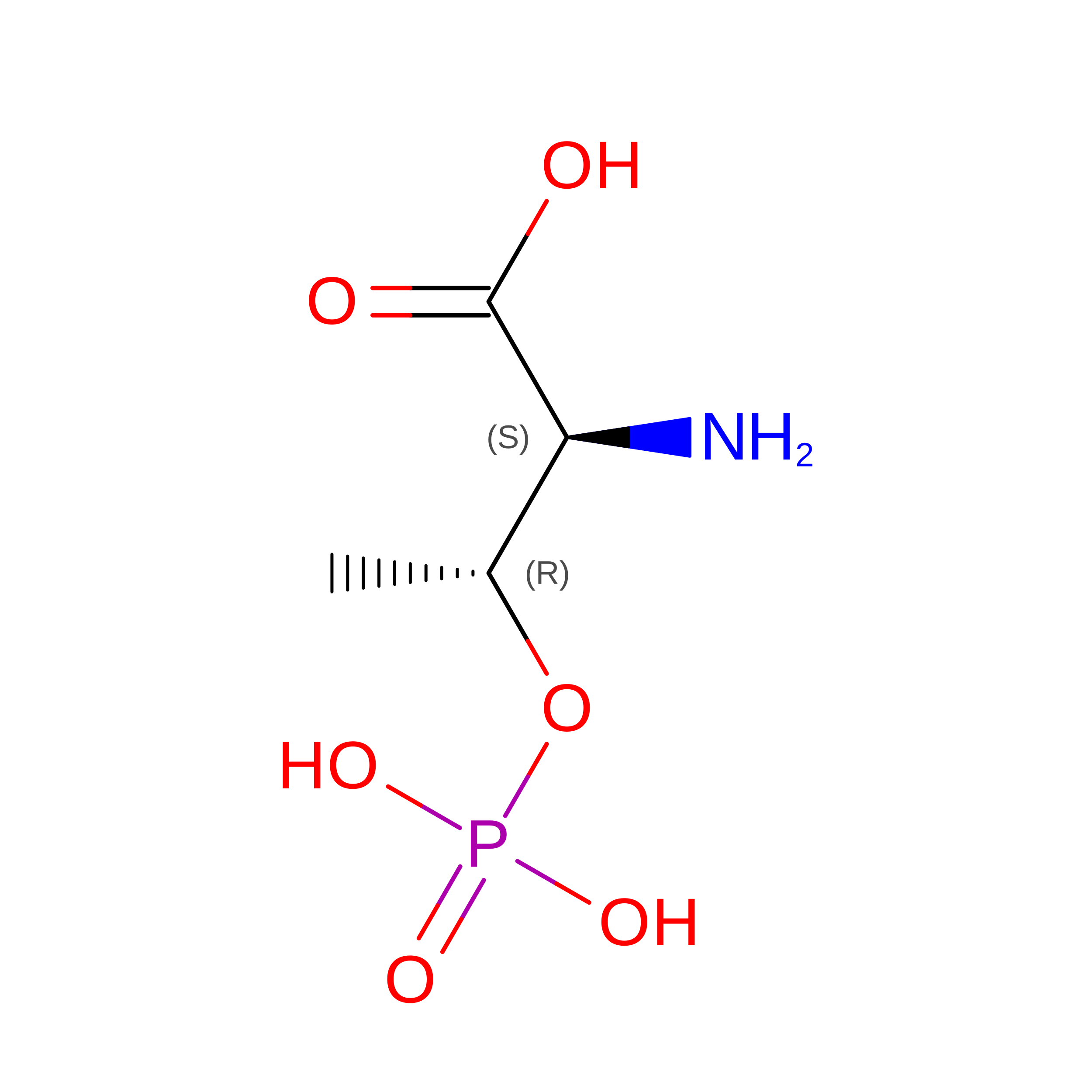
L-PEPTIDE LINKINGC4 H10 N O6 PTHR

Experimental Data & Validation

Experimental Data

  • Method: X-RAY DIFFRACTION
  • Resolution: 1.80 Å
  • R-Value Free:  0.214 (Depositor), 0.210 (DCC) 
  • R-Value Work:  0.188 (Depositor) 
  • R-Value Observed: 0.189 (Depositor) 
Space Group: C 2 2 21
Unit Cell:
Length ( Å )Angle ( ˚ )
a = 52.621α = 90
b = 103.054β = 90
c = 122.596γ = 90
Software Package:
Software NamePurpose
MAR345dtbdata collection
PHASERphasing
PHENIXrefinement
HKL-2000data reduction
HKL-2000data scaling

Structure Validation

View Full Validation Report


Entry History 

Deposition Data

Revision History  (Full details and data files)

  • Version 1.0: 2011-12-21
    Type: Initial release
  • Version 1.1: 2012-04-11
    Changes: Database references
  • Version 1.2: 2023-11-01
    Changes: Data collection, Database references, Derived calculations, Refinement description
  • Version 1.3: 2024-11-13
    Changes: Structure summary