Download Mendeley
Discovery and Characterization of Pseudocyclic Cystine-Knot Alpha-Amylase Inhibitors with High Resistance to Heat and Proteolytic Degradation.
Nguyen, P.Q., Wang, S., Kumar, A., Yap, L.J., Luu, T.T., Lescar, J., Tam, J.P.(2014) FEBS J 281: 4351
- PubMed: 25040200 Search on PubMed
- DOI: https://doi.org/10.1111/febs.12939
- Primary Citation Related Structures:
2MAU, 4BFH - PubMed Abstract:
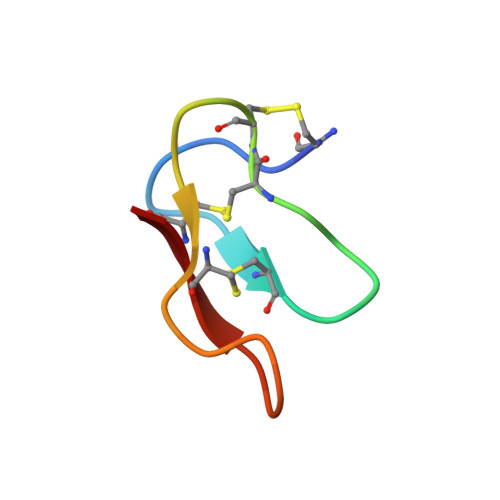
Obesity and type 2 diabetes are chronic metabolic diseases, and those affected could benefit from the use of α-amylase inhibitors to manage starch intake. The pseudocyclics, wrightides Wr-AI1 to Wr-AI3, isolated from an Apocynaceae plant show promise for further development as orally active α-amylase inhibitors. These linear peptides retain the stability known for cystine-knot peptides in the presence of harsh treatment. They are resistant to heat treatment and endopeptidase and exopeptidase degradation, which is characteristic of cyclic cystine-knot peptides. Our NMR and crystallography analysis also showed that wrightides, which are currently the smallest proteinaceous α-amylase inhibitors reported, contain the backbone-twisting cis-proline, which is preceded by a nonaromatic residue rather than a conventional aromatic residue. The modeled structure and a molecular dynamics study of Wr-AI1 in complex with yellow mealworm α-amylase suggested that, despite having a similar structure and cystine-knot fold, the knottin-type α-amylase inhibitors may bind to insect α-amylase via a different set of interactions. Finally, we showed that the precursors of pseudocyclic cystine-knot α-amylase inhibitors and their biosynthesis in plants follow a secretory protein synthesis pathway. Together, our findings provide insights for the use of the pseudocyclic α-amylase inhibitors as useful leads for the development of orally active peptidyl bioactives, as well as an alternative scaffold for cyclic peptides for engineering metabolically stable human α-amylase inhibitors.
- School of Biological Sciences, Nanyang Technological University, Singapore.
Organizational Affiliation: