4D25 | pdb_00004d25

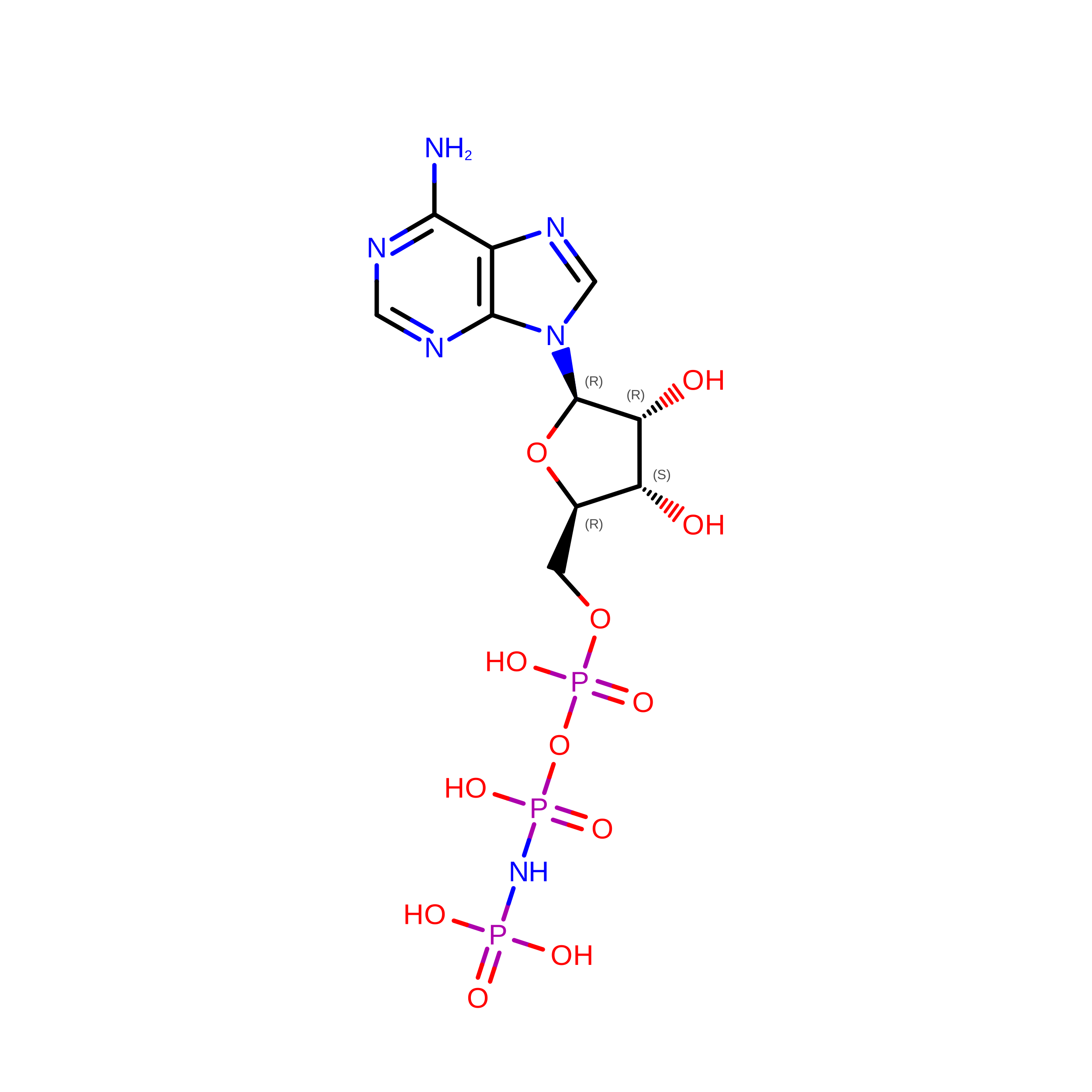
Crystal structure of the Bombyx mori Vasa helicase (E339Q) in complex with RNA and AMPPNP


Experimental Data Snapshot

  • Method: X-RAY DIFFRACTION
  • Resolution: 1.90 Å
  • R-Value Free: 
    0.208 (Depositor), 0.206 (DCC) 
  • R-Value Work: 
    0.171 (Depositor), 0.170 (DCC) 
  • R-Value Observed: 
    0.173 (Depositor) 

Starting Model: experimental
View more details

wwPDB Validation 3D Report Full Report

Validation slider image for 4D25

Ligand Structure Quality Assessment 


This is version 1.2 of the entry. See complete history

Literature

RNA Clamping by Vasa Assembles a Pirna Amplifier Complex on Transposon Transcripts.

Xiol, J.Spinelli, P.Laussmann, M.A.Homolka, D.Yang, Z.Cora, E.Coute, Y.Conn, S.Kadlec, J.Sachidanandam, R.Kaksonen, M.Cusack, S.Ephrussi, A.Pillai, R.S.

(2014) Cell 157: 1698

  • DOI: https://doi.org/10.1016/j.cell.2014.05.018
  • Primary Citation Related Structures: 
    4D25, 4D26

  • PubMed Abstract: 

    Germline-specific Piwi-interacting RNAs (piRNAs) protect animal genomes against transposons and are essential for fertility. piRNAs targeting active transposons are amplified by the ping-pong cycle, which couples Piwi endonucleolytic slicing of target RNAs to biogenesis of new piRNAs. Here, we describe the identification of a transient Amplifier complex that mediates biogenesis of secondary piRNAs in insect cells. Amplifier is nucleated by the DEAD box RNA helicase Vasa and contains the two Piwi proteins participating in the ping-pong loop, the Tudor protein Qin/Kumo and antisense piRNA guides. These components assemble on the surface of Vasa's helicase domain, which functions as an RNA clamp to anchor Amplifier onto transposon transcripts. We show that ATP-dependent RNP remodeling by Vasa facilitates transfer of 5' sliced piRNA precursors between ping-pong partners, and loss of this activity causes sterility in Drosophila. Our results reveal the molecular basis for the small RNA amplification that confers adaptive immunity against transposons.


  • Organizational Affiliation
    • European Molecular Biology Laboratory, Grenoble Outstation, University Grenoble Alpes-EMBL-CNRS, 71 avenue des Martyrs, 38042, France; Unit for Virus Host-Cell Interactions, University Grenoble Alpes-EMBL-CNRS, 71 avenue des Martyrs, 38042, France.

Macromolecule Content 

  • Total Structure Weight: 50.63 kDa 
  • Atom Count: 3,869 
  • Modeled Residue Count: 433 
  • Deposited Residue Count: 440 
  • Unique protein chains: 1
  • Unique nucleic acid chains: 1

Macromolecules


Find similar proteins by:|  3D Structure
Entity ID: 1
MoleculeChains  Sequence LengthOrganismDetailsImage
BMVLG PROTEIN434Bombyx moriMutation(s): 2 
EC: 3.6.4.13
UniProt
Find proteins for O01378 (Bombyx mori)
Explore O01378 
Go to UniProtKB:  O01378
Entity Groups
Sequence Clusters30% Identity50% Identity70% Identity90% Identity95% Identity100% Identity
UniProt GroupO01378
Sequence Annotations
Expand
Reference Sequence
Find similar nucleic acids by:  Sequence
Entity ID: 2
MoleculeChains LengthOrganismImage
5'-R(*UP*GP*AP*CP*AP*UP)-3'B [auth D]6Bombyx mori
Sequence Annotations
Expand
Reference Sequence

Experimental Data & Validation

Experimental Data

  • Method: X-RAY DIFFRACTION
  • Resolution: 1.90 Å
  • R-Value Free:  0.208 (Depositor), 0.206 (DCC) 
  • R-Value Work:  0.171 (Depositor), 0.170 (DCC) 
  • R-Value Observed: 0.173 (Depositor) 
Space Group: P 21 21 21
Unit Cell:
Length ( Å )Angle ( ˚ )
a = 52.48α = 90
b = 78.57β = 90
c = 104.58γ = 90
Software Package:
Software NamePurpose
REFMACrefinement
XDSdata reduction
XSCALEdata scaling
PHASERphasing

Structure Validation

View Full Validation Report


Ligand Structure Quality Assessment 


Entry History 

Deposition Data

Revision History  (Full details and data files)

  • Version 1.0: 2014-06-18
    Type: Initial release
  • Version 1.1: 2014-07-02
    Changes: Database references
  • Version 1.2: 2023-12-20
    Changes: Data collection, Database references, Derived calculations, Other, Refinement description