4GFT | pdb_00004gft

Malaria invasion machinery protein-Nanobody complex


Experimental Data Snapshot

  • Method: X-RAY DIFFRACTION
  • Resolution: 1.60 Å
  • R-Value Free: 
    0.205 (Depositor), 0.214 (DCC) 
  • R-Value Work: 
    0.181 (Depositor), 0.191 (DCC) 
  • R-Value Observed: 
    0.182 (Depositor) 

wwPDB Validation 3D Report Full Report

Validation slider image for 4GFT

This is version 2.1 of the entry. See complete history

Literature

The structure of the D3 domain of Plasmodium falciparum myosin tail interacting protein MTIP in complex with a nanobody.

Khamrui, S.Turley, S.Pardon, E.Steyaert, J.Fan, E.Verlinde, C.L.Bergman, L.W.Hol, W.G.

(2013) Mol Biochem Parasitol 190: 87-91

  • DOI: https://doi.org/10.1016/j.molbiopara.2013.06.003
  • Primary Citation Related Structures: 
    4GFT, 4GGN

  • PubMed Abstract: 

    Apicomplexan parasites enter host cells by many sophisticated steps including use of an ATP-powered invasion machinery. The machinery consists of multiple proteins, including a special myosin (MyoA) which moves along an actin fiber and which is connected to the myosin tail interaction protein (MTIP). Here we report a crystal structure of the major MyoA-binding domain (D3) of Plasmodium falciparum MTIP in complex with an anti-MTIP nanobody. In this complex, the MyoA-binding groove in MTIP-D3 is considerably less accessible than when occupied by the MyoA helix, due to a shift of two helices. The nanobody binds to an area slightly overlapping with the MyoA binding groove, covering a hydrophobic region next to the groove entrance. This provides a new avenue for arriving at compounds interfering with the invasion machinery since small molecules binding simultaneously to the nanobody binding site and the adjacent MyoA binding groove would prevent MyoA binding by MTIP.


  • Organizational Affiliation
    • Department of Biochemistry, Biomolecular Structure Center, School of Medicine, University of Washington, Seattle, WA 98195, United States.

Macromolecule Content 

  • Total Structure Weight: 22.72 kDa 
  • Atom Count: 1,562 
  • Modeled Residue Count: 189 
  • Deposited Residue Count: 204 
  • Unique protein chains: 2

Macromolecules

Find similar proteins by:|  3D Structure
Entity ID: 1
MoleculeChains  Sequence LengthOrganismDetailsImage
Myosin A tail domain interacting protein69Plasmodium falciparum 3D7Mutation(s): 1 
Gene Names: MTIPPFL2225w
UniProt
Find proteins for Q8I4W8 (Plasmodium falciparum (isolate 3D7))
Explore Q8I4W8 
Go to UniProtKB:  Q8I4W8
Entity Groups
Sequence Clusters30% Identity50% Identity70% Identity90% Identity95% Identity100% Identity
UniProt GroupQ8I4W8
Sequence Annotations
Expand
Reference Sequence
Find similar proteins by:|  3D Structure
Entity ID: 2
MoleculeChains  Sequence LengthOrganismDetailsImage
Nanobody135Lama glamaMutation(s): 0 

Small Molecules

Modified Residues  1 Unique
IDChains TypeFormula2D DiagramParent
PCA
Query on PCA
B
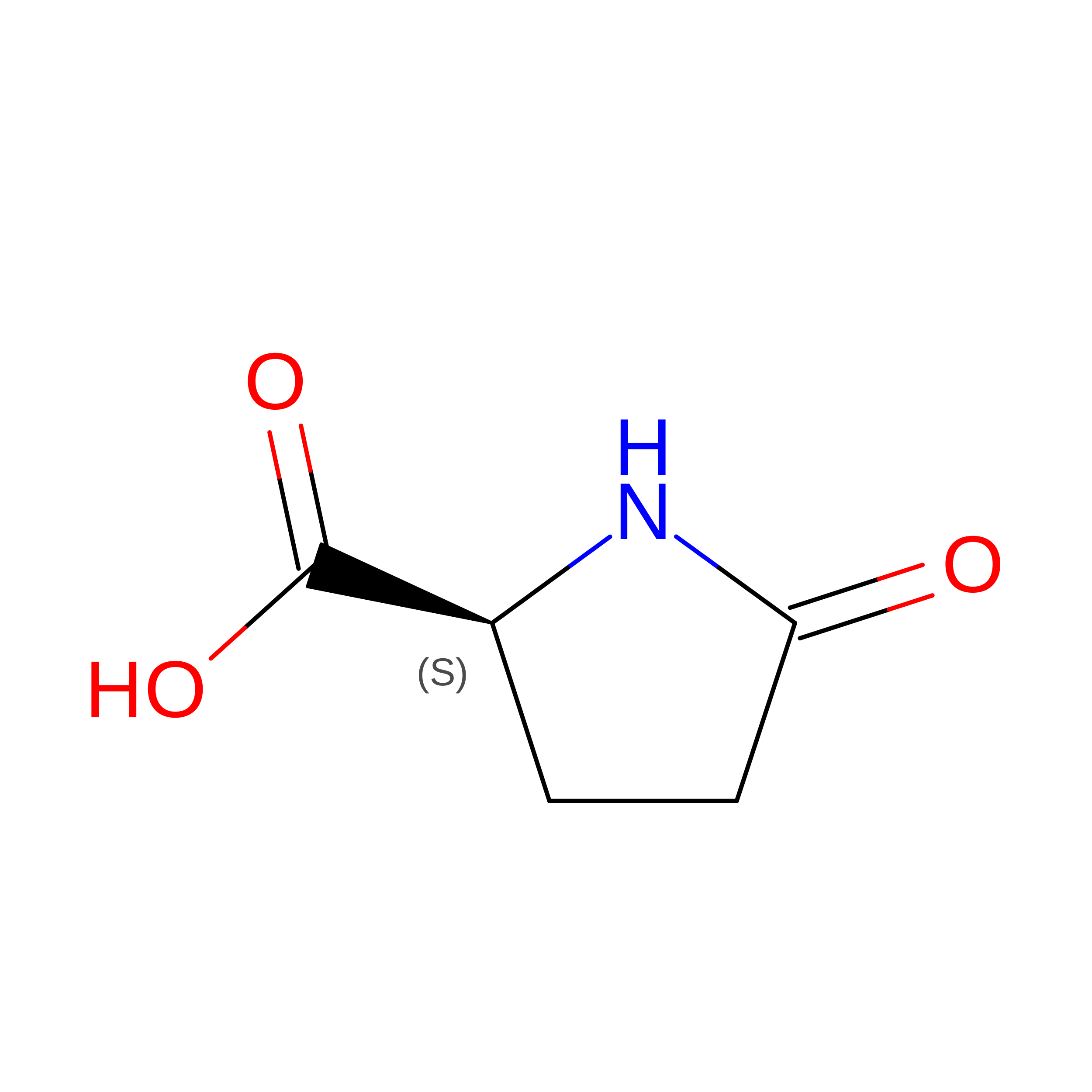
L-PEPTIDE LINKINGC5 H7 N O3GLN

Experimental Data & Validation

Experimental Data

  • Method: X-RAY DIFFRACTION
  • Resolution: 1.60 Å
  • R-Value Free:  0.205 (Depositor), 0.214 (DCC) 
  • R-Value Work:  0.181 (Depositor), 0.191 (DCC) 
  • R-Value Observed: 0.182 (Depositor) 
Space Group: P 21 21 21
Unit Cell:
Length ( Å )Angle ( ˚ )
a = 47.848α = 90
b = 52.951β = 90
c = 73.226γ = 90
Software Package:
Software NamePurpose
HKL-2000data collection
PHASERphasing
REFMACrefinement
HKL-2000data reduction
HKL-2000data scaling

Structure Validation

View Full Validation Report


Entry History 

Deposition Data

Revision History  (Full details and data files)

  • Version 1.0: 2013-07-03
    Type: Initial release
  • Version 1.1: 2013-07-24
    Changes: Other
  • Version 1.2: 2015-12-09
    Changes: Database references
  • Version 2.0: 2019-12-25
    Changes: Database references, Derived calculations, Polymer sequence
  • Version 2.1: 2024-10-09
    Changes: Data collection, Database references, Derived calculations, Structure summary