4IHP | pdb_00004ihp

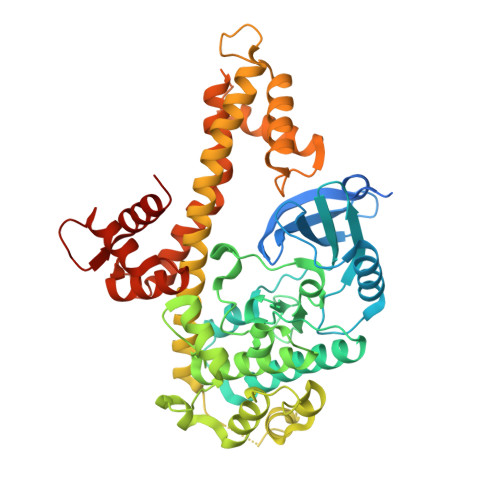
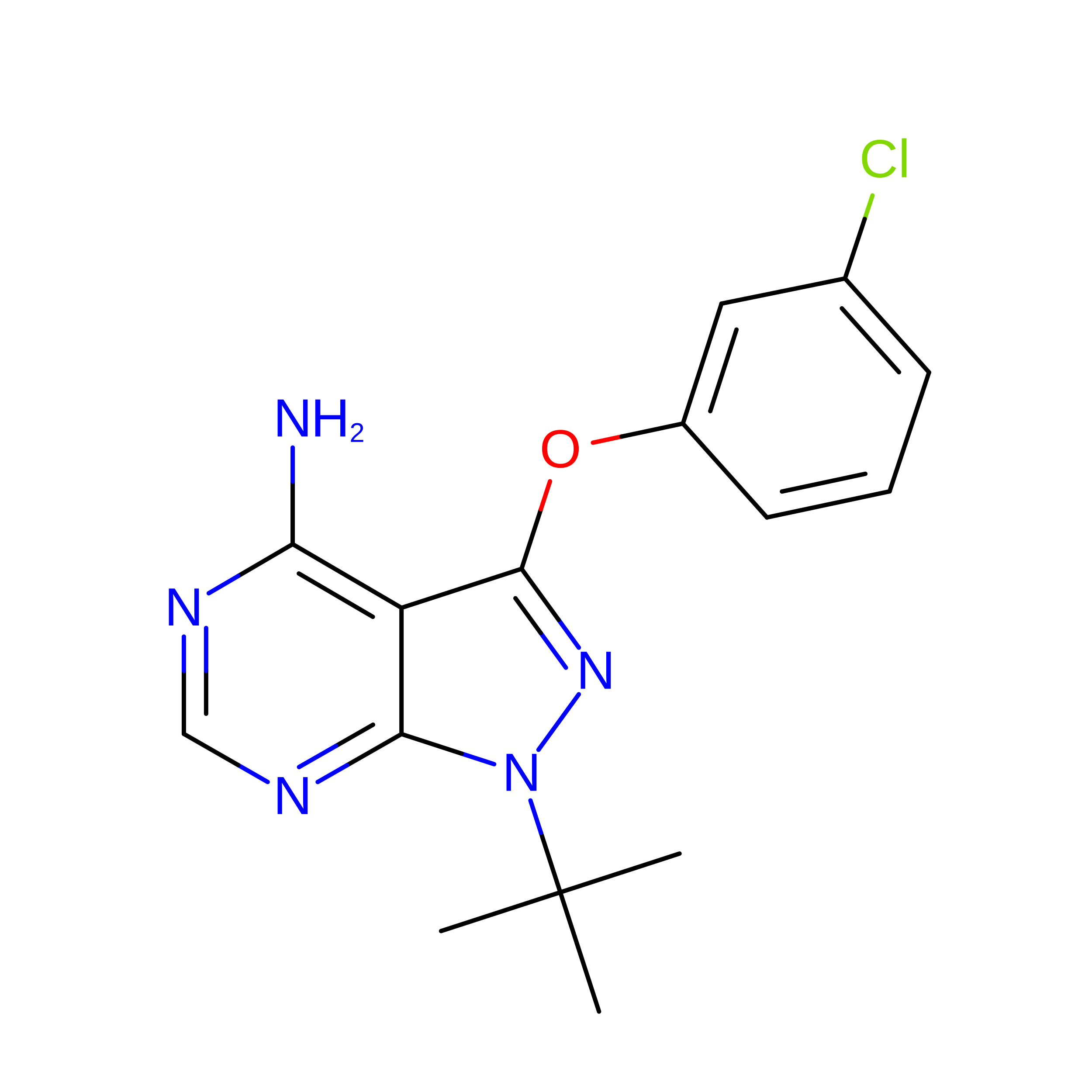
Crystal structure of TgCDPK1 with inhibitor bound


Experimental Data Snapshot

  • Method: X-RAY DIFFRACTION
  • Resolution: 2.27 Å
  • R-Value Free: 
    0.251 (Depositor), 0.247 (DCC) 
  • R-Value Work: 
    0.192 (Depositor), 0.198 (DCC) 
  • R-Value Observed: 
    0.195 (Depositor) 

wwPDB Validation 3D Report Full Report

Validation slider image for 4IHP

Ligand Structure Quality Assessment 


This is version 1.3 of the entry. See complete history

Literature

Inhibition of Calcium Dependent Protein Kinase 1 (CDPK1) by Pyrazolopyrimidine Analogs Decreases Establishment and Reoccurrence of Central Nervous System Disease by Toxoplasma gondii.

Rutaganira, F.U.Barks, J.Dhason, M.S.Wang, Q.Lopez, M.S.Long, S.Radke, J.B.Jones, N.G.Maddirala, A.R.Janetka, J.W.El Bakkouri, M.Hui, R.Shokat, K.M.Sibley, L.D.

(2017) J Med Chem 60: 9976-9989

  • DOI: https://doi.org/10.1021/acs.jmedchem.7b01192
  • Primary Citation Related Structures: 
    4IHP, 5W80, 5W8R, 5W91, 5W9E

  • PubMed Abstract: 

    Calcium dependent protein kinase 1 (CDPK1) is an essential enzyme in the opportunistic pathogen Toxoplasma gondii. CDPK1 controls multiple processes that are critical to the intracellular replicative cycle of T. gondii including secretion of adhesins, motility, invasion, and egress. Remarkably, CDPK1 contains a small glycine gatekeeper residue in the ATP binding pocket making it sensitive to ATP-competitive inhibitors with bulky substituents that complement this expanded binding pocket. Here we explored structure-activity relationships of a series of pyrazolopyrimidine inhibitors of CDPK1 with the goal of increasing selectivity over host enzymes, improving antiparasite potency, and improving metabolic stability. The resulting lead compound 24 exhibited excellent enzyme inhibition and selectivity for CDPK1 and potently inhibited parasite growth in vitro. Compound 24 was also effective at treating acute toxoplasmosis in the mouse, reducing dissemination to the central nervous system, and decreasing reactivation of chronic infection in severely immunocompromised mice. These findings provide proof of concept for the development of small molecule inhibitors of CDPK1 for treatment of CNS toxoplasmosis.


  • Organizational Affiliation
    • Howard Hughes Medical Institute and Department of Cellular and Molecular Pharmacology, University of California, San Francisco , San Francisco, California 94158, United States.

Macromolecule Content 

  • Total Structure Weight: 57.65 kDa 
  • Atom Count: 3,734 
  • Modeled Residue Count: 454 
  • Deposited Residue Count: 507 
  • Unique protein chains: 1

Macromolecules

Find similar proteins by:|  3D Structure
Entity ID: 1
MoleculeChains  Sequence LengthOrganismDetailsImage
Calmodulin-domain protein kinase 1507Toxoplasma gondiiMutation(s): 0 
Gene Names: CDPK1TGGT1_059880TGVEG_042030
EC: 2.7.11.17 (PDB Primary Data), 2.7.11.1 (UniProt)
UniProt
Find proteins for Q9BJF5 (Toxoplasma gondii)
Explore Q9BJF5 
Go to UniProtKB:  Q9BJF5
Entity Groups
Sequence Clusters30% Identity50% Identity70% Identity90% Identity95% Identity100% Identity
UniProt GroupQ9BJF5
Sequence Annotations
Expand
Reference Sequence

Small Molecules

Binding Affinity Annotations 
IDSourceBinding Affinity
1FB BindingDB:  4IHP IC50: min: 9.99, max: 10 (nM) from 2 assay(s)

Experimental Data & Validation

Experimental Data

  • Method: X-RAY DIFFRACTION
  • Resolution: 2.27 Å
  • R-Value Free:  0.251 (Depositor), 0.247 (DCC) 
  • R-Value Work:  0.192 (Depositor), 0.198 (DCC) 
  • R-Value Observed: 0.195 (Depositor) 
Space Group: P 21 21 21
Unit Cell:
Length ( Å )Angle ( ˚ )
a = 48.309α = 90
b = 73.235β = 90
c = 149.264γ = 90
Software Package:
Software NamePurpose
XSCALEdata scaling
PHASERphasing
REFMACrefinement
PDB_EXTRACTdata extraction
JBluIce-EPICSdata collection
XDSdata reduction

Structure Validation

View Full Validation Report


Ligand Structure Quality Assessment 


Entry History 

Revision History  (Full details and data files)

  • Version 1.0: 2014-01-15
    Type: Initial release
  • Version 1.1: 2017-11-15
    Changes: Refinement description
  • Version 1.2: 2024-02-28
    Changes: Data collection, Database references, Derived calculations
  • Version 1.3: 2026-05-20
    Changes: Database references, Derived calculations, Structure summary