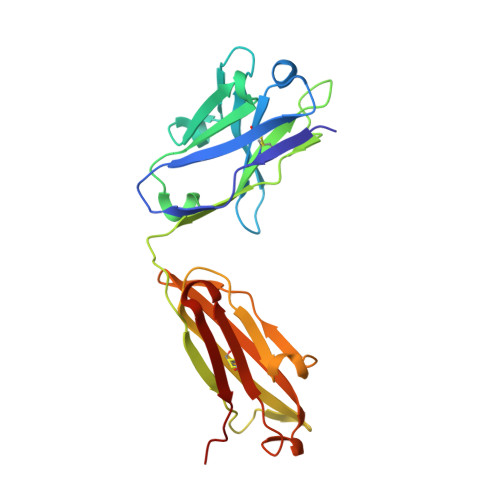
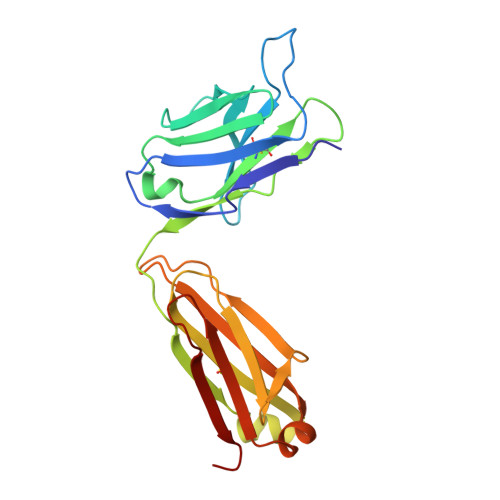
4N8C | pdb_00004n8c

Three-dimensional structure of the extracellular domain of Matrix protein 2 of influenza A virus


Experimental Data Snapshot

  • Method: X-RAY DIFFRACTION
  • Resolution: 1.60 Å
  • R-Value Free: 
    0.242 (Depositor), 0.246 (DCC) 
  • R-Value Work: 
    0.193 (Depositor), 0.202 (DCC) 
  • R-Value Observed: 
    0.196 (Depositor) 

Starting Model: experimental
View more details

wwPDB Validation 3D Report Full Report

Validation slider image for 4N8C

This is version 1.4 of the entry. See complete history

Literature

Structure of the extracellular domain of matrix protein 2 of influenza A virus in complex with a protective monoclonal antibody

Cho, K.J.Schepens, B.Seok, J.H.Kim, S.Roose, K.Lee, J.H.Gallardo, R.Hamme, E.V.Schymkowitz, J.Rousseau, F.Fiers, W.Saelens, X.Kim, K.H.

(2015) J Virol 89: 3700-3711

  • DOI: https://doi.org/10.1128/JVI.02576-14
  • Primary Citation Related Structures: 
    4N8C

  • PubMed Abstract: 

    The extracellular domain of influenza A virus matrix protein 2 (M2e) is conserved and is being evaluated as a quasiuniversal influenza A vaccine candidate. We describe the crystal structure at 1.6 Å resolution of M2e in complex with the Fab fragment of an M2e-specific monoclonal antibody that protects against influenza A virus challenge. This antibody binds M2 expressed on the surfaces of cells infected with influenza A virus. Five out of six complementary determining regions interact with M2e, and three highly conserved M2e residues are critical for this interaction. In this complex, M2e adopts a compact U-shaped conformation stabilized in the center by the highly conserved tryptophan residue in M2e. This is the first description of the three-dimensional structure of M2e. M2e of influenza A is under investigation as a universal influenza A vaccine, but its three-dimensional structure is unknown. We describe the structure of M2e stabilized with an M2e-specific monoclonal antibody that recognizes natural M2. We found that the conserved tryptophan is positioned in the center of the U-shaped structure of M2e and stabilizes its conformation. The structure also explains why previously reported in vivo escape viruses, selected with a similar monoclonal antibody, carried proline residue substitutions at position 10 in M2.


  • Organizational Affiliation
    • Department of Biotechnology & Bioinformatics, College of Science & Technology, Korea University, Sejong, South Korea Inflammation Research Center, VIB, Ghent, Belgium Department of Biomedical Molecular Biology, Ghent University, Ghent, Belgium.

Macromolecule Content 

  • Total Structure Weight: 101.82 kDa 
  • Atom Count: 7,783 
  • Modeled Residue Count: 909 
  • Deposited Residue Count: 928 
  • Unique protein chains: 3

Macromolecules

Find similar proteins by:|  3D Structure
Entity ID: 1
MoleculeChains  Sequence LengthOrganismDetailsImage
Heavy chain of monoclonal antibodyA [auth H],
B [auth I]
221Mus musculusMutation(s): 0 
Find similar proteins by:|  3D Structure
Entity ID: 2
MoleculeChains  Sequence LengthOrganismDetailsImage
Light chain of monoclonal antibodyC [auth L],
D [auth M]
220Mus musculusMutation(s): 0 
Find similar proteins by:  Sequence   |   3D Structure  
Entity ID: 3
MoleculeChains  Sequence LengthOrganismDetailsImage
Extracellular domain of influenza Matrix protein 2E [auth X],
F [auth Y]
23Influenza A virus (A/Puerto Rico/8/1934(H1N1))Mutation(s): 0 

Experimental Data & Validation

Experimental Data

  • Method: X-RAY DIFFRACTION
  • Resolution: 1.60 Å
  • R-Value Free:  0.242 (Depositor), 0.246 (DCC) 
  • R-Value Work:  0.193 (Depositor), 0.202 (DCC) 
  • R-Value Observed: 0.196 (Depositor) 
Space Group: P 1
Unit Cell:
Length ( Å )Angle ( ˚ )
a = 40.353α = 86.88
b = 72.276β = 77.53
c = 78.446γ = 84.63
Software Package:
Software NamePurpose
DENZOdata reduction
SCALEPACKdata scaling
MOLREPphasing
REFMACrefinement
PDB_EXTRACTdata extraction
HKL-2000data collection

Structure Validation

View Full Validation Report


Entry History 

Deposition Data

Revision History  (Full details and data files)

  • Version 1.0: 2014-10-22
    Type: Initial release
  • Version 1.1: 2015-09-30
    Changes: Database references
  • Version 1.2: 2017-11-15
    Changes: Refinement description
  • Version 1.3: 2023-11-08
    Changes: Data collection, Database references, Refinement description
  • Version 1.4: 2024-10-30
    Changes: Structure summary