4OCV | pdb_00004ocv

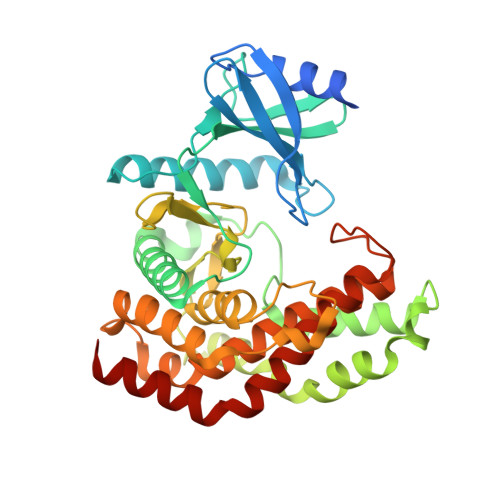
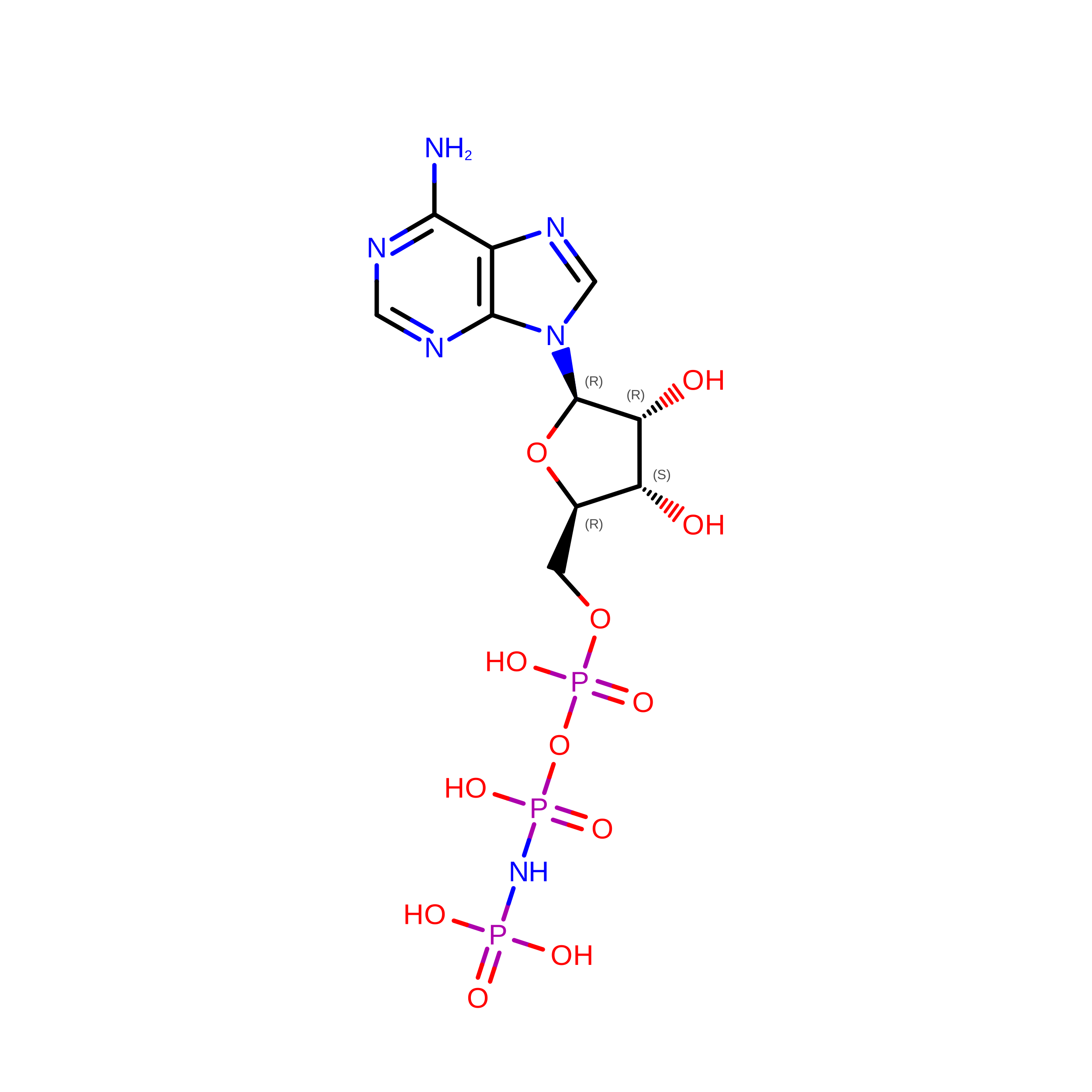
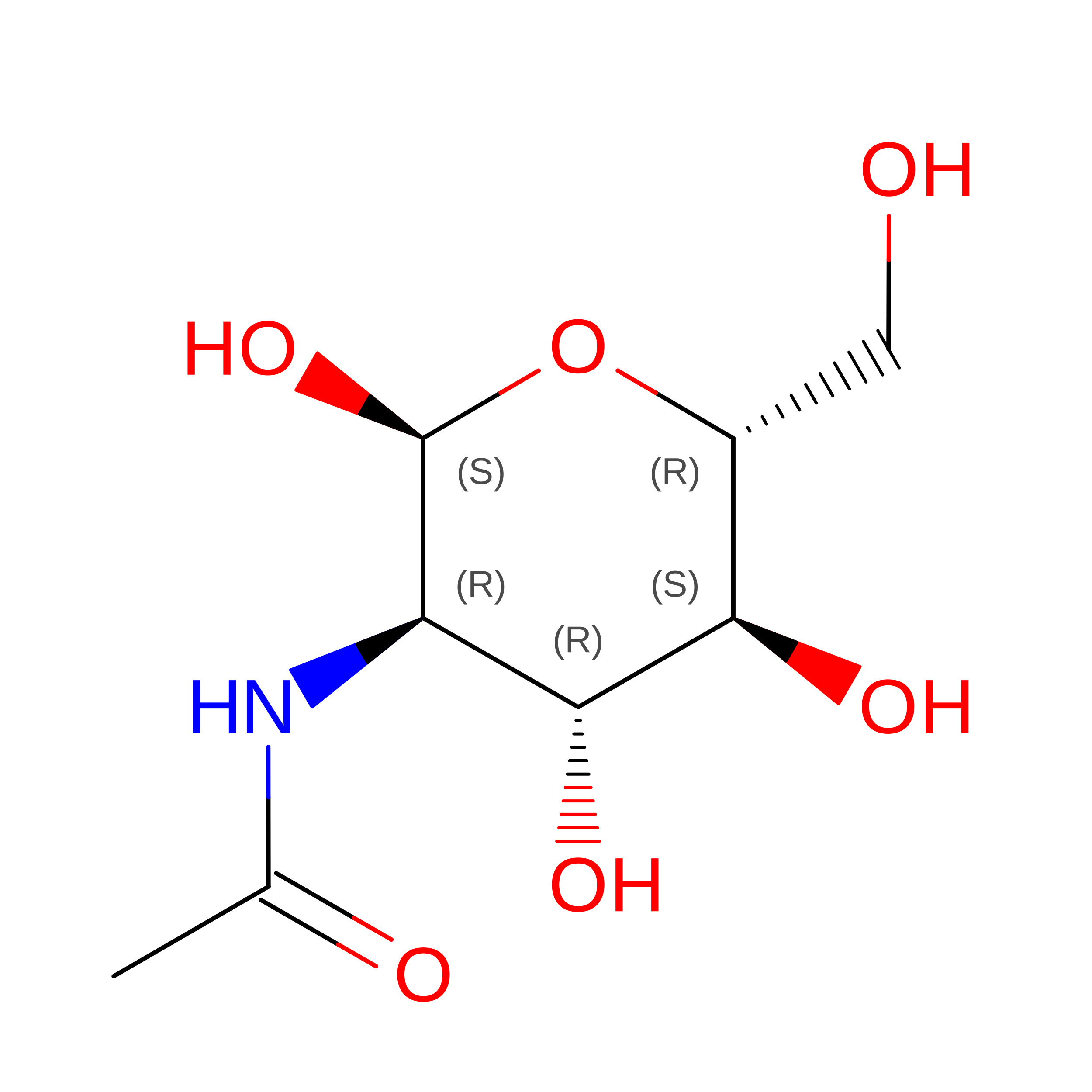
N-acetylhexosamine 1-phosphate kinase_ATCC15697 in complex with GlcNAc and AMPPNP


Experimental Data Snapshot

  • Method: X-RAY DIFFRACTION
  • Resolution: 1.47 Å
  • R-Value Free: 
    0.200 (Depositor), 0.199 (DCC) 
  • R-Value Work: 
    0.187 (Depositor), 0.186 (DCC) 
  • R-Value Observed: 
    0.188 (Depositor) 

Starting Model: experimental
View more details

wwPDB Validation 3D Report Full Report

Validation slider image for 4OCV

Ligand Structure Quality Assessment 


This is version 2.1 of the entry. See complete history

Literature

Insights into the binding specificity and catalytic mechanism of N-acetylhexosamine 1-phosphate kinases through multiple reaction complexes.

Wang, K.C.Lyu, S.Y.Liu, Y.C.Chang, C.Y.Wu, C.J.Li, T.L.

(2014) Acta Crystallogr D Biol Crystallogr 70: 1401-1410

  • DOI: https://doi.org/10.1107/S1399004714004209
  • Primary Citation Related Structures: 
    4OCJ, 4OCK, 4OCO, 4OCP, 4OCQ, 4OCU, 4OCV

  • PubMed Abstract: 

    Utilization of N-acetylhexosamine in bifidobacteria requires the specific lacto-N-biose/galacto-N-biose pathway, a pathway differing from the Leloir pathway while establishing symbiosis between humans and bifidobacteria. The gene lnpB in the pathway encodes a novel hexosamine kinase NahK, which catalyzes the formation of N-acetylhexosamine 1-phosphate (GlcNAc-1P/GalNAc-1P). In this report, seven three-dimensional structures of NahK in complex with GlcNAc, GalNAc, GlcNAc-1P, GlcNAc/AMPPNP and GlcNAc-1P/ADP from both Bifidobacterium longum (JCM1217) and B. infantis (ATCC15697) were solved at resolutions of 1.5-2.2 Å. NahK is a monomer in solution, and its polypeptide folds in a crescent-like architecture subdivided into two domains by a deep cleft. The NahK structures presented here represent the first multiple reaction complexes of the enzyme. This structural information reveals the molecular basis for the recognition of the given substrates and products, GlcNAc/GalNAc, GlcNAc-1P/GalNAc-1P, ATP/ADP and Mg(2+), and provides insights into the catalytic mechanism, enabling NahK and mutants thereof to form a choice of biocatalysts for enzymatic and chemoenzymatic synthesis of carbohydrates.


  • Organizational Affiliation
    • Genomics Research Center, Academia Sinica, Taipei 115, Taiwan.

Macromolecule Content 

  • Total Structure Weight: 43.65 kDa 
  • Atom Count: 3,319 
  • Modeled Residue Count: 355 
  • Deposited Residue Count: 379 
  • Unique protein chains: 1

Macromolecules

Find similar proteins by:|  3D Structure
Entity ID: 1
MoleculeChains  Sequence LengthOrganismDetailsImage
N-acetylhexosamine 1-phosphate kinase379Bifidobacterium longum subsp. infantis ATCC 15697 = JCM 1222 = DSM 20088Mutation(s): 0 
Gene Names: BLIJ_2250Blon_2173
EC: 2.7.1.162
UniProt
Find proteins for B7GN78 (Bifidobacterium longum subsp. infantis (strain ATCC 15697 / DSM 20088 / JCM 1222 / NCTC 11817 / S12))
Explore B7GN78 
Go to UniProtKB:  B7GN78
Entity Groups
Sequence Clusters30% Identity50% Identity70% Identity90% Identity95% Identity100% Identity
UniProt GroupB7GN78
Sequence Annotations
Expand
Reference Sequence

Small Molecules

Experimental Data & Validation

Experimental Data

  • Method: X-RAY DIFFRACTION
  • Resolution: 1.47 Å
  • R-Value Free:  0.200 (Depositor), 0.199 (DCC) 
  • R-Value Work:  0.187 (Depositor), 0.186 (DCC) 
  • R-Value Observed: 0.188 (Depositor) 
Space Group: P 41 21 2
Unit Cell:
Length ( Å )Angle ( ˚ )
a = 73.238α = 90
b = 73.238β = 90
c = 166.613γ = 90
Software Package:
Software NamePurpose
HKL-2000data collection
PHASERphasing
REFMACrefinement
HKL-2000data reduction
HKL-2000data scaling

Structure Validation

View Full Validation Report


Ligand Structure Quality Assessment 


Entry History 

Deposition Data

Revision History  (Full details and data files)

  • Version 1.0: 2014-05-14
    Type: Initial release
  • Version 1.1: 2014-09-24
    Changes: Database references
  • Version 2.0: 2020-07-29
    Type: Remediation
    Reason: Carbohydrate remediation
    Changes: Atomic model, Data collection, Database references, Derived calculations, Structure summary
  • Version 2.1: 2023-09-20
    Changes: Data collection, Database references, Refinement description, Structure summary