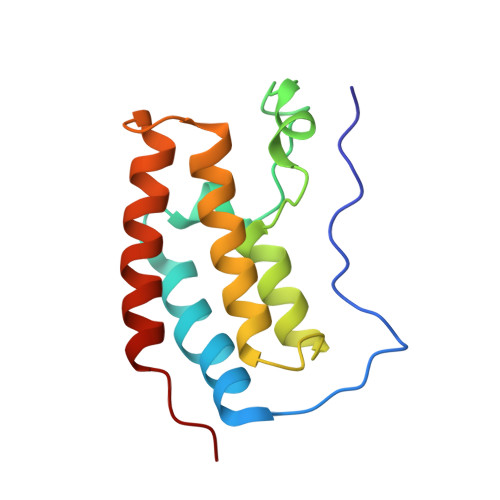
5AD3 | pdb_00005ad3

Bivalent binding to BET bromodomains


Experimental Data Snapshot

  • Method: X-RAY DIFFRACTION
  • Resolution: 1.49 Å
  • R-Value Free: 
    0.308 (Depositor), 0.359 (DCC) 
  • R-Value Work: 
    0.269 (Depositor), 0.298 (DCC) 
  • R-Value Observed: 
    0.271 (Depositor) 

Starting Model: experimental
View more details

wwPDB Validation 3D Report Full Report

Validation slider image for 5AD3

Ligand Structure Quality Assessment 


This is version 1.4 of the entry. See complete history

Literature

Potent and Selective Bivalent Inhibitors of Bet Bromodomains

Waring, M.J.Chen, H.Rabow, A.A.Walker, G.Bobby, R.Boiko, S.Bradbury, R.H.Callis, R.Clark, E.Dale, I.Daniels, D.L.Dulak, A.Flavell, L.Holdgate, G.Jowitt, T.A.Kikhney, A.Mcalister, M.Ogg, D.Patel, J.Petteruti, P.Robb, G.R.Robers, M.B.Saif, S.Stratton, N.Svergun, D.I.Wang, W.Whittaker, D.Wilson, D.M.Yao, Y.

(2016) Nat Chem Biol 12: 1097

  • DOI: https://doi.org/10.1038/nchembio.2210
  • Primary Citation Related Structures: 
    5AD2, 5AD3

  • PubMed Abstract: 

    Proteins of the bromodomain and extraterminal (BET) family, in particular bromodomain-containing protein 4 (BRD4), are of great interest as biological targets. BET proteins contain two separate bromodomains, and existing inhibitors bind to them monovalently. Here we describe the discovery and characterization of probe compound biBET, capable of engaging both bromodomains simultaneously in a bivalent, in cis binding mode. The evidence provided here was obtained in a variety of biophysical and cellular experiments. The bivalent binding results in very high cellular potency for BRD4 binding and pharmacological responses such as disruption of BRD4-mediator complex subunit 1 foci with an EC 50 of 100 pM. These compounds will be of considerable utility as BET/BRD4 chemical probes. This work illustrates a novel concept in ligand design-simultaneous targeting of two separate domains with a drug-like small molecule-providing precedent for a potentially more effective paradigm for developing ligands for other multi-domain proteins.


  • Organizational Affiliation
    • AstraZeneca, Alderley Park, UK.

Macromolecule Content 

  • Total Structure Weight: 30.73 kDa 
  • Atom Count: 2,402 
  • Modeled Residue Count: 253 
  • Deposited Residue Count: 254 
  • Unique protein chains: 1

Macromolecules

Find similar proteins by:|  3D Structure
Entity ID: 1
MoleculeChains  Sequence LengthOrganismDetailsImage
BROMODOMAIN-CONTAINING PROTEIN 4
A, B
127Homo sapiensMutation(s): 0 
UniProt & NIH Common Fund Data Resources
Find proteins for O60885 (Homo sapiens)
Explore O60885 
Go to UniProtKB:  O60885
PHAROS:  O60885
GTEx:  ENSG00000141867 
Entity Groups
Sequence Clusters30% Identity50% Identity70% Identity90% Identity95% Identity100% Identity
UniProt GroupO60885
Sequence Annotations
Expand
Reference Sequence

Small Molecules

Ligands 1 Unique
IDChains Name / Formula / InChI Key2D Diagram3D Interactions
K6K

Query on K6K


Download:Ideal Coordinates CCD File
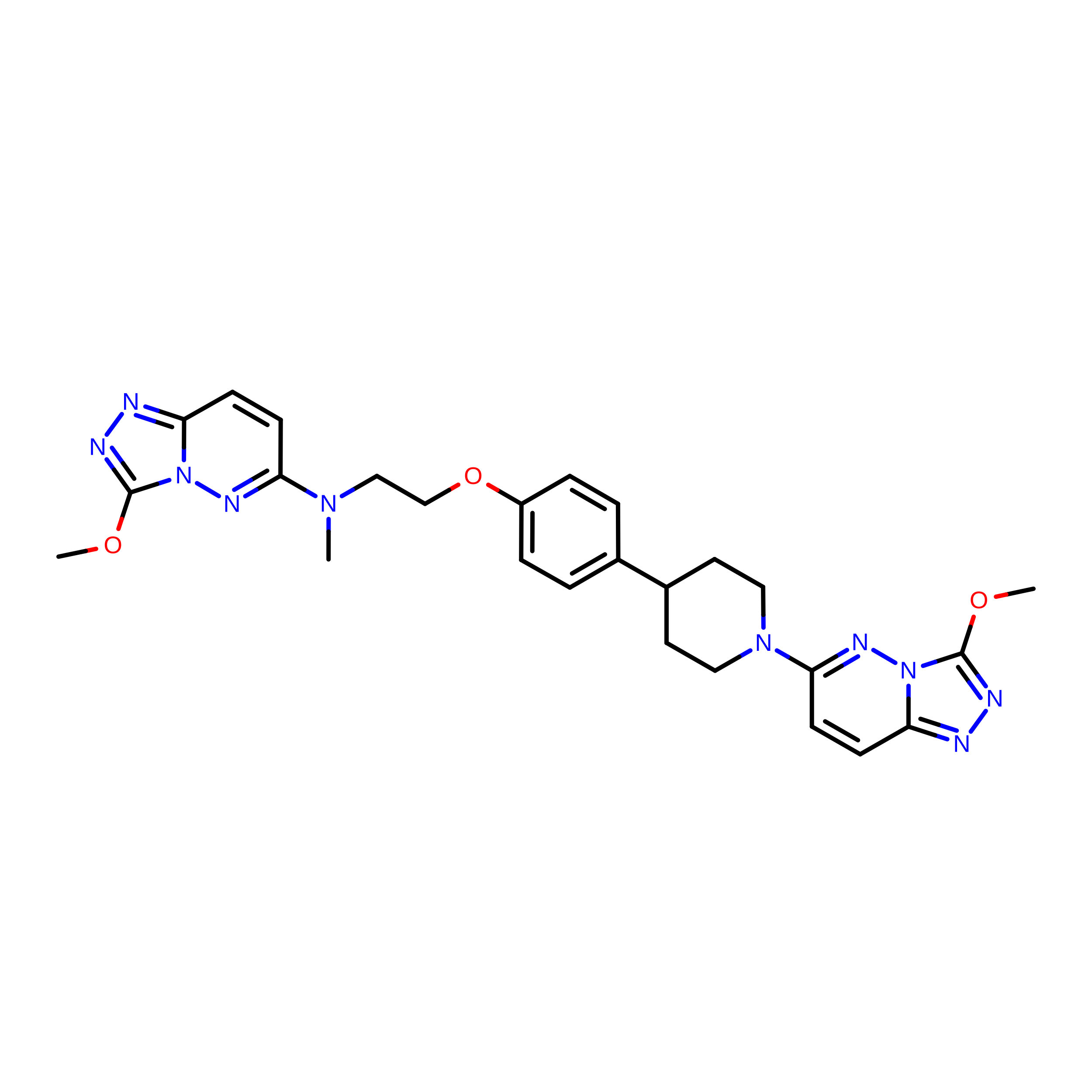
C [auth B]3-methoxy-N-[2-[4-[1-(3-methoxy-[1,2,4]triazolo[4,3-b]pyridazin-6-yl)-4-piperidyl]phenoxy]ethyl]-N-methyl-[1,2,4]triazolo[4,3-b]pyridazin-6-amine
C26 H30 N10 O3
LQHDIGAYVSAVRJ-UHFFFAOYSA-N

Experimental Data & Validation

Experimental Data

  • Method: X-RAY DIFFRACTION
  • Resolution: 1.49 Å
  • R-Value Free:  0.308 (Depositor), 0.359 (DCC) 
  • R-Value Work:  0.269 (Depositor), 0.298 (DCC) 
  • R-Value Observed: 0.271 (Depositor) 
Space Group: P 21 21 21
Unit Cell:
Length ( Å )Angle ( ˚ )
a = 109.64α = 90
b = 41.826β = 90
c = 59.591γ = 90
Software Package:
Software NamePurpose
BUSTERrefinement
XDSdata reduction
Aimlessdata scaling
PHASERphasing

Structure Validation

View Full Validation Report


Ligand Structure Quality Assessment 


Entry History 

Revision History  (Full details and data files)

  • Version 1.0: 2016-09-28
    Type: Initial release
  • Version 1.1: 2016-10-26
    Changes: Database references
  • Version 1.2: 2016-11-09
    Changes: Database references
  • Version 1.3: 2016-11-30
    Changes: Database references
  • Version 1.4: 2024-01-10
    Changes: Data collection, Database references, Derived calculations, Other, Refinement description