Download Mendeley
Mechanism of endonuclease cleavage by the HigB toxin.
Schureck, M.A., Repack, A., Miles, S.J., Marquez, J., Dunham, C.M.(2016) Nucleic Acids Res 44: 7944-7953
- PubMed: 27378776 Search on PubMedSearch on PubMed Central
- DOI: https://doi.org/10.1093/nar/gkw598
- Primary Citation Related Structures:
4ZSN, 5IWH, 5IXL - PubMed Abstract:
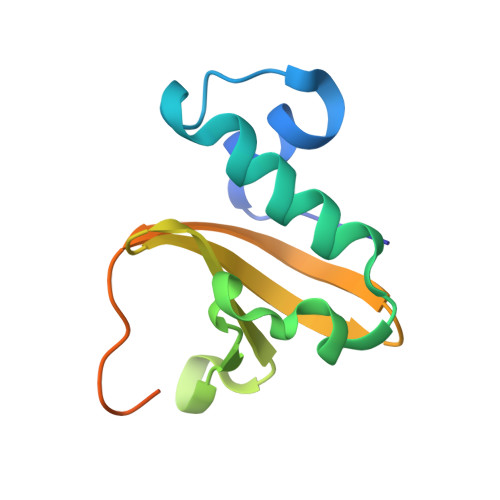
Bacteria encode multiple type II toxin-antitoxin modules that cleave ribosome-bound mRNAs in response to stress. All ribosome-dependent toxin family members structurally characterized to date adopt similar microbial RNase architectures despite possessing low sequence identities. Therefore, determining which residues are catalytically important in this specialized RNase family has been a challenge in the field. Structural studies of RelE and YoeB toxins bound to the ribosome provided significant insights but biochemical experiments with RelE were required to clearly demonstrate which residues are critical for acid-base catalysis of mRNA cleavage. Here, we solved an X-ray crystal structure of the wild-type, ribosome-dependent toxin HigB bound to the ribosome revealing potential catalytic residues proximal to the mRNA substrate. Using cell-based and biochemical assays, we further determined that HigB residues His54, Asp90, Tyr91 and His92 are critical for activity in vivo, while HigB H54A and Y91A variants have the largest effect on mRNA cleavage in vitro Comparison of X-ray crystal structures of two catalytically inactive HigB variants with 70S-HigB bound structures reveal that HigB active site residues undergo conformational rearrangements likely required for recognition of its mRNA substrate. These data support the emerging concept that ribosome-dependent toxins have diverse modes of mRNA recognition.
- Emory University School of Medicine, Department of Biochemistry, 1510 Clifton Road NE, Atlanta, GA 30322, USA.
Organizational Affiliation: