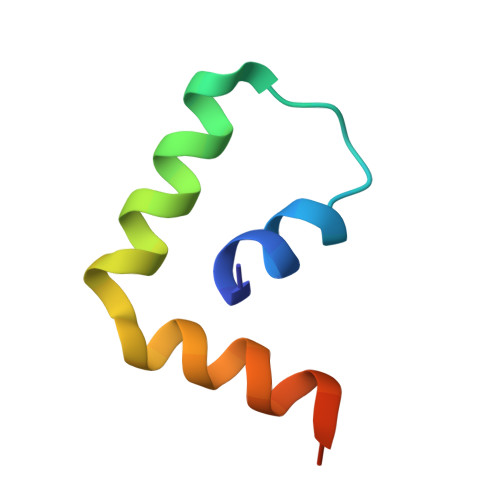
5JEM | pdb_00005jem

Complex of IRF-3 with CBP


Experimental Data Snapshot

  • Method: X-RAY DIFFRACTION
  • Resolution: 2.50 Å
  • R-Value Free: 
    0.242 (Depositor), 0.246 (DCC) 
  • R-Value Work: 
    0.192 (Depositor), 0.199 (DCC) 
  • R-Value Observed: 
    0.194 (Depositor) 

wwPDB Validation 3D Report Full Report

Validation slider image for 5JEM

This is version 1.2 of the entry. See complete history

Literature

Structural basis for concerted recruitment and activation of IRF-3 by innate immune adaptor proteins.

Zhao, B.Shu, C.Gao, X.Sankaran, B.Du, F.Shelton, C.L.Herr, A.B.Ji, J.Y.Li, P.

(2016) Proc Natl Acad Sci U S A 113: E3403-E3412

  • DOI: https://doi.org/10.1073/pnas.1603269113
  • Primary Citation Related Structures: 
    5JEJ, 5JEK, 5JEL, 5JEM, 5JEO, 5JER

  • PubMed Abstract: 

    Type I IFNs are key cytokines mediating innate antiviral immunity. cGMP-AMP synthase, ritinoic acid-inducible protein 1 (RIG-I)-like receptors, and Toll-like receptors recognize microbial double-stranded (ds)DNA, dsRNA, and LPS to induce the expression of type I IFNs. These signaling pathways converge at the recruitment and activation of the transcription factor IRF-3 (IFN regulatory factor 3). The adaptor proteins STING (stimulator of IFN genes), MAVS (mitochondrial antiviral signaling), and TRIF (TIR domain-containing adaptor inducing IFN-β) mediate the recruitment of IRF-3 through a conserved pLxIS motif. Here we show that the pLxIS motif of phosphorylated STING, MAVS, and TRIF binds to IRF-3 in a similar manner, whereas residues upstream of the motif confer specificity. The structure of the IRF-3 phosphomimetic mutant S386/396E bound to the cAMP response element binding protein (CREB)-binding protein reveals that the pLxIS motif also mediates IRF-3 dimerization and activation. Moreover, rotavirus NSP1 (nonstructural protein 1) employs a pLxIS motif to target IRF-3 for degradation, but phosphorylation of NSP1 is not required for its activity. These results suggest a concerted mechanism for the recruitment and activation of IRF-3 that can be subverted by viral proteins to evade innate immune responses.


  • Organizational Affiliation
    • Department of Biochemistry and Biophysics, Texas A&M University, College Station, TX 77843;

Macromolecule Content 

  • Total Structure Weight: 116.2 kDa 
  • Atom Count: 7,872 
  • Modeled Residue Count: 977 
  • Deposited Residue Count: 1,040 
  • Unique protein chains: 2

Macromolecules

Find similar proteins by:|  3D Structure
Entity ID: 1
MoleculeChains  Sequence LengthOrganismDetailsImage
Interferon regulatory factor 3A,
C [auth B],
E,
G
213Homo sapiensMutation(s): 0 
Gene Names: IRF3
UniProt & NIH Common Fund Data Resources
Find proteins for Q14653 (Homo sapiens)
Explore Q14653 
Go to UniProtKB:  Q14653
PHAROS:  Q14653
GTEx:  ENSG00000126456 
Entity Groups
Sequence Clusters30% Identity50% Identity70% Identity90% Identity95% Identity100% Identity
UniProt GroupQ14653
Sequence Annotations
Expand
Reference Sequence
Find similar proteins by:|  3D Structure
Entity ID: 2
MoleculeChains  Sequence LengthOrganismDetailsImage
CREB-binding proteinB [auth C],
D,
F,
H
47Homo sapiensMutation(s): 0 
Gene Names: CREBBPCBP
EC: 2.3.1.48 (PDB Primary Data), 2.3.1 (UniProt)
UniProt & NIH Common Fund Data Resources
Find proteins for Q92793 (Homo sapiens)
Explore Q92793 
Go to UniProtKB:  Q92793
PHAROS:  Q92793
GTEx:  ENSG00000005339 
Entity Groups
Sequence Clusters30% Identity50% Identity70% Identity90% Identity95% Identity100% Identity
UniProt GroupQ92793
Sequence Annotations
Expand
Reference Sequence

Experimental Data & Validation

Experimental Data

  • Method: X-RAY DIFFRACTION
  • Resolution: 2.50 Å
  • R-Value Free:  0.242 (Depositor), 0.246 (DCC) 
  • R-Value Work:  0.192 (Depositor), 0.199 (DCC) 
  • R-Value Observed: 0.194 (Depositor) 
Space Group: P 1 21 1
Unit Cell:
Length ( Å )Angle ( ˚ )
a = 85.23α = 90
b = 88.66β = 113.09
c = 92.81γ = 90
Software Package:
Software NamePurpose
PHENIXrefinement
MOSFLMdata reduction
Aimlessdata scaling
PHASERphasing

Structure Validation

View Full Validation Report


Entry History 

Deposition Data

Revision History  (Full details and data files)

  • Version 1.0: 2016-06-15
    Type: Initial release
  • Version 1.1: 2016-06-29
    Changes: Database references
  • Version 1.2: 2024-03-06
    Changes: Data collection, Database references, Derived calculations