5XG5 | pdb_00005xg5

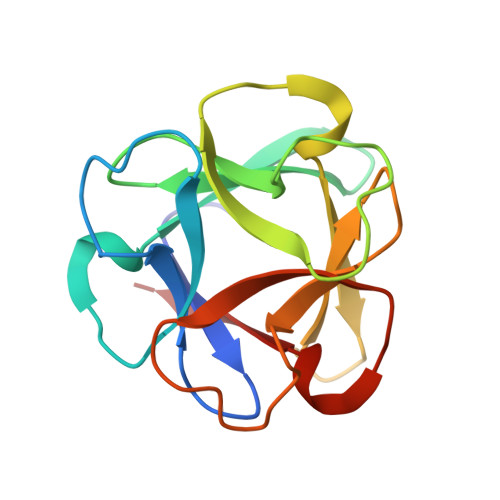
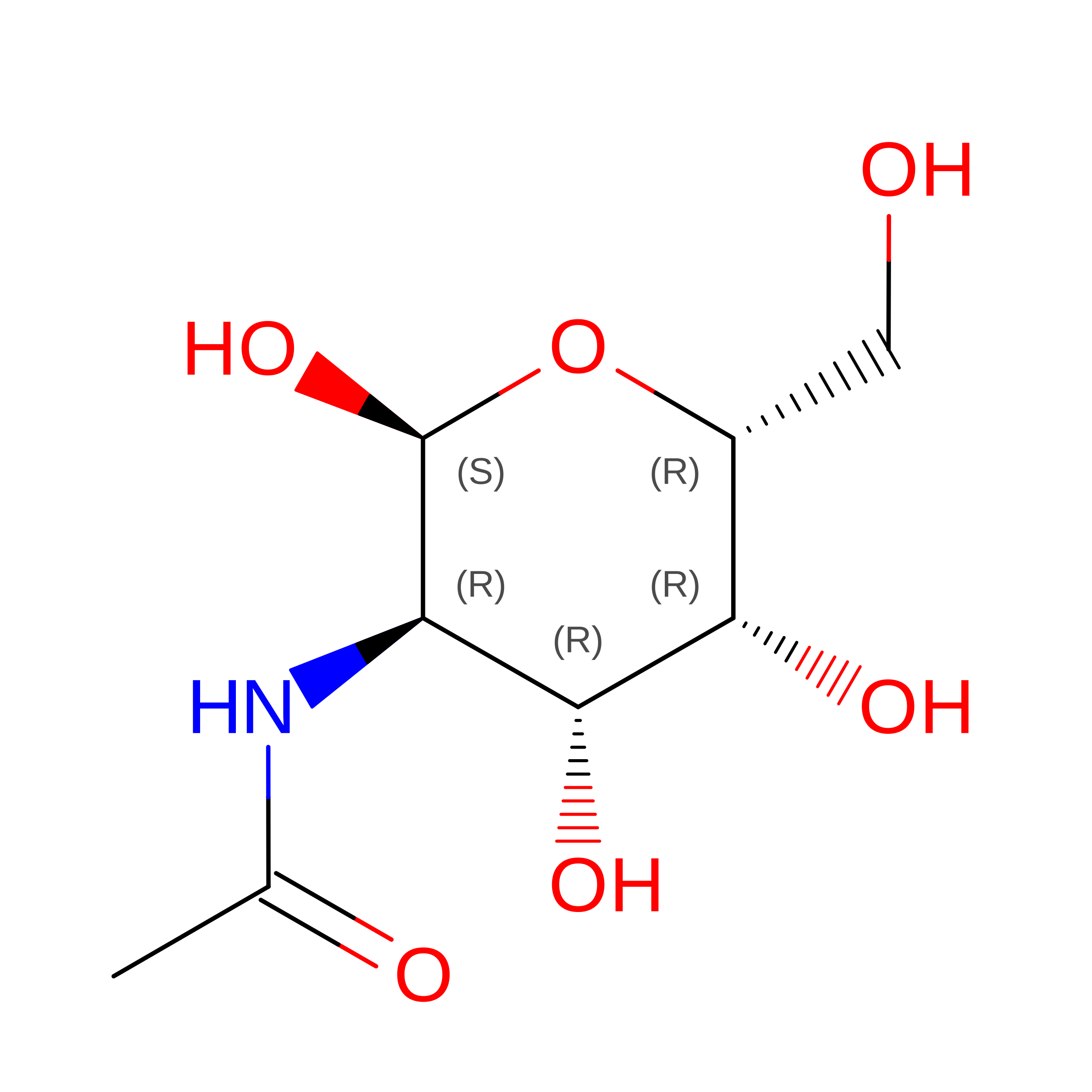
Crystal structure of Mitsuba-1 with bound NAcGal


Experimental Data Snapshot

  • Method: X-RAY DIFFRACTION
  • Resolution: 1.54 Å
  • R-Value Free: 
    0.197 (Depositor), 0.207 (DCC) 
  • R-Value Work: 
    0.150 (Depositor), 0.162 (DCC) 
  • R-Value Observed: 
    0.152 (Depositor) 

wwPDB Validation 3D Report Full Report

Validation slider image for 5XG5

Ligand Structure Quality Assessment 


This is version 2.1 of the entry. See complete history

Literature

Computational design of a symmetrical beta-trefoil lectin with cancer cell binding activity.

Terada, D.Voet, A.R.D.Noguchi, H.Kamata, K.Ohki, M.Addy, C.Fujii, Y.Yamamoto, D.Ozeki, Y.Tame, J.R.H.Zhang, K.Y.J.

(2017) Sci Rep 7: 5943-5943

  • DOI: https://doi.org/10.1038/s41598-017-06332-7
  • Primary Citation Related Structures: 
    5XG5

  • PubMed Abstract: 

    Computational protein design has advanced very rapidly over the last decade, but there remain few examples of artificial proteins with direct medical applications. This study describes a new artificial β-trefoil lectin that recognises Burkitt's lymphoma cells, and which was designed with the intention of finding a basis for novel cancer treatments or diagnostics. The new protein, called "Mitsuba", is based on the structure of the natural shellfish lectin MytiLec-1, a member of a small lectin family that uses unique sequence motifs to bind α-D-galactose. The three subdomains of MytiLec-1 each carry one galactose binding site, and the 149-residue protein forms a tight dimer in solution. Mitsuba (meaning "three-leaf" in Japanese) was created by symmetry constraining the structure of a MytiLec-1 subunit, resulting in a 150-residue sequence that contains three identical tandem repeats. Mitsuba-1 was expressed and crystallised to confirm the X-ray structure matches the predicted model. Mitsuba-1 recognises cancer cells that express globotriose (Galα(1,4)Galβ(1,4)Glc) on the surface, but the cytotoxicity is abolished.


  • Organizational Affiliation
    • Graduate School of Medical Life Science, Yokohama City University, 1-7-29 Suehiro, Yokohama, Kanagawa, 230-0045, Japan.

Macromolecule Content 

  • Total Structure Weight: 17.11 kDa 
  • Atom Count: 1,338 
  • Modeled Residue Count: 145 
  • Deposited Residue Count: 145 
  • Unique protein chains: 1

Macromolecules

Find similar proteins by:|  3D Structure
Entity ID: 1
MoleculeChains  Sequence LengthOrganismDetailsImage
MITSUBA-1145synthetic constructMutation(s): 0 

Experimental Data & Validation

Experimental Data

  • Method: X-RAY DIFFRACTION
  • Resolution: 1.54 Å
  • R-Value Free:  0.197 (Depositor), 0.207 (DCC) 
  • R-Value Work:  0.150 (Depositor), 0.162 (DCC) 
  • R-Value Observed: 0.152 (Depositor) 
Space Group: P 1 21 1
Unit Cell:
Length ( Å )Angle ( ˚ )
a = 42.782α = 90
b = 38.677β = 97.56
c = 42.761γ = 90
Software Package:
Software NamePurpose
SCALEPACKdata scaling
REFMACrefinement
PDB_EXTRACTdata extraction
DENZOdata reduction
MOLREPphasing

Structure Validation

View Full Validation Report


Ligand Structure Quality Assessment 


Entry History 

Deposition Data

Revision History  (Full details and data files)

  • Version 1.0: 2017-07-12
    Type: Initial release
  • Version 1.1: 2017-08-30
    Changes: Data collection, Database references
  • Version 2.0: 2020-07-29
    Type: Remediation
    Reason: Carbohydrate remediation
    Changes: Atomic model, Data collection, Derived calculations, Structure summary
  • Version 2.1: 2024-03-27
    Changes: Data collection, Database references, Structure summary